
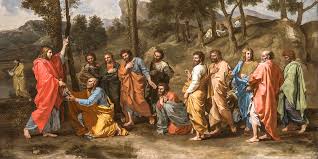
Sacraments and the Sixth Sunday of Easter
Someone once said to me, “I don’t need a priest to forgive my sins. I go directly to God.” I shuddered, hoping that he didn’t realize the import of what he was saying, for no one goes directly to God: “There is one mediator between God and men, the man Christ Jesus.”[1] Furthermore, the essential characteristic of that mediation is what we may call physical. Jesus did things: he visited, he spoke, he touched, he even once made a paste and applied it to the eyes of the man born blind. In short, he was located, and one had to go to where he was to encounter God in the man Jesus. The pre-Reformation Churches—Roman Catholic in the Latin and Easter rites, as well as the Orthodox—have maintained this pattern, established by Jesus himself, in their sacramental ministry where location, words and actions are the means by which the believer encounters God in the Lord Jesus. Hence, we have church buildings, sacred art, rituals, liturgies, postures of prayer and so on. The entire panoply of Catholic devotion, with its abundant use of images, and especially of the crucifix, witnesses to our appreciation of the concrete nature of God’s mode of acting in Jesus, and throughout sacred history as well. When, for instance, God established the Old Testament forms of worship, he prescribed external rites, the execution of which gave the worshipper the sure conviction that his prayer was being heard. Are we Christians to be less favoured than our Jewish forbears in the faith? Certainly not! For we too have our assured access to the throne of God, through Jesus, seated “at the right hand of God to intercedes for us?[2]
Our tradition has singled out seven acts that in a special way assure our acting in accordance with God’s commands and as such are pleasing to him. The sacraments, whose effect may be enhanced by the devotion one brings to their celebration,[3] have an objective reality that is independent of fervour on the part of the participant.[4] Baptism does remove original sin and incorporate the infant into the Church, even if he is unaware of it. Similarly, the Eucharist is the body and blood of Christ whatever one’s disposition, to the point that “whoever eats the bread or drinks the cup of the Lord in an unworthy manner will be guilty of profaning the body and blood of the Lord.”[5] An instance of this aspect of the sacraments is found in today’s first reading, in which the Apostles Peter and John travel from Jerusalem to Samaria to endow the baptized Christians there with the Holy Spirit, i.e., to complete their Christian initiation that had begun with their baptism. This episode raises a question that can illumine our understanding of the event, which corresponds to the sacrament of confirmation: Were the Apostles themselves confirmed? More broadly, had they been baptized, or ordained or received any of the sacraments as we know them in the Church today?
I can best respond to these questions by noting that a sacrament is a participation by the believer in some event or aspect of the mission of Jesus. Confirmation, to begin with today’s reading, is the fulfilment now of what Jesus promised his disciples when he met them after the resurrection, viz., that he would send “the Spirit of truth [who] will guide you into all the truth.”[6] That pledge was accomplished at Pentecost when the Spirit descended on the Apostles gathered in the upper room. Pentecost, sometimes recognized as the birthday of the Church, signals the beginning of the public proclamation of the Gospel. That apostolic experience is made available to us today in confirmation, by which the Christian is empowered to witness to his faith by having experienced in the sacrament his own Pentecost. The Apostles, therefore, were confirmed, perhaps not in what we might now consider a full liturgical ritual, but by the event itself. And it is access to this event that the ceremony gives to us, who come after. Similarly, in baptism we die to sin and rise to new life in sacramental contact with the death and resurrection of Jesus:
Do you not know that all of us who have been baptized into Christ Jesus were baptized into his death? We were buried therefore with him by baptism into death, so that as Christ was raised from the dead by the glory of the Father, we too might walk in newness of life.[7]
Again, the Apostles experienced the actual events that baptism makes present, in that they lived through the agony of the crucifixion and the exultation of the resurrection. That was their “baptism.” Similarly, their “first Holy Communion,” so to speak, was at the Last Supper when the Eucharist was established; and their ordination was effected when Jesus then said, “Do this in memory of me.”[8] Repentance and forgiveness likewise, in the paradigmatic case of Peter, were associated with the Passion, when “the Lord turned and looked at Peter. And Peter remembered the word of the Lord, how he had said to him, ‘Before the cock crows today, you will deny me three times.’ And he went out and wept bitterly,”[9] a text complemented by Peter’s threefold profession of love for Jesus on the shore of the Sea of Galilee.[10] Thus, sins can be forgiven, and, of course, the sacramental principle states that forgiveness will be experienced in a ceremony of some kind. The intriguing history of the sacrament of reconciliation—confession—shows how the tradition of the Church preserved as it developed the original germ of the sacrament as exhibited in Peter. We may be inclined to envy the Apostles for their immediate contact with Jesus during his time on earth, but in the sacraments we are as close to him as they were: as present to Jesus on the cross as if we were on Mount Calvary and to Christ risen as if we had encountered him at the empty tomb or in the upper room: “Blessed,” indeed, “are those who have not seen and yet believe.”[11]
[1] 1 Tim 2.5.
[2] Rom 8.34.
[3] Ex opere operantis.
[4] Ex opere operato.
[5] 1 Cor 11.27.
[6] Jn 16.7,13.
[7] Rom 6.3-4.
[8] Lk 22.19.
[9] Lk 22.61-62.
[10] Jn 21.15-19.
[11] Jn 20.29.

Saint Kateri , Canada’s Protectress
This was the title given to Saint Kateri Tekakwitha, by Pope Benedict XVI, when he canonized her on October 28th, 2012, along with six others, in Saint Peter’ Square (she had been beatified by Pope John Paul II back in 1980). With Saint Joseph as our protector, along with the Canadian martyrs, we seem to[…]Continue reading→

Remembering Father Alphonse de Valk
(Today marks the sixth anniversary of the death of Father Alphonse de Valk, C.S.B., a faithful, courageous and indefatigable Basilian priest, pro-life-and-family apostle, and the founder of Catholic Insight magazine. Here is what we wrote those on his entering into eternity five years ago, as we continue to remember him in our prayers and thoughts)[…]Continue reading→

My Name is Bernadette
April 16th is a propitious day, for besides the anniversary of Father de Valk’s death, who founded Catholic Insight in its print form decades ago, and the commemoration of the ‘two Benedicts’, mentioned in accompanying posts, today we also recall Saint Bernadette Soubirous, the young visionary to whom the Virgin Mary appeared numerous times at[…]Continue reading→

Canonizing Sister Faustina and Divine Mercy
HOMILY OF THE HOLY FATHER MASS IN ST PETER’S SQUARE FOR THE CANONIZATION OF SR MARY FAUSTINA KOWALSKA Sunday, 30 April 2000 1. “Confitemini Domino quoniam bonus, quoniam in saeculum misericordia eius”; “Give thanks to the Lord for he is good; his steadfast love endures for ever” (Ps 118: 1). So the Church sings on the Octave of[…]Continue reading→

Divine Mercy Sunday – An Echo of Every Mass
Reach out your hand and put it in my side. Do not doubt but believe’… ‘My Lord and my God!’ (Jn. 20:18)). Today is Divine Mercy Sunday, and as we celebrate the end of the Easter Octave, we contemplate the wounded side of our Saviour, the Church’s source of life. On Good Friday in the[…]Continue reading→

Saint Stanislaus of Szczepanów
We celebrate Saint Stanislaus today (+ April 11, 1079), in light of this Easter Octave, a bishop and martyr who accepted the episcopacy only at the direct order of Pope Alexander II. He proved a wise and courageous leader of his flock, put to death by his own king, Boleslaus, for rebuking the monarch’s ‘immoral[…]Continue reading→

First Holy Communion: Sermon from May 16, 1943
Here is a sermon from the good old days by +Rev. Msgr. Vincent Nicholas Foy (August 14, 1915 – March 13, 2017), from 1943. Readers may recall that Pope Saint Pius X, by the decree Quam Singulari in 1910, lowered the customary age of reception of Holy Communion – after the rigours of the plague[…]Continue reading→

In the Glorious Light of Easter, Alleluia!
Set your minds on things that are above, not on things that are on earth, for you have died, and your life is hidden with Christ in God. When Christ who is your life is revealed, then you also will be revealed with him in glory (Col. 3:3-4). The Resurrection of Our Lord and Saviour[…]Continue reading→

An Ancient Homily for Holy Saturday
The time between Good Friday and Easter Sunday is one of waiting, in silence, as the world wonders – anticipates – what will happen, after the death of Christ. We re-live this time each year in the anamnesis of our liturgy, and in turn look forward to the glorious re-creation of all things at the[…]Continue reading→

Europe’s Long Descent
(As we meditate on this day on Christ’s burial, and His descent into hell, it is fitting to ponder here with contributor Peter Marcus how the world seems to be heading there as well. The difference is that, although God cannot ‘redeem’ hell, nor those therein, He can and did redeem the world. There is[…]Continue reading→