
Ælfheah of Canterbury and Leo IX of Rome
Two saints are commemorated on this 19th of April, both of the Middle Ages:
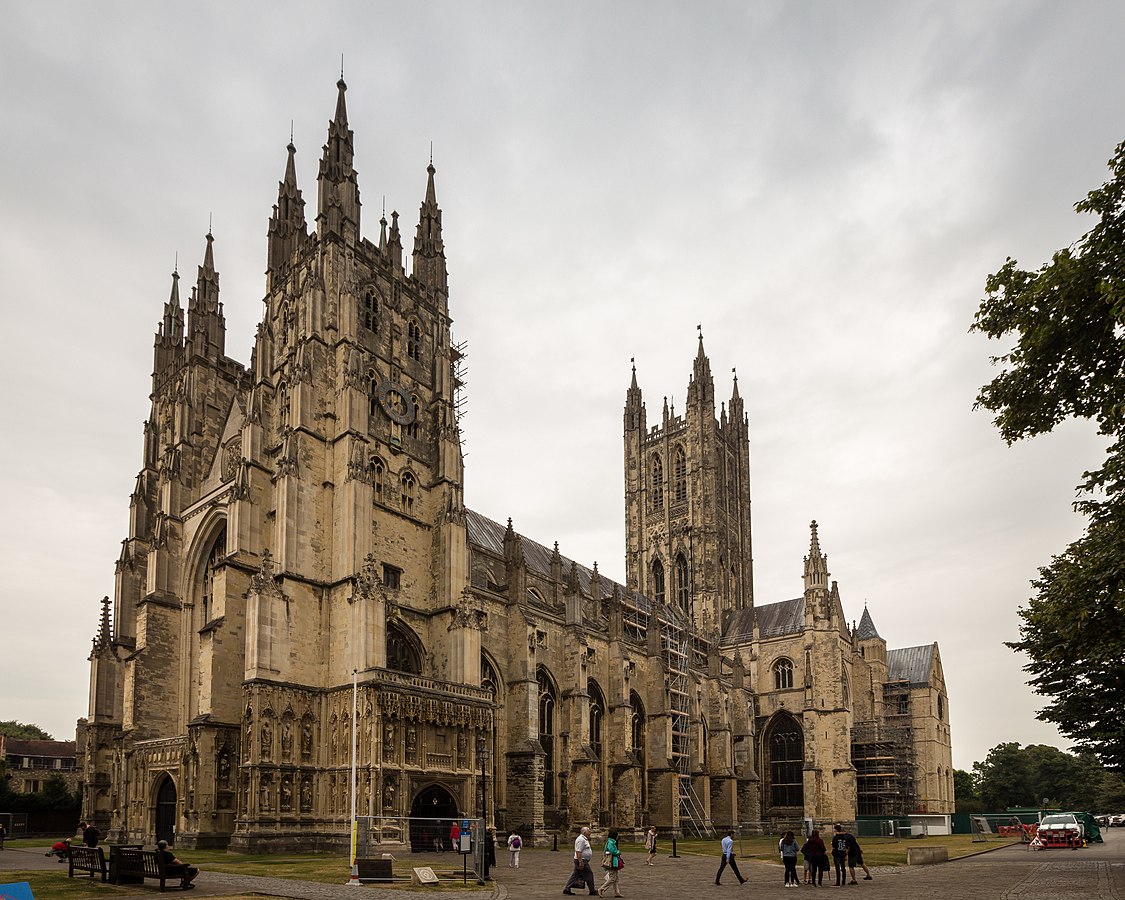
Saint Ælfheah of Canterbury, more commonly known as ‘Alphege’, was born in 953 outside of Bath in southern England. In youth, he chose the higher path, becoming an anchorite, enclosing himself in as a hermit and dedicating his life solely to God. But his virtue and holiness were soon recognized, and he was chosen as the Abbot of Glastonbury Abbey, in which task dedicated himself to the beauty and transcendence in liturgy. One anecdote that stood out for me was his having an organ constructed in the cathedral that took 24 men to operate (organs had to be manually pumped back then), and could be heard a mile away (what must it have sounded like sitting in the pews!)
In 1006, Alphege was chosen Archbishop of Canterbury, and the diocese flourished during his reign. But these were fraught days with enemies all around, and five years later the good bishop was captured in a raid by the pagan Danes, who razed the cathedral (it would be rebuilt to its current glory) and held the bishop for ransom. Alphege, however, refused either to pay, or have others pay for his release. After a few months, the pagan Danes, in a drunken revelry on this April 19th in 1012, made sport of their hostage, throwing whatever they could find at him, before finishing him off with a axe-blow to the head.
Saint Alphege was venerated as a martyr, and it is to him that another bishop of Canterbury, Thomas Becket, prayed before his own martyrdom.
Pope Saint Leo IX was elected to the chair of Peter in 1049, at the age of 47 (which seems very young now for a Pope, but life expectancies were far lower back then), and reigned until his death in 1054. He is known for battling the entrenched vices of simony and clerical ‘marriage’, which is really clerical concubinage, for priests cannot get validly married (which is different from priests being validly married, for even in the East, a priest must get married before his ordination to the priesthood – more on that, perhaps, anon).
Pope Leo also clarified and corrected the errors of Berengar of Tours, who denied transubstantiation, and the reality of Christ’s presence in the Eucharist.
More controversially, it was under the authority of Leo IX, by means his legate, Cardinal Humbert, that the Patriarch of Constantinople, Michael Cerularius, was excommunicated on July 16th, 1054 When Humbert marched up the nave to place the decree on the altar of Hagia Sophia, the Patriarch immediately excommunicated the Pope and his legates.
It may have all been for naught, for Pope Leo had died in the meantime, making Humbert’s excommunication likely null. And no one, not even a patriarch, can ‘excommunicate’ the Pope. But the formal schism between the Churches of the East and West had begun, and, in some way, continues to our own day. In 1965, in the wake of the Second Vatican Council, Pope Paul VI and Patriarch Athenagoras formally abolished the excommunications, casting them into oblivion, and we may hope and pray for full reunion between what Pope John Paul called the ‘two lungs of the Church’ breathe together again one day. +
Carney’s Amoral Majority
After five defections – euphemistically described as ‘crossing the floor’ – and three by-elections, Mark Carney and his Liberals how have their coveted majority. One wonders what bowls of pottage were offered in back-room deals. In the archaic monarchical system that is the Dominion of Canada, this majority allows the newly-minted Prime Minister to rule[…]Continue reading→
A Closed, Unsustainable, Descending Loop
As a follow-up to my thoughts on Payette’s payout, here be a stark image of where are here in Canada. As the graph shows in, well, graphic terms, since 2025, the public sector has contributed to 95.5% of economic growth. The private sector – which funds the public sector, or is supposed to – has[…]Continue reading→

Remembering Father Alphonse de Valk
(Today marks the sixth anniversary of the death of Father Alphonse de Valk, C.S.B., a faithful, courageous and indefatigable Basilian priest, pro-life-and-family apostle, and the founder of Catholic Insight magazine. Here is what we wrote those on his entering into eternity five years ago, as we continue to remember him in our prayers and thoughts)[…]Continue reading→

A Tale of Two Benedicts
A grace-filled Holy Week to all our readers! As we await and prepare for the Resurrection about to dawn upon us, we might keep in mind two Benedicts: Pope Emeritus Benedict XVI, requiescat in pace, elected on this day in 2005; and today’s commemoration of the mystic pilgrim, Benedict Joseph Labre, who died on this[…]Continue reading→
Presidential Pardon of Weronika Krawczyk
As a good news, follow-up to our story from Poland, of the persecution of Weronika Krawczyk for her pro-life views, we heard that she has been granted a presidential pardon. One might still wonder why one needs a presidential pardon for simply holding the long-held belief that the child within the womb is a child,[…]Continue reading→

Saint Lydwina of Schiedam and Suffering Joyfully
Saint Lydwina of Schiedam (1380 – 1433) was one of the countless and glorious ‘victim souls’ in the history of the Church, those whose lives are filled with suffering, often of an unimaginable intensity, but who suffer joyfully. She was a fifteen-year old Dutch girl, out skating one day, when she fell and broke one[…]Continue reading→

The Glorious Martyrdoms of Martin and Maximus
As we enter into Eastertide, we recall on this 13th of April Pope Saint Martin I (+655), one of the noblest, if most tragic, of the successors of Saint Peter. Born in Umbria, Italy, he was of noble lineage, with great intelligence combined with charity and love of the poor and the Church. While still[…]Continue reading→
Pope Leo and a Rosary for Peace
Pope Leo XIV has asked Catholics across the world to join him in a Rosary for peace today, at 18:00 Rome time (6 pm), which would be noon from where I write (EST). If you are able, whether at that time or another, and in whatever way you pray, to join in intercession with the[…]Continue reading→
Payette’s Payout
I was glancing through some headlines, and noticed a mention of Julie Payette – engineer and astronaut and sometime the Queen’s representative in Canada – which brought back vague memories. She was appointed Governor-General by Justin Trudeau in 2017. Ms. Payette resigned in 2021, amidst claims that she created a ‘toxic work environment’, with allegations[…]Continue reading→

Saint Stanislaus of Szczepanów
We celebrate Saint Stanislaus today (+ April 11, 1079), in light of this Easter Octave, a bishop and martyr who accepted the episcopacy only at the direct order of Pope Alexander II. He proved a wise and courageous leader of his flock, put to death by his own king, Boleslaus, for rebuking the monarch’s ‘immoral[…]Continue reading→