
Women’s Day Through the Lens of Pope John Paul II
What would Pope Saint John Paul II think of International Women’s Day (IWD), which was celebrated on March 8th, whose theme is the social, economic, cultural and political achievement of women? One promotes their dignity and never tramples upon their innate vocation for motherhood, as abortion proponents would tend to do.
One of the great advocates for women was certainly the great Pope. His precious teaching legacy gave us the correct understanding to evaluate and promote women in the way God wants them to be promoted. To begin with, women are both equal as well as different from men. Their equality stems from the fact that, with men, they are equal persons before God. Let us bring to our minds what his apostolic letter on the dignity and vocation of women on the occasion of the 1987 Marian Year, Mulieris dignitatem tells us: Both man and woman are human beings to an equal degree, both are created in God’s image (no.6). Hence, they are endowed with the capacity of loving, and are also gifted with reason, free will and conscience.
Every woman is a unique gift of God by being a human person, a particular person and a feminine person. The dignity of each woman stands in the fact that she is the living sacrament of love for the entire humanity. Mulieris Dignitatem says:
Unless we refer to this order and primacy we cannot give a complete and adequate answer to the question about women’s dignity and vocation. When we say that the woman is the one who receives love in order to love in return, this refers not only or above all to the specific spousal relationship of marriage. It means something more universal, based on the very fact of her being a woman within all the interpersonal relationships which, in the most varied ways, shape society and structure the interaction between all persons – men and women. In this broad and diversified context, a woman represents a particular value by the fact that she is a human person, and, at the same time, this particular person, by the fact of her femininity. This concerns each and every woman, independently of the cultural context in which she lives, and independently of her spiritual, psychological and physical characteristics, as for example, age, education, health, work, and whether she is married or single (no. 29).
In Pope John Paul II’s view, women, together with men, have been created to fulfil their full capacity of what it signifies to be human. The apostolic letter explains:
It also means that man and woman, created as a “unity of the two” in their common humanity, are called to live in a communion of love, and in this way to mirror in the world the communion of love that is in God, through which the Three Persons love each other in the intimate mystery of the one divine life (no. 7).
Women are complementary to men because they are created in the Trinitarian image. Mulieres Dignitatem gives us this detail: In the Book of Genesis we find another description of the creation of man – man and woman (cf. 2:18-25) – to which we shall refer shortly. At this point, however, we can say that the biblical account puts forth the truth about the personal character of the human being. Man is a person, man and woman equally so, since both were created in the image and likeness of the personal God. What makes man like God is the fact that – unlike the whole world of other living creatures, including those endowed with senses (animalia) – man is also a rational being (animal rationale). Thanks to this property, man and woman are able to “dominate” the other creatures of the visible world (cf. Gen 1:28) (no 6).
Pope Wojtyła was extremely careful, highly responsible and justly appreciative of the feminine nature.
In the name of liberation from male “domination”, women must not appropriate to themselves male characteristics contrary to their own feminine “originality”. There is a well-founded fear that if they take this path, women will not “reach fulfilment”, but instead will deform and lose what constitutes their essential richness. It is indeed an enormous richness. In the biblical description, the words of the first man at the sight of the woman who had been created are words of admiration and enchantment, words which fill the whole history of man on earth (no. 6).
It is from such an understanding that stems the natural vocation for each woman to live in harmony with the particular qualities that are proper to her femininity. Filled with such admiration and thanksgiving Pope John Paul wrote in Mulieris Dignitatem: Therefore the Church gives thanks for each and every woman: for mothers, for sisters, for wives; for women consecrated to God in virginity; for women dedicated to the many human beings who await the gratuitous love of another person; for women who watch over the human persons in the family, which is the fundamental sign of the human community; for women who work professionally, and who at times are burdened by a great social responsibility; for “perfect” women and for “weak” women – for all women as they have come forth from the heart of God in all the beauty and richness of their femininity; as they have been embraced by his eternal love; as, together with men, they are pilgrims on this earth, which is the temporal “homeland” of all people and is transformed sometimes into a “valley of tears”; as they assume, together with men, a common responsibility for the destiny of humanity according to daily necessities and according to that definitive destiny which the human family has in God himself, in the bosom of the ineffable Trinity (no. 31).
We truly love, respect and promote women by allowing them to live what is theirs by God. When we help them live their unique feminine vocation, both in the society and in the Church, in complete harmony with that of men, we give glory to God for the precious gift of femininity. It is in this way that we authentically can wish each and every woman, now and always, Happy Women’s Day.
Thank you Pope St John Paul II for your sterling reflection!
A Closed, Unsustainable, Descending Loop
As a follow-up to my thoughts on Payette’s payout, here be a stark image of where are here in Canada. As the graph shows in, well, graphic terms, since 2025, the public sector has contributed to 95.5% of economic growth. The private sector – which funds the public sector, or is supposed to – has[…]Continue reading→
Presidential Pardon of Weronika Krawczyk
As a good news, follow-up to our story from Poland, of the persecution of Weronika Krawczyk for her pro-life views, we heard that she has been granted a presidential pardon. One might still wonder why one needs a presidential pardon for simply holding the long-held belief that the child within the womb is a child,[…]Continue reading→
Pope Leo and a Rosary for Peace
Pope Leo XIV has asked Catholics across the world to join him in a Rosary for peace today, at 18:00 Rome time (6 pm), which would be noon from where I write (EST). If you are able, whether at that time or another, and in whatever way you pray, to join in intercession with the[…]Continue reading→
Payette’s Payout
I was glancing through some headlines, and noticed a mention of Julie Payette – engineer and astronaut and sometime the Queen’s representative in Canada – which brought back vague memories. She was appointed Governor-General by Justin Trudeau in 2017. Ms. Payette resigned in 2021, amidst claims that she created a ‘toxic work environment’, with allegations[…]Continue reading→
Weronika Krawczyk and Injustice in Poland
Catholic Action in Poland has issued a formal statement appealing to the President of the Republic of Poland to pardon Weronika Krawczyk—convicted for warning other women against an abortion-performing gynaecologist. Catholic Action (AK) emphasizes that no apology is owed to a doctor who has performed numerous abortions and proposed others; furthermore, the organization considers the[…]Continue reading→
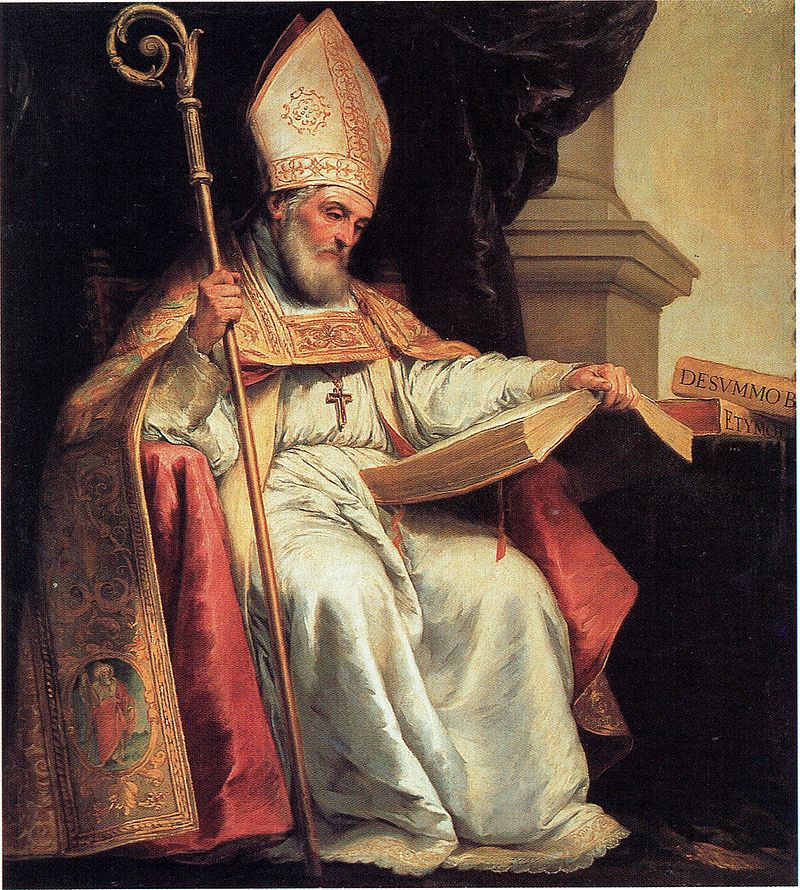
Saint Isidore of Seville, the Internet and Industriousness
Today, April 4th, muted this year by Holy Saturday, is the commemoration of Saint Isidore of Seville (560-636) a bishop and doctor of the Church during a tumultuous age, when civilization was crumbling, coming apart at its very seams, which may sound sort of au courant. Then again, the form of this world has always[…]Continue reading→
Bishop Fulton Sheen’s 58th Good Friday Reflection
Incredible, at the beginning of this reflection, that the Venerable Bishop Sheen declares that he has given nearly 58 Good Friday reflections – this, as far as I can gather, was his final one, and he seems in full vigour in mind and body. The good bishop and evangelist died in his 84th year on[…]Continue reading→
A Minimal Friar and the Death of a Great Pope
This April the second- overshadowed by Holy Thursday this year – marks the memorial of Saint Francis of Paola (1417-1507), founder of the ‘Minim’ friars, so called for their humility and poverty, who interpreted the rule of Saint Francis of Assisi in quite a literal sense: extreme poverty, trust in God, foregoing all animal and[…]Continue reading→
Woven versus Seamless Garments
The reflection on the worthy project by Magie Dominic was intriguing, and I thought I would offer a brief follow-up commentary. The garment woven out of many pieces is a poignant symbol, even a ‘sacramental’, inspired by prayer and grace. We are all united in some way, and should strive for such unity, wherever we[…]Continue reading→
Bill C-9: Prelude to Persecution?
Well, it happened, as I suppose was inevitable, at least in a secular sense (from God’ perspective, there’s always hope). Bill C-9, the ironically named ‘Combatting Hate Act’ passed the House of Commons with a 186-137 vote. Look on the good side – there’s still over a hundred sane people in parliament who believe in[…]Continue reading→