
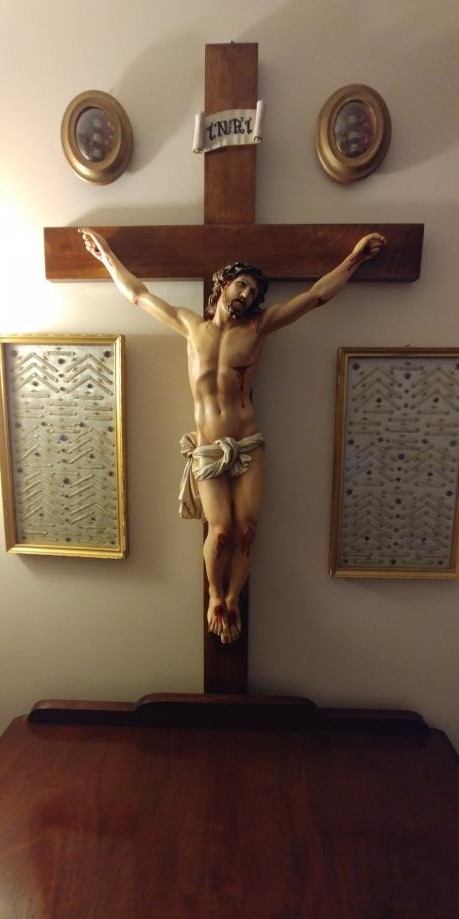
The Message of Pope Benedict for Lent from 2010
MESSAGE OF HIS HOLINESS
BENEDICT XVI
FOR LENT 2010
“The justice of God has been manifested
through faith in Jesus Christ” (cf. Rm 3, 21-22)
Dear Brothers and Sisters!
Each year, on the occasion of Lent, the Church invites us to a sincere review of our life in light of the teachings of the Gospel. This year, I would like to offer you some reflections on the great theme of justice, beginning from the Pauline affirmation: “The justice of God has been manifested through faith in Jesus Christ” (cf. Rm 3, 21-22).
Justice: “dare cuique suum”
First of all, I want to consider the meaning of the term “justice,” which in common usage implies “to render to every man his due,” according to the famous expression of Ulpian, a Roman jurist of the third century. In reality, however, this classical definition does not specify what “due” is to be rendered to each person. What man needs most cannot be guaranteed to him by law. In order to live life to the full, something more intimate is necessary that can be granted only as a gift: we could say that man lives by that love which only God can communicate since He created the human person in His image and likeness. Material goods are certainly useful and required – indeed Jesus Himself was concerned to heal the sick, feed the crowds that followed Him and surely condemns the indifference that even today forces hundreds of millions into death through lack of food, water and medicine – yet “distributive” justice does not render to the human being the totality of his “due.” Just as man needs bread, so does man have even more need of God. Saint Augustine notes: if “justice is that virtue which gives every one his due … where, then, is the justice of man, when he deserts the true God?” (De civitate Dei, XIX, 21).
What is the Cause of Injustice?
The Evangelist Mark reports the following words of Jesus, which are inserted within the debate at that time regarding what is pure and impure: “There is nothing outside a man which by going into him can defile him; but the things which come out of a man are what defile him … What comes out of a man is what defiles a man. For from within, out of the heart of man, come evil thoughts” (Mk 7, 14-15, 20-21). Beyond the immediate question concerning food, we can detect in the reaction of the Pharisees a permanent temptation within man: to situate the origin of evil in an exterior cause. Many modern ideologies deep down have this presupposition: since injustice comes “from outside,” in order for justice to reign, it is sufficient to remove the exterior causes that prevent it being achieved. This way of thinking – Jesus warns – is ingenuous and shortsighted. Injustice, the fruit of evil, does not have exclusively external roots; its origin lies in the human heart, where the seeds are found of a mysterious cooperation with evil. With bitterness the Psalmist recognises this: “Behold, I was brought forth in iniquity, and in sin did my mother conceive me” (Ps 51,7). Indeed, man is weakened by an intense influence, which wounds his capacity to enter into communion with the other. By nature, he is open to sharing freely, but he finds in his being a strange force of gravity that makes him turn in and affirm himself above and against others: this is egoism, the result of original sin. Adam and Eve, seduced by Satan’s lie, snatching the mysterious fruit against the divine command, replaced the logic of trusting in Love with that of suspicion and competition; the logic of receiving and trustfully expecting from the Other with anxiously seizing and doing on one’s own (cf. Gn 3, 1-6), experiencing, as a consequence, a sense of disquiet and uncertainty. How can man free himself from this selfish influence and open himself to love?
(To continue reading, please see here).

Saint Kateri , Canada’s Protectress
This was the title given to Saint Kateri Tekakwitha, by Pope Benedict XVI, when he canonized her on October 28th, 2012, along with six others, in Saint Peter’ Square (she had been beatified by Pope John Paul II back in 1980). With Saint Joseph as our protector, along with the Canadian martyrs, we seem to[…]Continue reading→

Remembering Father Alphonse de Valk
(Today marks the sixth anniversary of the death of Father Alphonse de Valk, C.S.B., a faithful, courageous and indefatigable Basilian priest, pro-life-and-family apostle, and the founder of Catholic Insight magazine. Here is what we wrote those on his entering into eternity five years ago, as we continue to remember him in our prayers and thoughts)[…]Continue reading→

My Name is Bernadette
April 16th is a propitious day, for besides the anniversary of Father de Valk’s death, who founded Catholic Insight in its print form decades ago, and the commemoration of the ‘two Benedicts’, mentioned in accompanying posts, today we also recall Saint Bernadette Soubirous, the young visionary to whom the Virgin Mary appeared numerous times at[…]Continue reading→

Canonizing Sister Faustina and Divine Mercy
HOMILY OF THE HOLY FATHER MASS IN ST PETER’S SQUARE FOR THE CANONIZATION OF SR MARY FAUSTINA KOWALSKA Sunday, 30 April 2000 1. “Confitemini Domino quoniam bonus, quoniam in saeculum misericordia eius”; “Give thanks to the Lord for he is good; his steadfast love endures for ever” (Ps 118: 1). So the Church sings on the Octave of[…]Continue reading→

Divine Mercy Sunday – An Echo of Every Mass
Reach out your hand and put it in my side. Do not doubt but believe’… ‘My Lord and my God!’ (Jn. 20:18)). Today is Divine Mercy Sunday, and as we celebrate the end of the Easter Octave, we contemplate the wounded side of our Saviour, the Church’s source of life. On Good Friday in the[…]Continue reading→

Saint Stanislaus of Szczepanów
We celebrate Saint Stanislaus today (+ April 11, 1079), in light of this Easter Octave, a bishop and martyr who accepted the episcopacy only at the direct order of Pope Alexander II. He proved a wise and courageous leader of his flock, put to death by his own king, Boleslaus, for rebuking the monarch’s ‘immoral[…]Continue reading→
First Holy Communion: Sermon from May 16, 1943
Here is a sermon from the good old days by +Rev. Msgr. Vincent Nicholas Foy (August 14, 1915 – March 13, 2017), from 1943. Readers may recall that Pope Saint Pius X, by the decree Quam Singulari in 1910, lowered the customary age of reception of Holy Communion – after the rigours of the plague[…]Continue reading→
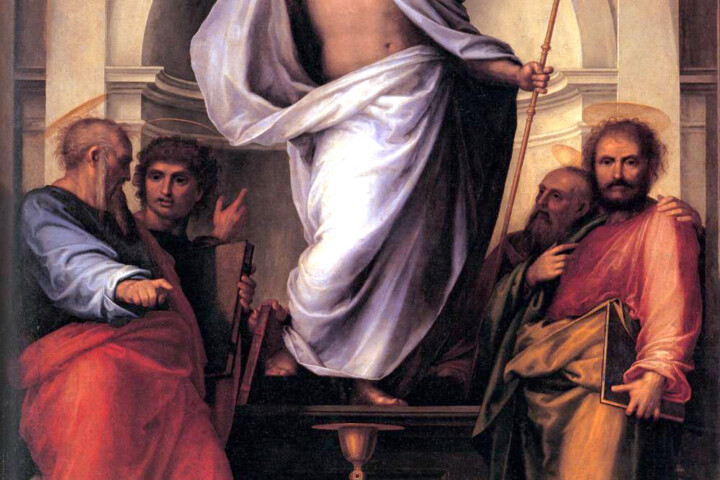
In the Glorious Light of Easter, Alleluia!
Set your minds on things that are above, not on things that are on earth, for you have died, and your life is hidden with Christ in God. When Christ who is your life is revealed, then you also will be revealed with him in glory (Col. 3:3-4). The Resurrection of Our Lord and Saviour[…]Continue reading→
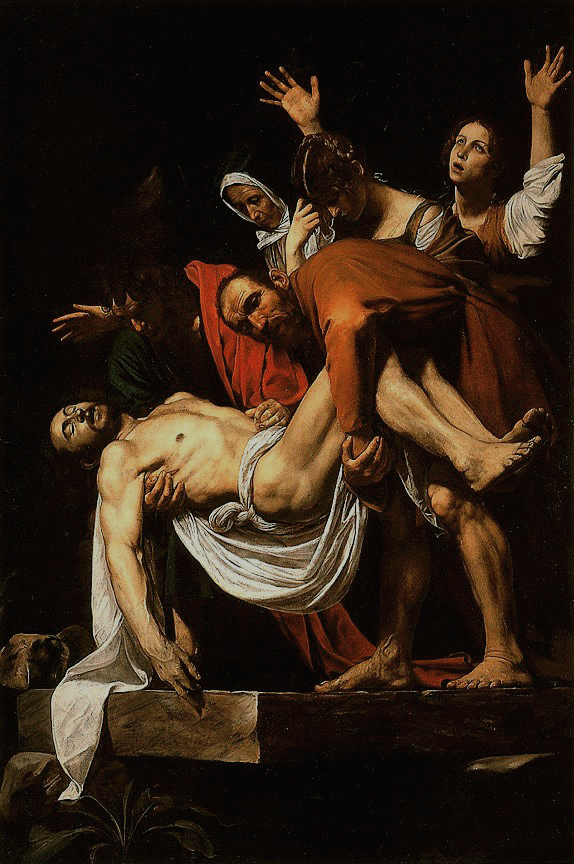
An Ancient Homily for Holy Saturday
The time between Good Friday and Easter Sunday is one of waiting, in silence, as the world wonders – anticipates – what will happen, after the death of Christ. We re-live this time each year in the anamnesis of our liturgy, and in turn look forward to the glorious re-creation of all things at the[…]Continue reading→

Europe’s Long Descent
(As we meditate on this day on Christ’s burial, and His descent into hell, it is fitting to ponder here with contributor Peter Marcus how the world seems to be heading there as well. The difference is that, although God cannot ‘redeem’ hell, nor those therein, He can and did redeem the world. There is[…]Continue reading→