
Life-giving Inspirations from Pope Benedict XVI
On Saturday 31 December 2022 – the very last day of last year, Pope Benedict XVI entered eternity. Every time the Lord gives me the grace to think about Pope Benedict the more I feel in my heart a great gratitude to the Lord Jesus for having chosen him to lead his Church.
For Pope Benedict the Petrine Ministry is one of rebuilding the complete visible unity of Christ’s disciples through practical gestures which invite for true conversion of heart. In his first message to the College of Cardinals, dated April 20, 2005, this great German Pope said: At the beginning of his ministry in the Church of Rome which Peter bathed in his blood, Peter’s current Successor takes on as his primary task the duty to work tirelessly to rebuild the full and visible unity of all Christ’s followers. This is his ambition, his impelling duty. He is aware that good intentions do not suffice for this. Concrete gestures that enter hearts and stir consciences are essential, inspiring in everyone that inner conversion that is the prerequisite for all ecumenical progress.
Moreover, for Benedict, Vatican II is a privileged place and time wherein the divine calling for ongoing continual renewal in the Church is encouraged and helped to go on and on. In his address to the Roman Curia, on December 22, 2005, Pope Benedict asserted: The hermeneutic of discontinuity risks ending in a split between the pre-conciliar Church and the post-conciliar Church. It asserts that the texts of the Council as such do not yet express the true spirit of the Council. It claims that they are the result of compromises in which, to reach unanimity, it was found necessary to keep and reconfirm many old things that are now pointless. However, the true spirit of the Council is not to be found in these compromises but instead in the impulses toward the new that are contained in the texts.
Pope Ratzinger also gave an innovative way of thinking about being Christian, solidly built on both the Holy Bible and the sound Tradition of the Church’s teaching. In his first encyclical on Christian love, entitled Deus Caritas Est, of December 25, 2005, the Holy Father wrote: We have come to believe in God’s love: In these words the Christian can express the fundamental decision of his life. Being Christian is not the result of an ethical choice or a lofty idea, but the encounter with an event, a person, which gives life a new horizon and a decisive direction (no. 1).
Regarding religion in our western civilization, Pope Benedict appealed for the fruitful reconciliation between religion and reason. The two go together and are never against each other. On this vital point this forward looking Pope had this to say during his Regensburg address on 12 September 2006: In the Western world it is widely held that only positivistic reason and the forms of philosophy based on it are universally valid. Yet the world’s profoundly religious cultures see this exclusion of the divine from the universality of reason as an attack on their most profound convictions. A reason which is deaf to the divine and which relegates religion into the realm of subcultures is incapable of entering into the dialogue of cultures.
We all know that Pope Benedict XVI was an outstanding liturgist and true liturgical reformer. For him, true liturgical renewal is always in continuum and never divided or cut into pieces for convenience’s sake. It is our great and grave responsibility to protect and develop for the best what we have been handed on in the sacred liturgy. In his letter accompanying Summorum Pontificium of July 7, 2007, he stated: In the history of the liturgy there is growth and progress, but no rupture. What earlier generations held as sacred, remains sacred and great for us too, and it cannot be all of a sudden entirely forbidden or even considered harmful. It behoves all of us to preserve the riches which have developed in the Church’s faith and prayer, and to give them their proper place.
Pope Benedict XVI had a particular and very solid view on the relationship between religion and politics. Within the political debate religion’s role is that of purifying and enlightening the use of reason to ground itself on those much sought and applicable moral tenets. During his address in Westminster Hall, London, on September 17, 2010, he put forward this illuminating reflection: Where is the ethical foundation for political choices to be found? The Catholic tradition maintains that the objective norms governing right action are accessible to reason, prescinding from the content of revelation. According to this understanding, the role of religion in political debate is not so much to supply these norms, as if they could not be known by non-believers – still less to propose concrete political solutions, which would lie altogether outside the competence of religion – but rather to help purify and shed light upon the application of reason to the discovery of objective moral principles.
Finally, Pope Benedict XVI offers us a good understanding of the vital role of Christian Culture in the ambience of contemporary society. It was Christian faith which promoted human rights and the personal responsibility of the human person for his and her actions. In his Berlin address at the Reichstag Building, on September 22, 2011, Pope Ratzinger said: The conviction that there is a Creator God is what gave rise to the idea of human rights, the idea of the equality of all people before the law, the recognition of the inviolability of human dignity in every single person and the awareness of people’s responsibility for their actions. Our cultural memory is shaped by these rational insights. To ignore it or dismiss it as a thing of the past would be to dismember our culture totally and to rob it of its completeness.
These few insights centred on the Petrine Ministry, Vatican II, being a Christian, religion in the west, the Sacred Liturgy, religion and politics, and Christian culture, openly demonstrate the superb gift Pope Benedict XVI has been and still is for the Church and the entire humanity. Let us resort to his life-giving inspirations and let them form our way of being and acting as Christians and, most of all, as human beings, irrespective of our religious tradition.
A Closed, Unsustainable, Descending Loop
As a follow-up to my thoughts on Payette’s payout, here be a stark image of where are here in Canada. As the graph shows in, well, graphic terms, since 2025, the public sector has contributed to 95.5% of economic growth. The private sector – which funds the public sector, or is supposed to – has[…]Continue reading→
Presidential Pardon of Weronika Krawczyk
As a good news, follow-up to our story from Poland, of the persecution of Weronika Krawczyk for her pro-life views, we heard that she has been granted a presidential pardon. One might still wonder why one needs a presidential pardon for simply holding the long-held belief that the child within the womb is a child,[…]Continue reading→
Pope Leo and a Rosary for Peace
Pope Leo XIV has asked Catholics across the world to join him in a Rosary for peace today, at 18:00 Rome time (6 pm), which would be noon from where I write (EST). If you are able, whether at that time or another, and in whatever way you pray, to join in intercession with the[…]Continue reading→
Payette’s Payout
I was glancing through some headlines, and noticed a mention of Julie Payette – engineer and astronaut and sometime the Queen’s representative in Canada – which brought back vague memories. She was appointed Governor-General by Justin Trudeau in 2017. Ms. Payette resigned in 2021, amidst claims that she created a ‘toxic work environment’, with allegations[…]Continue reading→
Weronika Krawczyk and Injustice in Poland
Catholic Action in Poland has issued a formal statement appealing to the President of the Republic of Poland to pardon Weronika Krawczyk—convicted for warning other women against an abortion-performing gynaecologist. Catholic Action (AK) emphasizes that no apology is owed to a doctor who has performed numerous abortions and proposed others; furthermore, the organization considers the[…]Continue reading→
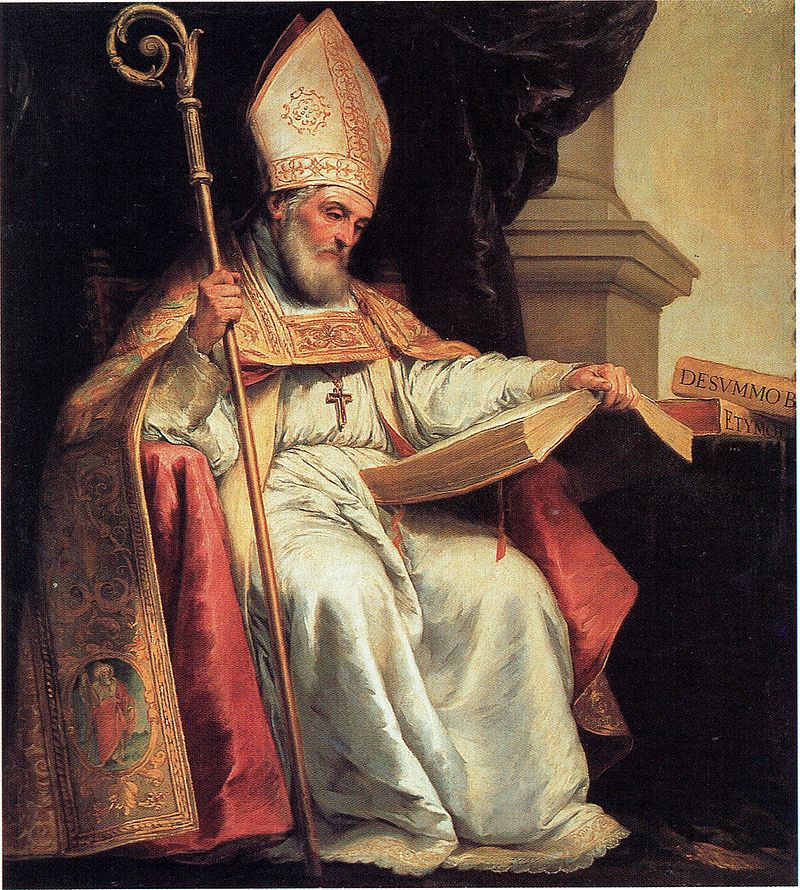
Saint Isidore of Seville, the Internet and Industriousness
Today, April 4th, muted this year by Holy Saturday, is the commemoration of Saint Isidore of Seville (560-636) a bishop and doctor of the Church during a tumultuous age, when civilization was crumbling, coming apart at its very seams, which may sound sort of au courant. Then again, the form of this world has always[…]Continue reading→
Bishop Fulton Sheen’s 58th Good Friday Reflection
Incredible, at the beginning of this reflection, that the Venerable Bishop Sheen declares that he has given nearly 58 Good Friday reflections – this, as far as I can gather, was his final one, and he seems in full vigour in mind and body. The good bishop and evangelist died in his 84th year on[…]Continue reading→
A Minimal Friar and the Death of a Great Pope
This April the second- overshadowed by Holy Thursday this year – marks the memorial of Saint Francis of Paola (1417-1507), founder of the ‘Minim’ friars, so called for their humility and poverty, who interpreted the rule of Saint Francis of Assisi in quite a literal sense: extreme poverty, trust in God, foregoing all animal and[…]Continue reading→
Woven versus Seamless Garments
The reflection on the worthy project by Magie Dominic was intriguing, and I thought I would offer a brief follow-up commentary. The garment woven out of many pieces is a poignant symbol, even a ‘sacramental’, inspired by prayer and grace. We are all united in some way, and should strive for such unity, wherever we[…]Continue reading→
Bill C-9: Prelude to Persecution?
Well, it happened, as I suppose was inevitable, at least in a secular sense (from God’ perspective, there’s always hope). Bill C-9, the ironically named ‘Combatting Hate Act’ passed the House of Commons with a 186-137 vote. Look on the good side – there’s still over a hundred sane people in parliament who believe in[…]Continue reading→