
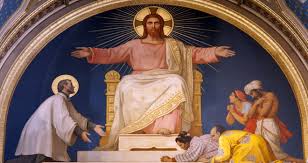
Christ the King
An Irish bull is a statement that is, strictly speaking, illogical and yet whose meaning is somehow clear. Yogi Berra, a baseball player of another generation, was famous for them, as when he said, “No one goes there anymore; it’s too crowded” and “Always go to other people’s funerals, otherwise they won’t come to yours” I actually once heard a speaker say, “Raise your hand if you can’t hear me.” They need not be comic, as in this statement attributed variously to Blaise Pascal and to Mark Twain: “I have written a long letter because I don’t have time to write a short one.” They can also be profound, as with John Henry Newman—“We change only in order to remain the same,”[1]—as with Saint Paul—“When I am weak, then I am strong,”[2]—and, sublimely, as with Our Lord—“ Whoever would save his life will lose it, and whoever loses his life for my sake will find it.”[3] In contrast, a paradox is a perfectly logical statement that seems at first glance to be self-contradictory but, on closer examination, make a lot of sense. G.K. Chesterton had a genius for them, as in this statement from Orthodoxy: “A maniac is not a man who has lost his reason. A maniac is a man who has lost everything except his reason.” Paradoxically, he did not write his most famous one: “Everything worth doing is worth doing badly.” What he actually said was: “. . . writing one’s own love-letters or blowing one’s own nose. These things we want a man to do for himself, even if he does them badly.”[4] Well, I have a paradox, one that can lead us into a consideration of today’s feast, Christ the King: “An aristocracy is the highest form of democracy; a democracy is the highest form of aristocracy.”
The defining characteristic of an aristocracy is not, as the word suggests, governance by the best, but rather governance by the heir, as the new Duke of Norfolk is the oldest son of the dead Duke, and as Prince Charles, whatever his abilities and convictions, will succeed Queen Elizabeth should she ever die. An aristocratic society, therefore, is based on the principle that anybody can do anything. If you happen to be heir to the throne, you can be a worthy ruler. The same holds across society; if your father was a farmer or a shoemaker, you will be one too, and there’s no reason why you should not be a good one. Of course, people broke out of the rigid divisions that governed a society based on distinctions of class, but the expectation was that you would remain where you were born, and, as everyone was equal in native ability, he who was upper class could—or rather should—meet the obligations of his state, just as a merchant’s son or a seaman’s would be good at managing a business or sailing a boat. I call it democratic in the sense that everyone is essentially equal. Differences in class and occupation do not arise from greater or lesser ability, but merely from an accident of birth. Playwrights and novelists exploited or challenged the concept by creating a character, apparently low born, who was actually of the nobility, or passed off as such. Shakespeare used the device in, e.g., Cymbeline and A Winter’s Tale; Mark Twain, in The Prince and the Pauper; and Shaw, in Pygmalion (alias My Fair Lady) as did J.M. Barrie in The Admirable Crichton.
The obvious limitations of aristocracy have been amply displayed in history. Henry VIII, who became king at seventeen, abused the royal power by waging unprofitable wars, executing political opponents, and pillaging the Church. The bewildering fluctuations in policy and practice during the reigns his successors—Edward VI, Queen Mary and Queen Elizabeth—demonstrate the weakness of vesting power in the heir, whoever he turns out to be. Having royal parents does not equip a man or woman to rule, any more than the children of artists or mathematicians are necessarily as talented as their parents were. Democracy, then, enters as a corrective to the evils of aristocracy. Ironically, it turns out to be “rule by the best,” i.e., a true ‘aristocracy’. For in a democracy, the best, the highly talented, rise to the top. Consider the Olympics, where only those who are citius, altius, fortius (faster, higher, stronger) make the team. Similarly, a symphony orchestra recruits the best players, with no concern for quotas or other forms of political correctness. Universities, in theory at least, hire the smartest and most highly educated, as voters are called upon to elect only wise and experienced candidates to parliament. Thus, the most gifted—or perhaps, the richest or the most cunning—succeed in a democracy.
Democracy certainly has its weaknesses. but it still unquestionably the best available form of government: “Indeed it has been said that democracy is the worst form of Government except for all those other forms that have been tried from time to time.”[5] Admitting as much, might we not ask Pope Francis to change the character of today’s feast. It would then no longer be Christ the King, but Christ the Prime Minister. The answer would be, of course, a decided “no” for the simple reason that Jesus has the qualities that overcome the weaknesses of aristocracy and eliminate the need for democracy. Aristocracy would be perfectly acceptable if there were a ruler who was truly noble—wise and compassionate—and if his heir were equally so. But this statement is a precise description of Christ the King. His Father is the eternal, merciful and omniscient God whose his Son is the eternal Word, equal in all things to the Father. Furthermore, the Word is the agent of creation: “Through him all things were made, and without him was made nothing that was made.”[6] Hence, as Lord of creation, Jesus, the incarnate Word, is the governor of the world and, we know, its ultimate judge. In him, “aristocracy” really is “rule by the best.” Democracy, on the other hand, is based on two principles: first, that the elected official is the delegate of the people and, secondly, that an abuse or an inadequacy can be controlled by limiting his power with checks and balances or by rejecting him in the next election. But redemption, which is the “policy” of Christ the King, cannot arise from below, from the people. It is a grace that we can do nothing to deserve: “Since all have sinned and fall short of the glory of God, they are justified by his grace as a gift, through the redemption which is in Christ Jesus.”[7] Nor could there be any abuse of power or inadequacy of performance in our all-knowing, all-powerful Lord. We rejoice, then, in the feast of Christ the King, who safeguards the common, and the uncommon, good.
[1] John Henry Newman, An Essay on the Development of Christian Doctrine (London: Longmans, Green, and Col, 1909). p. 40.
[2] 2 Cor 12.10.
[3] Matt 16.25.
[4] G.K. Chesterton, Orthodoxy: A Centenary Edition (South Orange [NJ]; Chesterton Institute Press, 2008), p. 134.
[5] Winston Churchill, at https://winstonchurchill.org/resources/quotes/the-worst-form-of-government/.
[6] Jn 1.3.
[7] Rom 3.23-24.

Saint Kateri , Canada’s Protectress
This was the title given to Saint Kateri Tekakwitha, by Pope Benedict XVI, when he canonized her on October 28th, 2012, along with six others, in Saint Peter’ Square (she had been beatified by Pope John Paul II back in 1980). With Saint Joseph as our protector, along with the Canadian martyrs, we seem to[…]Continue reading→

Remembering Father Alphonse de Valk
(Today marks the sixth anniversary of the death of Father Alphonse de Valk, C.S.B., a faithful, courageous and indefatigable Basilian priest, pro-life-and-family apostle, and the founder of Catholic Insight magazine. Here is what we wrote those on his entering into eternity five years ago, as we continue to remember him in our prayers and thoughts)[…]Continue reading→

My Name is Bernadette
April 16th is a propitious day, for besides the anniversary of Father de Valk’s death, who founded Catholic Insight in its print form decades ago, and the commemoration of the ‘two Benedicts’, mentioned in accompanying posts, today we also recall Saint Bernadette Soubirous, the young visionary to whom the Virgin Mary appeared numerous times at[…]Continue reading→
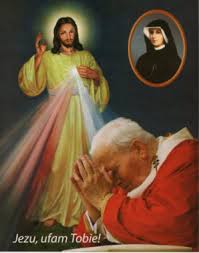
Canonizing Sister Faustina and Divine Mercy
HOMILY OF THE HOLY FATHER MASS IN ST PETER’S SQUARE FOR THE CANONIZATION OF SR MARY FAUSTINA KOWALSKA Sunday, 30 April 2000 1. “Confitemini Domino quoniam bonus, quoniam in saeculum misericordia eius”; “Give thanks to the Lord for he is good; his steadfast love endures for ever” (Ps 118: 1). So the Church sings on the Octave of[…]Continue reading→

Divine Mercy Sunday – An Echo of Every Mass
Reach out your hand and put it in my side. Do not doubt but believe’… ‘My Lord and my God!’ (Jn. 20:18)). Today is Divine Mercy Sunday, and as we celebrate the end of the Easter Octave, we contemplate the wounded side of our Saviour, the Church’s source of life. On Good Friday in the[…]Continue reading→

Saint Stanislaus of Szczepanów
We celebrate Saint Stanislaus today (+ April 11, 1079), in light of this Easter Octave, a bishop and martyr who accepted the episcopacy only at the direct order of Pope Alexander II. He proved a wise and courageous leader of his flock, put to death by his own king, Boleslaus, for rebuking the monarch’s ‘immoral[…]Continue reading→
First Holy Communion: Sermon from May 16, 1943
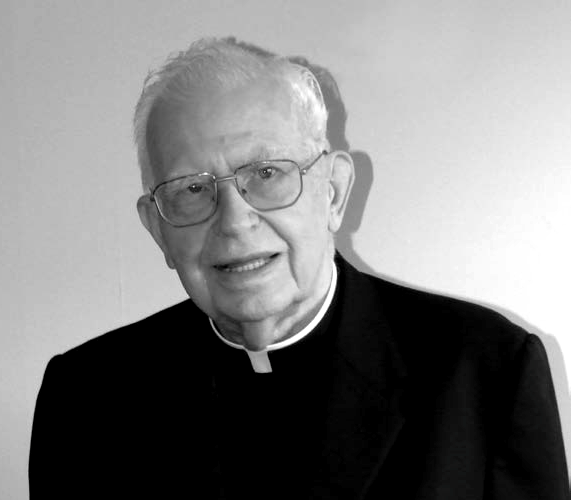
Here is a sermon from the good old days by +Rev. Msgr. Vincent Nicholas Foy (August 14, 1915 – March 13, 2017), from 1943. Readers may recall that Pope Saint Pius X, by the decree Quam Singulari in 1910, lowered the customary age of reception of Holy Communion – after the rigours of the plague[…]Continue reading→

In the Glorious Light of Easter, Alleluia!
Set your minds on things that are above, not on things that are on earth, for you have died, and your life is hidden with Christ in God. When Christ who is your life is revealed, then you also will be revealed with him in glory (Col. 3:3-4). The Resurrection of Our Lord and Saviour[…]Continue reading→

An Ancient Homily for Holy Saturday
The time between Good Friday and Easter Sunday is one of waiting, in silence, as the world wonders – anticipates – what will happen, after the death of Christ. We re-live this time each year in the anamnesis of our liturgy, and in turn look forward to the glorious re-creation of all things at the[…]Continue reading→
Europe’s Long Descent
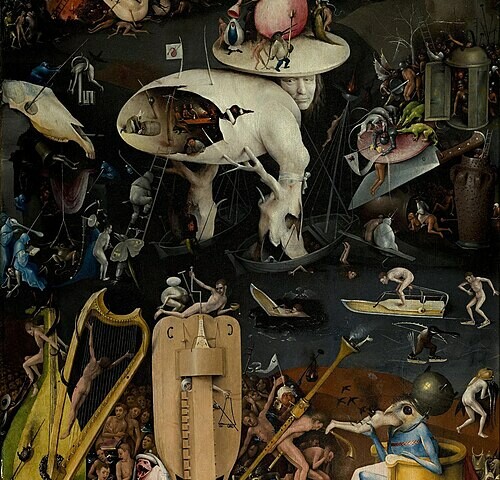
(As we meditate on this day on Christ’s burial, and His descent into hell, it is fitting to ponder here with contributor Peter Marcus how the world seems to be heading there as well. The difference is that, although God cannot ‘redeem’ hell, nor those therein, He can and did redeem the world. There is[…]Continue reading→