
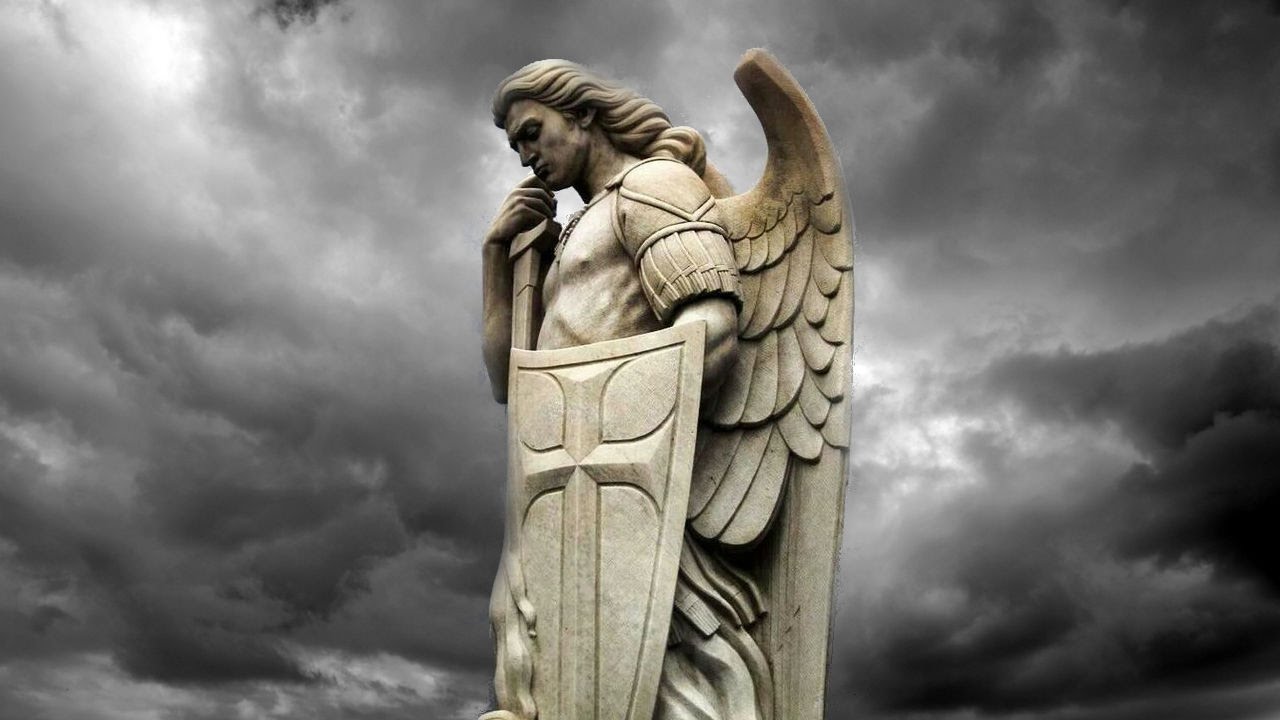
‘Adding’ the Saint Michael Prayer After Mass
(One of our most popular articles from the archives from a few years ago, but well worth a read or re-read on this feast of Michaelmas, and his angelic brethren, Raphael and Gabriel…Not least that in a certain diocese south of here, the prayer has been disallowed after Mass. We should, au contraire, maintain the great tradition of this prayer, especially as diabolical activity increase.)
Following my previous article, “Becoming a Catholic Pastor, Post – ‘Pennsylvania’”, I unplugged from the world of ecclesial and secular news. I tried to follow my own advice and focus on the duties of my own state in life. In general, I don’t follow the news much anyway, but this month I was particularly oblivious. In fact, other than priest friends, no one has even mentioned the scandals unfolding in the Church. In the little town of Mattawa, for good or ill, the problems of the world flow past us, like the two rivers that meet here, and we keep living our lives.
This weekend, however, I am reminding my parishioners of our need to pray for the universal Church, particularly the hierarchy. Today is the feast of the Archangels. It was formerly just the feast of St. Michael, while Saints Gabriel and Raphael were honoured on March 24th and November 24th respectively, but the 1969 revision of the General Roman Calendar put them all together on September 29th. I mention this historical fact because it is my excuse for only focusing on St. Michael in this article. This weekend I am using the occasion of St. Michael’s feast as an opportunity to encourage devotion at my parish to God’s great warrior: beginning today, we will recite the prayer to St. Michael after each Mass.
At the end of the 19th Century Pope Leo XIII added the prayer to St. Michael to the prayers recited after Low Masses, the so-called Leonine Prayers. This custom held until 1964 when the Leonine Prayers were suppressed at the Second Vatican Council (AAS 56, p. 888 par. 48. J). Suppressed means suppressed, right? Does that mean we shouldn’t say the prayer to St. Michael after Mass? Sacrosanctum Concilium (the Church’s Constitution on the Liturgy) states, “Therefore no other person, even if he be a priest, may add, remove, or change anything in the liturgy on his own authority” (SC 22). That norm was broken many times in the years following the Second Vatican Council; however, that’s no excuse for me to make “good” changes to the liturgy. I am striving to be a faithful son of the Church and I don’t want to abuse the liturgy or contribute to confusion regarding its integrity, so I will give a brief explanation of my decision to recite the prayer to St. Michael with my congregation after Mass.
The simple answer is that the prayer is being recited after Mass, which ends with the dismissal “Ite, missa est (Go forth, the Mass is ended)” and the priest’s veneration of the altar (cf. General Instruction of the Roman Missal, par. 90). That’s pretty straightforward, and yet there is still debate over the validity of reciting this venerable prayer after Mass; therefore, I will also refer to Sacrosanctum Concilium for a more developed response:
That sound tradition may be retained, and yet the way remain open to legitimate progress careful investigation is always to be made into each part of the liturgy which is to be revised. This investigation should be theological, historical, and pastoral. Also the general laws governing the structure and meaning of the liturgy must be studied in conjunction with the experience derived from recent liturgical reforms and from the indults conceded to various places. Finally, there must be no innovations unless the good of the Church genuinely and certainly requires them; and care must be taken that any new forms adopted should in some way grow organically from forms already existing (SC 23).
Reciting the prayer to St. Michael after Mass seems to be an organic development that is in accord with the tradition of the Church. Reciting the prayer to St. Michael after Mass is rapidly growing in popularity. It is being requested by many among the laity and even mandated by some bishops. The current drama in the Church is a painful reminder that human powers are insufficient to build the Kingdom of God and, sadly, they often undermine it. Satan and his legion are at work in the world and they often twist human powers toward their own ends. Therefore, we need to be more strategic in our fight.
In the Eastern Churches, the faithful refer to St. Michael as the “Archistrategos”, the chief general of God’s army. The English words ‘strategy’ and ‘strategist’ are derivatives of strategos. St. Michael cast Satan out of heaven in their first battle (cf. Rev. 12:7-10), he continued to fight the powers of evil in Biblical times (e.g. Dan. 10:13-21), and he still fights for those who invoke his name today. St. Michael the Archangel defend us in battle!

Saint Kateri , Canada’s Protectress
This was the title given to Saint Kateri Tekakwitha, by Pope Benedict XVI, when he canonized her on October 28th, 2012, along with six others, in Saint Peter’ Square (she had been beatified by Pope John Paul II back in 1980). With Saint Joseph as our protector, along with the Canadian martyrs, we seem to[…]Continue reading→

Remembering Father Alphonse de Valk
(Today marks the sixth anniversary of the death of Father Alphonse de Valk, C.S.B., a faithful, courageous and indefatigable Basilian priest, pro-life-and-family apostle, and the founder of Catholic Insight magazine. Here is what we wrote those on his entering into eternity five years ago, as we continue to remember him in our prayers and thoughts)[…]Continue reading→

My Name is Bernadette
April 16th is a propitious day, for besides the anniversary of Father de Valk’s death, who founded Catholic Insight in its print form decades ago, and the commemoration of the ‘two Benedicts’, mentioned in accompanying posts, today we also recall Saint Bernadette Soubirous, the young visionary to whom the Virgin Mary appeared numerous times at[…]Continue reading→

Canonizing Sister Faustina and Divine Mercy
HOMILY OF THE HOLY FATHER MASS IN ST PETER’S SQUARE FOR THE CANONIZATION OF SR MARY FAUSTINA KOWALSKA Sunday, 30 April 2000 1. “Confitemini Domino quoniam bonus, quoniam in saeculum misericordia eius”; “Give thanks to the Lord for he is good; his steadfast love endures for ever” (Ps 118: 1). So the Church sings on the Octave of[…]Continue reading→

Divine Mercy Sunday – An Echo of Every Mass
Reach out your hand and put it in my side. Do not doubt but believe’… ‘My Lord and my God!’ (Jn. 20:18)). Today is Divine Mercy Sunday, and as we celebrate the end of the Easter Octave, we contemplate the wounded side of our Saviour, the Church’s source of life. On Good Friday in the[…]Continue reading→

Saint Stanislaus of Szczepanów
We celebrate Saint Stanislaus today (+ April 11, 1079), in light of this Easter Octave, a bishop and martyr who accepted the episcopacy only at the direct order of Pope Alexander II. He proved a wise and courageous leader of his flock, put to death by his own king, Boleslaus, for rebuking the monarch’s ‘immoral[…]Continue reading→

First Holy Communion: Sermon from May 16, 1943
Here is a sermon from the good old days by +Rev. Msgr. Vincent Nicholas Foy (August 14, 1915 – March 13, 2017), from 1943. Readers may recall that Pope Saint Pius X, by the decree Quam Singulari in 1910, lowered the customary age of reception of Holy Communion – after the rigours of the plague[…]Continue reading→

In the Glorious Light of Easter, Alleluia!
Set your minds on things that are above, not on things that are on earth, for you have died, and your life is hidden with Christ in God. When Christ who is your life is revealed, then you also will be revealed with him in glory (Col. 3:3-4). The Resurrection of Our Lord and Saviour[…]Continue reading→

An Ancient Homily for Holy Saturday
The time between Good Friday and Easter Sunday is one of waiting, in silence, as the world wonders – anticipates – what will happen, after the death of Christ. We re-live this time each year in the anamnesis of our liturgy, and in turn look forward to the glorious re-creation of all things at the[…]Continue reading→

Europe’s Long Descent
(As we meditate on this day on Christ’s burial, and His descent into hell, it is fitting to ponder here with contributor Peter Marcus how the world seems to be heading there as well. The difference is that, although God cannot ‘redeem’ hell, nor those therein, He can and did redeem the world. There is[…]Continue reading→