
Camillus’ Way
It is with great joy and thanksgiving to the Lord that today I share with you some thoughts on the feast of St Camillus de Lellis. In his address to the participants in the general chapter of the Order of Ministers of the Infirm, the Camillians, on Monday, 16 May 2022, Pope Francis told them: Saint Camillus De Lellis, transformed by God’s love, heard the call to give life to a new religious family that, imitating Jesus’ compassion and tenderness towards those who suffer in body and in spirit, might live out the commandment of love by joyfully spreading the Gospel announcement and taking care of the most fragile.
But this was the ending result of a lifelong journey which the humble Camillus had to undertake. Born on May 25, 1550, in Bocchiavico, in Abruzzi, in the Kingdom of Naples, St Camillus had a difficult upbringing. As his story told us very well, his father was hot-tempered. His long absence from the home due to his military assignment in both French and Neapolitan armies made it difficult for his wife, Camilla Compelli de Laureto, to care for her little child Camillus. Lack of discipline from his old age mother, who later died when he was only twelve years old and the utter neglect he experienced from other family members ruined the life of the young Camillus.
Upon reaching his sixteenth birthday the young man decided to undertake the journey of his father, and at this time we encounter Camillus fighting with the Venetians against the Turks. However things went really bad for him. He was not only wounded in the leg but his wound could not heal at all.
When in 1575 his army unit was dissolved the young Camillus’ frustration was expressed in unbridled gambling. He gambled so much that he lost all his possessions and found himself penniless. Providentially, the Lord provided for him a work at the Capuchin friary at Manfredonia. It was not easy for him to stop gambling. At the Capuchins in Manfredonia, Camillus kept gambling his wages. Nevertheless the patient and corrective insistence of the guardian helped Camillus realize the seriousness of his situation. From there he took the decision to stop gambling altogether. Later on in his life he would make the following comment regarding this period in his life: Since God did not want me Cappuccino, nor in that state of penance that I so longed to be and die, it is therefore a sign that He wants me here, at the service of these poor sick people of his.
Around this time Camillus experienced a religious conversion. Full of fervour for the Lord he thought that the Lord was calling him to become a Capuchin friar. Life events showed him another path. The Capuchins did not let him join them due to the incurable wound in his leg. For Camillus this was a sign that God had other plans for him. Hence, he went to Rome and there had the job as a caregiver in the San Giacomo Hospital. This institution specialized in caring for desperate as well as incurable cases. His admirable dedication for the job earned him the position of Superintendent.
While serving at San Giacomo Hospital, Camillus kept persevering in his spiritual life under the wise guidance of the local priest St Philip Neri. During this time his calling to care for the poor and the sick was all the time being strengthened and incredibly flourish. It was precisely at this time when Camillus felt the great need to organize a group of men who also felt called, like him, to dedicate themselves to the sick at the hospital. Gradually Camillus saw the need of founding a religious community whose goal would be the service of the sick. His spiritual director, St Philip Neri, gave him his blessing to start his studies for the priesthood. It was the Bishop of St Asaph, Wales, Lord Thomas Godwell, who ordained Camillus to the priesthood in 1584.
Two years after, Pope Sixtus V, a Franciscan friar, gave the Camillians, officially known as Order of Clerics Regular, Ministers to the Sick, the authoritative recognition as a congregation. The Camillians made another vow, namely to serve the sick, even with danger to one’s own life. Up to this day the large red cross on their habit clearly shows their heroic and dedicated witness of service and charity.
An interesting detail in St Camillus’ life recounts that once the Cross spoke to him and said: Why are you afraid? Do you not realize that this is not your work but mine? Nowadays the Red Cross symbol is used by the Red Cross as well as Red Crescent Movements. In the year 1601 we find the Camillians caring for the wounded in their tent at the Battle of Canizza. Due to the explosives that it contained their tent caught fire and was destroyed. Only the Cross and the habit remained intact. This incident showed that their mission of the Red Cross of St Camillus was from God.
Another significant event within Camillian history was their heroic presence accompanying the victims of the Bubonic plague. St Camillus and his Camillian Community’s witness was so compelling that he frequently was referred to as the Saint of Rome. Life experience taught Camillus to wait after a patient died. This he did so as to avoid having sick and wounded people buried alive. He accordingly advised his Camillian confreres to wait fifteen minutes after the patients they looked after died.
Even though he experienced great discomfort due to his ailing leg he would never delay to help any sick person and wounded. Camillus would even crawl when his leg did not offer him the support he needed. Following his resignation as Superior General of the Order in 1607 he kept serving the Camillian community as Vicar General. As the Camillian Order kept spreading throughout Italy St Camillus died as he was inspecting the hospitals of the Order in Italy. Our saint fell ill and died in Genoa on July 14, 1614.
This patron saint of sick people, nurses, hospitals and hospital workers teach us to use the talents God gives us for his glory and the good of our neighbour. In his letter from the deathbed St Camillus wrote:
Because without doubt within a few days I will go to another life, given that I am most grave because of my long infirmities…it appears to me that I would fail in my duty if, before this life ends, I did not tell you with all simplicity and rectitude what I have heard and hear in me about our holy Order, so that everyone may walk with the rectitude and faithfulness that God wants of us. He asks us that we do not bury the very valuable talent that God has placed in our hands so that we may achieve holiness in life and then in eternal glory. There is also another reason: speaking in conscience and in truth, one can almost say that this foundation was done in a miraculous way with a view to the glory of his Divine Majesty and of such a great good for the souls and bodies of our neighbors…
About his passion for serving Jesus in the sick St Camillus said: With the greatest possible diligence, with the affection of a mother towards her only sick child and looking at the poor as the person of Christ. Serve the sick, even plague, with a risk of life. The sick are the pupil and heart of God and what you do to these poor people is done to God himself. Whoever serves the sick, assists Christ our Redeemer. None of the works of charity pleases God more than that of service to the sick poor. Who serves the sick, has a clear sign of predestination. My fathers and brothers, let us look to the person of Christ in the sick. These sick people we serve let us see the face of God one day.
Thank you St Camillus for letting yourself be changed by God’s love. Pray for us to love and serve the sick with the same love you showed towards them. Remind us that in each and everyone of them there is Jesus who is levelling at us the following invitation: ‘I am sick. Can you help me?’ Help us to say our Yes to him not only by our words but, and most of all, by our committed loving service to him. Amen.
A Closed, Unsustainable, Descending Loop
As a follow-up to my thoughts on Payette’s payout, here be a stark image of where are here in Canada. As the graph shows in, well, graphic terms, since 2025, the public sector has contributed to 95.5% of economic growth. The private sector – which funds the public sector, or is supposed to – has[…]Continue reading→
Presidential Pardon of Weronika Krawczyk
As a good news, follow-up to our story from Poland, of the persecution of Weronika Krawczyk for her pro-life views, we heard that she has been granted a presidential pardon. One might still wonder why one needs a presidential pardon for simply holding the long-held belief that the child within the womb is a child,[…]Continue reading→
Pope Leo and a Rosary for Peace
Pope Leo XIV has asked Catholics across the world to join him in a Rosary for peace today, at 18:00 Rome time (6 pm), which would be noon from where I write (EST). If you are able, whether at that time or another, and in whatever way you pray, to join in intercession with the[…]Continue reading→
Payette’s Payout
I was glancing through some headlines, and noticed a mention of Julie Payette – engineer and astronaut and sometime the Queen’s representative in Canada – which brought back vague memories. She was appointed Governor-General by Justin Trudeau in 2017. Ms. Payette resigned in 2021, amidst claims that she created a ‘toxic work environment’, with allegations[…]Continue reading→
Weronika Krawczyk and Injustice in Poland
Catholic Action in Poland has issued a formal statement appealing to the President of the Republic of Poland to pardon Weronika Krawczyk—convicted for warning other women against an abortion-performing gynaecologist. Catholic Action (AK) emphasizes that no apology is owed to a doctor who has performed numerous abortions and proposed others; furthermore, the organization considers the[…]Continue reading→
Saint Isidore of Seville, the Internet and Industriousness
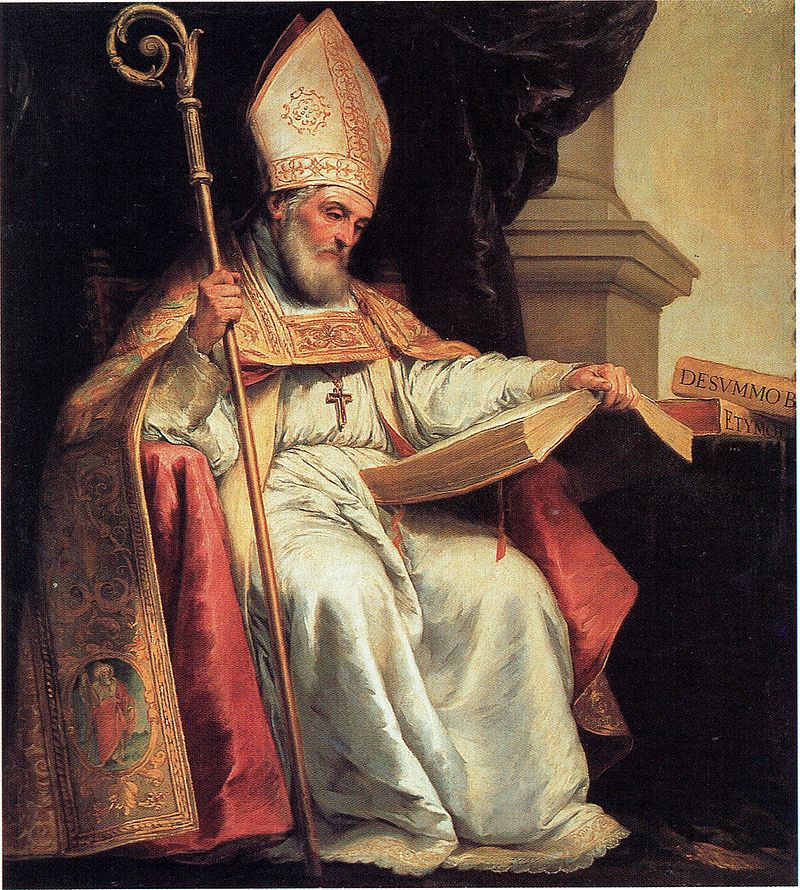
Today, April 4th, muted this year by Holy Saturday, is the commemoration of Saint Isidore of Seville (560-636) a bishop and doctor of the Church during a tumultuous age, when civilization was crumbling, coming apart at its very seams, which may sound sort of au courant. Then again, the form of this world has always[…]Continue reading→
Bishop Fulton Sheen’s 58th Good Friday Reflection
Incredible, at the beginning of this reflection, that the Venerable Bishop Sheen declares that he has given nearly 58 Good Friday reflections – this, as far as I can gather, was his final one, and he seems in full vigour in mind and body. The good bishop and evangelist died in his 84th year on[…]Continue reading→
A Minimal Friar and the Death of a Great Pope
This April the second- overshadowed by Holy Thursday this year – marks the memorial of Saint Francis of Paola (1417-1507), founder of the ‘Minim’ friars, so called for their humility and poverty, who interpreted the rule of Saint Francis of Assisi in quite a literal sense: extreme poverty, trust in God, foregoing all animal and[…]Continue reading→
Woven versus Seamless Garments
The reflection on the worthy project by Magie Dominic was intriguing, and I thought I would offer a brief follow-up commentary. The garment woven out of many pieces is a poignant symbol, even a ‘sacramental’, inspired by prayer and grace. We are all united in some way, and should strive for such unity, wherever we[…]Continue reading→
Bill C-9: Prelude to Persecution?
Well, it happened, as I suppose was inevitable, at least in a secular sense (from God’ perspective, there’s always hope). Bill C-9, the ironically named ‘Combatting Hate Act’ passed the House of Commons with a 186-137 vote. Look on the good side – there’s still over a hundred sane people in parliament who believe in[…]Continue reading→