
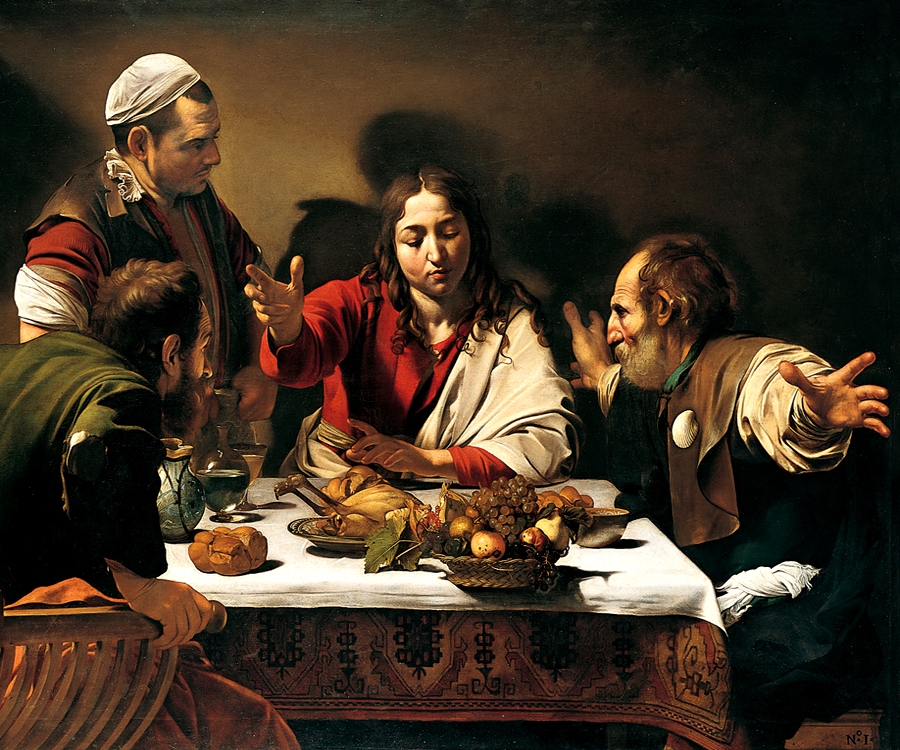
The Road to Emmaus
As Catholics, we are truly blessed by how our Scripture readings at Mass are linked to the great events we are commemorating. For instance, today we are celebrating the third Sunday of Easter and the Church provides us with another appearance of the Risen Lord Jesus. It is one of the most well-known and loved descriptions of the Resurrected Christ – the Emmaus event described by St. Luke (24.13-35).1
It begins with Luke explaining how the Risen Jesus met two disciples on their way to the village of Emmaus but that “their eyes were kept from recognizing [H]im.” Jesus asked them what they were talking about and Luke notes they “stood still…[and that they] look[ed] sad” (vv.13-17).
The disciples then explained to Jesus the cause of their sorrow: “…Jesus of Nazareth…a Prophet mighty in deed and word before God and all the people…our chief priests and leaders handed [H]im over to be condemned to death and crucified [H]im. But we had hoped that [H]e was the one to redeem Israel” (vv. 19b-21a).
The disciples’ great sadness was understandable. The crucifixion of Jesus was a horrific event prompted by the demands of some of His own people. The disciples had hoped that Jesus was the one who was going to redeem Israel, a glorious leader who would free them from Roman occupation and oppression. But their hopes about Jesus being the Messiah came crashing down as He was led like a lamb to the slaughter and put to death on a cross. Consequently, they were in a state of uncertainly and distress – anxiously wondering what they would do next and how they would carry on.2
The disciples on the road to Emmaus seemed to be so seized by uncertainty and distress over Jesus’ death that they had difficulty focusing on anything else, even when they heard claims about Our Lord’s tomb being empty and that He had risen from the dead. This is implied when they say, “Moreover, some women of our group astounded us. They were at the tomb early this morning, and when they did not find [H]is body there, they came back and told us that they had indeed seen a vision of Angels who said that [H]e was alive. Some of those who were with us went to the tomb and found it just as the women had said; but they did not see [H]im” (vv.22-24).
It was at this point that Jesus began to challenge their false assumption that He was dead. He explained to them that the Scriptures, which we now refer to as the Old Testament, actually point to Him. As Luke says, Jesus, starting “with Moses and all of the Prophets,…interpreted to them things about [H]imself in all the Scriptures” (v27).
We refer to this way of analyzing Scripture as typology, the “study of Old Testament prefigurations (events, realities, signs and things) that…are fulfilled in the New Testament, in the new covenant of Jesus – in his…[l]ife…[D]eath and… [R]esurrection.” 3
For examples of typology consider how Moses, the great lawgiver in the Old Covenant, points us to Christ, who gave us the New Law in the Sermon on the Mount (see Mt 5-7). Also, the powerful King David found in the Old Testament reflects Jesus, who assumed His royal throne forever. Moreover, the Jerusalem Temple sheltered the presence of God within Israel. And yet Jesus radiates God’s glory in a more profound way for He is both God and man!4
After Jesus’ captivating explanation of the Scriptures, the disciples asked Him to stay with them. Jesus did so and as they sat at a table, He revealed Himself to them. Jesus took bread, blessed and broke it, and gave it to the two disciples. They recognized Jesus and then suddenly He was gone! This breathtaking manifestation of the Risen Lord left the disciples in awe, as they said to each other “[w]ere not our hearts burning within us while [H]e was talking to us on the road, while [H]e was opening the Scriptures to us?” Then they returned to Jerusalem, uncertain and distressed no more as they joyfully shared with others that they had encountered the Risen Lord in the breaking of the bread (vv. 28-35).
It is vital we recognize how the Emmaus event mirrors the way in which Jesus reveals Himself to us in the Holy Mass. Just as Jesus explicated His presence in the Scriptures to the disciples, so do we encounter Him when the Scriptures are proclaimed at Mass. And just as Jesus made Himself known in the breaking of the bread when He sat at the table, so too is the Risen Jesus found in the Most Holy Eucharist, as His Body, Blood, Soul, and Divinity are fully present under the appearances of bread and wine.5
In many ways we are like those two disciples walking to Emmaus. In life we experience many ups and downs and we may come to Mass feeling sad, distressed, and uncertain. But when the Scriptures are proclaimed we hear the words of Jesus and our hearts are warmed with faith and hope.6
And it is through the breaking of the bread, in receiving Holy Communion, that we love God and others more fully and we become more detached from earthly temptations and anxieties. Furthermore, the Eucharist provides us with spiritual strength. In fact, Holy Communion is sometimes referred to as “the bread of the strong.”
The challenges of daily life may drain our energy to the point that we find ourselves growing weary from the strain. Yet the Risen Jesus comes to us in the Most Holy Eucharist and He energizes and renews us so that we can take up our cross daily and follow Him.7
At Holy Mass we come together as a community to pray for others and ourselves, to encounter the Lord in the Scriptures, and to receive Him in Holy Communion. The Mass is truly glorious and it for this reason that St. John Vianney explained that going to “Mass is the greatest action we can do. All the good works taken together do not equal the sacrifice of the Mass, because they are the works of man and the Holy Mass is the work of God.”8
Turning to the words of Pope Benedict XVI, the now deceased pontiff wrote that “[t]hrough the intercession of [the Blessed Virgin] Mary, let us pray that every Christian, in reliving the experience of the disciples of Emmaus, especially at Sunday Mass, may rediscover the grace of the transforming encounter with …the Risen Lord, who is with us always. There is always…[the] Word of God that gives us guidance after we slip; and through our weariness and disappointments there is always…[the] Bread that is broken [the Holy Eucharist] that keeps us going on the journey.”9
Sources
1 Brant Pitre, The Mass Readings Explained: Third Sunday in Easter:Year A (Part one), p. 1.
2 Source: http://www.jrtalks.com/Luke/luke24v13to35.html (Retrieved April 19, 2023).
3 Brant Pitre, The Mass Readings Explained: Third Sunday in Easter:
Year A (Part one), pp.4-5.
4 Ignatius Catholic Study Bible – New Testament, p. 28.
5 Catechism of the Catholic Church. 1347.
6 Source: https://2026.catholicinsight.com/pope-benedict-and-the-third-sunday-of-easter/ (Retrieved April 19, 2023).
7 Source: https://www.catholic365.com/article/8615/emotional-healing-from-the-eucharist.html (Retrieved April 19, 2023).
8 Source: https://diopitt.org/news/st-john-vianney-the-mass-is-everything (Retrieved April 19, 2023).
9 https://2026.catholicinsight.com/pope-benedict-and-the-third-sunday-of-easter/ (Retrieved April 19, 2023).

Saint Kateri , Canada’s Protectress
This was the title given to Saint Kateri Tekakwitha, by Pope Benedict XVI, when he canonized her on October 28th, 2012, along with six others, in Saint Peter’ Square (she had been beatified by Pope John Paul II back in 1980). With Saint Joseph as our protector, along with the Canadian martyrs, we seem to[…]Continue reading→

Remembering Father Alphonse de Valk
(Today marks the sixth anniversary of the death of Father Alphonse de Valk, C.S.B., a faithful, courageous and indefatigable Basilian priest, pro-life-and-family apostle, and the founder of Catholic Insight magazine. Here is what we wrote those on his entering into eternity five years ago, as we continue to remember him in our prayers and thoughts)[…]Continue reading→

My Name is Bernadette
April 16th is a propitious day, for besides the anniversary of Father de Valk’s death, who founded Catholic Insight in its print form decades ago, and the commemoration of the ‘two Benedicts’, mentioned in accompanying posts, today we also recall Saint Bernadette Soubirous, the young visionary to whom the Virgin Mary appeared numerous times at[…]Continue reading→

Canonizing Sister Faustina and Divine Mercy
HOMILY OF THE HOLY FATHER MASS IN ST PETER’S SQUARE FOR THE CANONIZATION OF SR MARY FAUSTINA KOWALSKA Sunday, 30 April 2000 1. “Confitemini Domino quoniam bonus, quoniam in saeculum misericordia eius”; “Give thanks to the Lord for he is good; his steadfast love endures for ever” (Ps 118: 1). So the Church sings on the Octave of[…]Continue reading→

Divine Mercy Sunday – An Echo of Every Mass
Reach out your hand and put it in my side. Do not doubt but believe’… ‘My Lord and my God!’ (Jn. 20:18)). Today is Divine Mercy Sunday, and as we celebrate the end of the Easter Octave, we contemplate the wounded side of our Saviour, the Church’s source of life. On Good Friday in the[…]Continue reading→

Saint Stanislaus of Szczepanów
We celebrate Saint Stanislaus today (+ April 11, 1079), in light of this Easter Octave, a bishop and martyr who accepted the episcopacy only at the direct order of Pope Alexander II. He proved a wise and courageous leader of his flock, put to death by his own king, Boleslaus, for rebuking the monarch’s ‘immoral[…]Continue reading→

First Holy Communion: Sermon from May 16, 1943
Here is a sermon from the good old days by +Rev. Msgr. Vincent Nicholas Foy (August 14, 1915 – March 13, 2017), from 1943. Readers may recall that Pope Saint Pius X, by the decree Quam Singulari in 1910, lowered the customary age of reception of Holy Communion – after the rigours of the plague[…]Continue reading→

In the Glorious Light of Easter, Alleluia!
Set your minds on things that are above, not on things that are on earth, for you have died, and your life is hidden with Christ in God. When Christ who is your life is revealed, then you also will be revealed with him in glory (Col. 3:3-4). The Resurrection of Our Lord and Saviour[…]Continue reading→

An Ancient Homily for Holy Saturday
The time between Good Friday and Easter Sunday is one of waiting, in silence, as the world wonders – anticipates – what will happen, after the death of Christ. We re-live this time each year in the anamnesis of our liturgy, and in turn look forward to the glorious re-creation of all things at the[…]Continue reading→

Europe’s Long Descent
(As we meditate on this day on Christ’s burial, and His descent into hell, it is fitting to ponder here with contributor Peter Marcus how the world seems to be heading there as well. The difference is that, although God cannot ‘redeem’ hell, nor those therein, He can and did redeem the world. There is[…]Continue reading→