
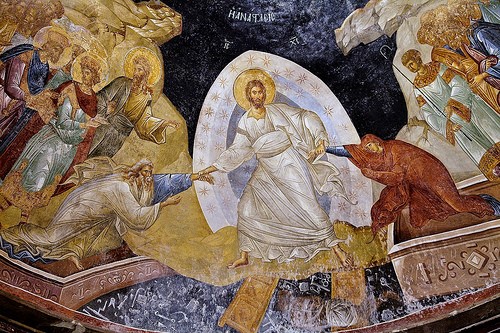
Easter and Forgiveness
An increase in crime rates typically generates a lot of attention from the public, the media, and from political leaders. Responding to a recent increase in reported crimes in Alberta, a few days ago the province’s premier Danielle Smith reported her government would assist the big cities of Calgary and Edmonton with the costs of hiring 100 new police officers. Commenting on the uptick of crime in her province and her funding decision, Smith tweeted: “It ends now, it has to end now. We can’t allow this to get any worse. In fact, it’s got to get a whole lot better. We’re going to break the back of crime.”1
There are a lot of different ways to respond to crime. Quite a few years ago and before I became a priest, I worked at an agency that provided a Victim-Offender Reconciliation Program. This program that I administered focused on young people, mostly in their teenage years, who had committed various crimes such as auto theft and breaking into people’s homes.
My role included meeting with both the victim of the crime, such as a car owner or homeowner, and a young offender, and arrange for a face-to-face meeting between the two that at which I would also be present. The goal of these meetings was to develop a plan of action for the youth to help compensate the victims for the crimes they committed against them.
These various action plans included work, paying for damages, and a personal apology.
As I look back on this job, there is one case in particular that “sticks out’ in my mind as a potentially life-changing experience. The offender was a young male around 15 years old and the victim was a middle-aged woman. The youth had broken into her home. The three of us sat down to meet and the woman explained to the youth what a terrible feeling it was to find out that someone had gone through her home and personal belongings.
She didn’t do this in a vicious manner but she was definitely clear and direct! In my view, she genuinely wanted to help this young fellow so that he would leave the criminal lifestyle “for good” and she was not just using this meeting as an opportunity to unload her feelings of anger and hurt on him.
The youth was clearly moved by the woman’s empathetic and courageous stance and he eventually began to cry. And he uttered those powerful words that can break down many barriers: “I’m sorry!” This was one of those times when this program really seemed to “make a difference.” It’s as if the woman’s own empathetic nature reached out to the youth and elevated his empathy to a level it had not been before- he was beginning to understand how his actions affected others.
This story of one person’s noble character elevating the character of someone else’s is an imperfect but meaningful reflection of how our minds and hearts are transformed by Jesus’ glorious Resurrection from the Dead. It is the celebration of the Resurrection of Jesus that makes today, Easter Sunday, the greatest of all the Church Feasts! We know that Jesus Christ is both true God and true man, and because God became one of us and then died and rose again our humanity is changed in a way that we could never do through our own efforts.2
This is what we read today in Paul’s letter to the Colossians (3:1-4) in which he tells us that if we “have been raised with Christ”, that is, if we have been baptized and we prayerfully focus on Jesus’ glorious Resurrection, then our minds and hearts will gravitate more to the things of God and less to the things of the world. So, God’s grace, His free and unearned gift to us, elevates and transforms human nature.3
All four Gospels describe Jesus’ Resurrection and today we read John’s account (20:1-18). John tells us that on an early Sunday morning Mary Magdalene came to the tomb in which the body of the dead Jesus had been placed. To her surprise the stone covering the tomb had been removed so she went and told Simon Peter and another disciple of Jesus what she saw.
Peter and the other disciple ran to the tomb to see for themselves. First Peter and then the other disciple went into the tomb and though there was no sign of Jesus’ body, they saw his burial clothes neatly arranged. The disciples must have sensed that something remarkable had occurred, but they were not certain of what. As John explains, at this point “they did not understand the Scripture, that [Jesus] must rise from the dead…[so] the disciples returned to their homes” (vv. 9-10).
The ”Scripture” John refers to here is what we would now consider the Old Testament, and various passages in the Old Testament point to Jesus’ Resurrection long before the Incarnation. For instance, the experience of the prophet Jonah emerging from a whale after three days in its stomach points to Jesus rising from the tomb after three days in the earth (Jon 1.17; Mt. 12.40). And Isaac was for three days under a death sentence until God intervened to return him alive to his father Abraham (Gen 22.4, 13).4
Despite this Scriptural foreshadowing, the empty tomb, and Jesus’ own previous predictions that He would rise on the third day (see Lk 9.22; 18.33; 24.6-7), Peter and the other disciple could not quite grasp the magnitude of what had happened. But then the unthinkable occurred, as the Risen Jesus began appearing to people.
As we read today, He appeared to Mary Magdalene and Luke 24:34 explains that “The Lord has risen indeed, and [H]e has appeared to Simon [Peter]!” The transformation that Peter underwent as a result of his encounter with the Risen Lord is nothing less than remarkable. Prior to Jesus’ crucifixion Peter denied knowing Jesus three times out of fear of persecution, and then he wept bitterly over his acts of cowardice (Lk 22:54-62).5
And yet after encountering the Risen One and experiencing the presence of the Lord at Pentecost, Peter was filled with the power and courage of the Holy Spirit. This is evidenced by today’s first reading, taken from the Acts of the Apostles (Acts 10.34a, 37-43). Peter is preaching to the Gentiles, proclaiming that Jesus of Nazareth was crucified but was then raised from the dead.
Clearly, Peter was no longer acting like a coward who denied Jesus. Instead, he had been transformed into a passionate and courageous proclaimer of the saving truth that the Lord Jesus is Risen, He is Risen indeed! In fact, other chapters in Acts (see chaps. 4 & 5) describe how Peter faced persecution by tirelessly proclaiming the Holy Name of Jesus.
The power of Jesus’ Resurrection also transforms us in a variety of ways. For instance, we encounter the Risen Jesus in the sacraments – such as Confession and the Holy Eucharist, and it is through the sacraments that we experience the forgiveness and mercy of almighty God, and we are given the courage and desire to live full, holy lives and to share the Good News with others.6
We must also recognize that the fruits of Jesus’ Resurrection go beyond our earthly lives, as Jesus tells us that “[He is] the resurrection and the life, [and] [that][t]hose who believe in [Him], even though they die, will live” (Jn 11:25). What does Jesus mean by this?
When our earthly lives end our immortal souls will leave our physical bodies and one of three things will happen. We will enter into heaven right away, or we will enter heaven through a purification process called purgatory, or we will face everlasting damnation. Those who have died in the friendship of our Lord will join Him in paradise, since by His death and Resurrection Jesus “opened” heaven for us.7
But our ultimate destiny does not end there. Jesus will return to the earth for the General Judgement and our souls will be reunited with our physical bodies. Like Jesus, our earthly bodies will be raised – for He is the source of our own future resurrection. These new bodies will not die, and for those judged to be in union with Christ, their bodies will be transformed into a glorious state, freed from all suffering and pain.8
With this, the Kingdom of God will come in its fullness, the universe itself will be renewed and all anguish will be no more– the former things will have passed away. All those in Christ will be united with Him in a state of eternal fulfillment.9
As human beings, there is much we can do to strengthen and elevate the characters of each other, so let us honor that. But there is nothing we can do that comes close to the transformation we undergo through Christ’s Resurrection. It is through His Resurrection, it is through our being raised with Christ, that we become what God wants us to be and what He willed for us at the moment of creation.
So, at its core, Easter is about how the ultimate destiny of every human being is summed up in one glorious way, that is, the Lord Jesus Christ is Risen, He is truly Risen! Let us rejoice and be glad!!
Sources
1 Source: https://calgaryherald.com/news/local-news/province-to-announce-new-measures-addressing-transit-safety (Retrieved April 5th, 2023).
2Source: https://www.catholicculture.org/culture/liturgicalyear/activities/view.cfm?id=1042 (Retrieved April 5th, 2023).
3Source: http://professorjohnston.com/grace-does-not-build-on-nature/ (Retrieved April 5th, 2023).
4 Ignatius Catholic Study Bible – New Testament, p. 155..
5 Ibid., p. 151.
6 Catechism of the Catholic Church. 1002-1003.
7 Ibid., 366, 1022-1032.
8Source: https://www.catholic.com/tract/resurrection-of-the-body (Retrieved April 5th , 2023).
9 Catechism of the Catholic Church. 1042-44.

Saint Kateri , Canada’s Protectress
This was the title given to Saint Kateri Tekakwitha, by Pope Benedict XVI, when he canonized her on October 28th, 2012, along with six others, in Saint Peter’ Square (she had been beatified by Pope John Paul II back in 1980). With Saint Joseph as our protector, along with the Canadian martyrs, we seem to[…]Continue reading→

Remembering Father Alphonse de Valk
(Today marks the sixth anniversary of the death of Father Alphonse de Valk, C.S.B., a faithful, courageous and indefatigable Basilian priest, pro-life-and-family apostle, and the founder of Catholic Insight magazine. Here is what we wrote those on his entering into eternity five years ago, as we continue to remember him in our prayers and thoughts)[…]Continue reading→

My Name is Bernadette
April 16th is a propitious day, for besides the anniversary of Father de Valk’s death, who founded Catholic Insight in its print form decades ago, and the commemoration of the ‘two Benedicts’, mentioned in accompanying posts, today we also recall Saint Bernadette Soubirous, the young visionary to whom the Virgin Mary appeared numerous times at[…]Continue reading→

Canonizing Sister Faustina and Divine Mercy
HOMILY OF THE HOLY FATHER MASS IN ST PETER’S SQUARE FOR THE CANONIZATION OF SR MARY FAUSTINA KOWALSKA Sunday, 30 April 2000 1. “Confitemini Domino quoniam bonus, quoniam in saeculum misericordia eius”; “Give thanks to the Lord for he is good; his steadfast love endures for ever” (Ps 118: 1). So the Church sings on the Octave of[…]Continue reading→
Divine Mercy Sunday – An Echo of Every Mass
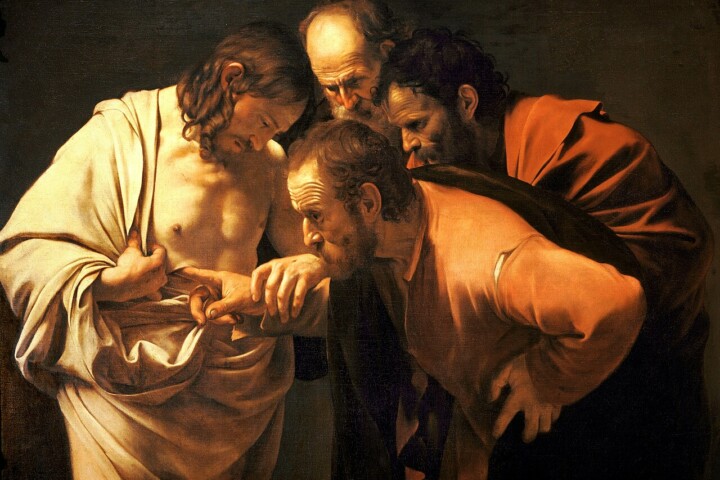
Reach out your hand and put it in my side. Do not doubt but believe’… ‘My Lord and my God!’ (Jn. 20:18)). Today is Divine Mercy Sunday, and as we celebrate the end of the Easter Octave, we contemplate the wounded side of our Saviour, the Church’s source of life. On Good Friday in the[…]Continue reading→

Saint Stanislaus of Szczepanów
We celebrate Saint Stanislaus today (+ April 11, 1079), in light of this Easter Octave, a bishop and martyr who accepted the episcopacy only at the direct order of Pope Alexander II. He proved a wise and courageous leader of his flock, put to death by his own king, Boleslaus, for rebuking the monarch’s ‘immoral[…]Continue reading→
First Holy Communion: Sermon from May 16, 1943
Here is a sermon from the good old days by +Rev. Msgr. Vincent Nicholas Foy (August 14, 1915 – March 13, 2017), from 1943. Readers may recall that Pope Saint Pius X, by the decree Quam Singulari in 1910, lowered the customary age of reception of Holy Communion – after the rigours of the plague[…]Continue reading→
In the Glorious Light of Easter, Alleluia!
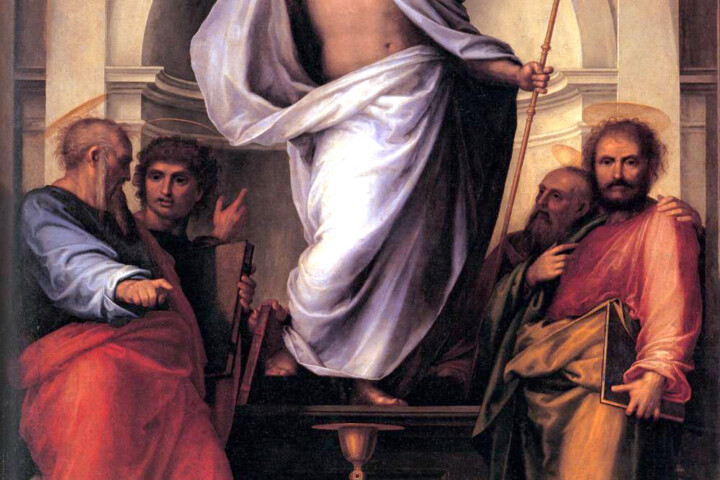
Set your minds on things that are above, not on things that are on earth, for you have died, and your life is hidden with Christ in God. When Christ who is your life is revealed, then you also will be revealed with him in glory (Col. 3:3-4). The Resurrection of Our Lord and Saviour[…]Continue reading→
An Ancient Homily for Holy Saturday
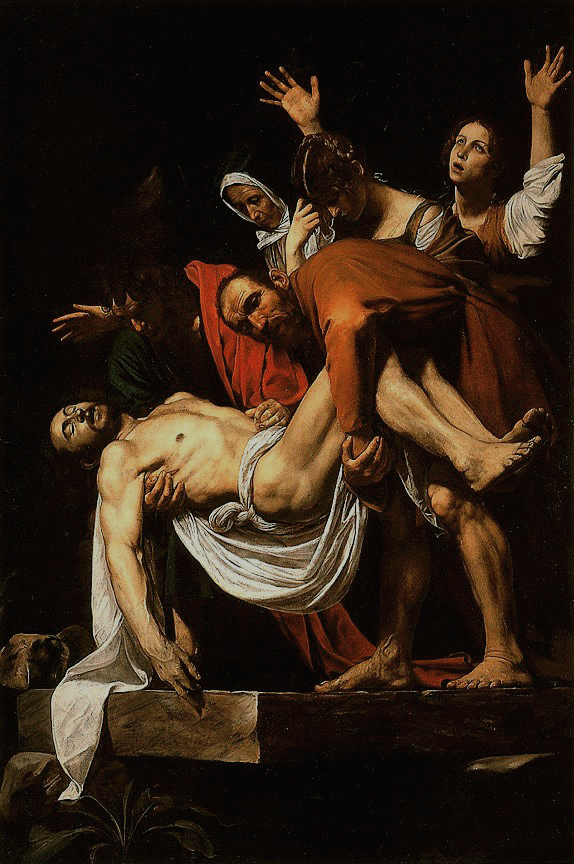
The time between Good Friday and Easter Sunday is one of waiting, in silence, as the world wonders – anticipates – what will happen, after the death of Christ. We re-live this time each year in the anamnesis of our liturgy, and in turn look forward to the glorious re-creation of all things at the[…]Continue reading→

Europe’s Long Descent
(As we meditate on this day on Christ’s burial, and His descent into hell, it is fitting to ponder here with contributor Peter Marcus how the world seems to be heading there as well. The difference is that, although God cannot ‘redeem’ hell, nor those therein, He can and did redeem the world. There is[…]Continue reading→