
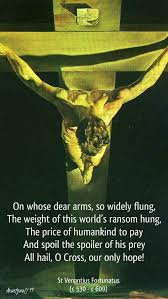
Venantius and his Vexilla
Vexilla regis prodeunt; The banners of the king come forth;
fulget crucis mysterium, brightly gleams the mystery of the cross
quo carne carnis conditor by which the creator of flesh in the flesh
suspensus est patibulo. was hung from a gibbet,
Quo vulneratus insuper upon which he was wounded,
mucrone diro lanceae, by the cruel point of a spear
ut nos lavaret crimine, and there issued forth water and blood
manavit unda et sanguine. to cleanse us from our sin.
Arbor decora et sanguine, O beautiful tree, adorned
ornata regis purpura, with the purple blood of the king;
electa digno stipite chosen to bear on your worthy trunk
tam sancta membra tangere! limbs so holy!
Beata, cuius brachiis O blessed [tree] upon whose branches hung
saeculi pependit pretium; the ransom of the world;
statera facta est corporis, it was made the balance of the body
praedam tulitque tartari. and snatched away the prey of hell.
Salve, ara, salve, victima, Hail, O altar, hail, O victim,
de passionis gloria for the glory of the passion
qua vita mortem pertulit by which life endured death
et morte vitam reddidit! and restored life by death.
O crux ave, spes unica![1] Hail, O cross, our only hope!1
hoc passionis tempore! In this Passiontide
piis adauge gratiam, increase the grace of the just,
reisque dele crimina. and for sinners blot out their sins.
Te, fons salutis Trinitas, O Trinity, the font of salvation;
collaudet omnis spiritus: May every spirit praise you,
quos per crucis mysterium by the mystery of the cross.
salvas, fove per saecula. cherish forever those whom you save
Amen Amen.
Venantius Fortunatus (ca. 530 – ca. 610)
Venantius Fortunatus was an Italian who finished his life as bishop of Poitiers, France, having earlier served as chaplain to Queen Radegunde. She had retired from the world to live as a nun in a monastery near Poitiers. In A.D. 569 she obtained for the convent a fragment of the true cross, and Venantius Fortunatus wrote his famous hymn, Vexilla Regis, to welcome the relic. The hymn was in constant and ever-wider use for many centuries, but—although it can still be found in the Latin text of the liturgy—it has now been everywhere superseded by vernacular songs. There is always a price to be paid for a change, even one that many would consider an improvement, and we must regret the loss of this important fragment of our Tradition.
It’s impossible to translate anything from one language to another, all the more so when Latin is to be rendered into English. Simply look at the different appearance of the two. The Latin is sober, majestic, lapidary, while the English looks fussy, with too many small words. It’s as if an oracle had given forth its solemn proclamation in Latin, and afterwards a nervous spokesman desperately searched for ways to convey the sublime message to the chattering devotees at the shrine. The reason for the difference is simple. Latin does not use definite or indefinite articles; there is no word for “the” or “a.” It also largely dispenses with prepositions; there is not one in the entire hymn. Consider the opening word, for instance. Vexilla is plural. It could be translated as “the banners” or merely “banners.” Similarly, “regis” means “of the king,” or perhaps “of a king.” The person listening to the hymn would have recognized an initial ambiguity in the wording. Was it “the banners of the king,” i.e., referring to a particular monarch, or “banners of a king,” i.e., any king? Of course, the second line resolves the matter, for we see that these banners adorn the cross. They have been unfurled to honour Christ, the King.
That vexilla is a plural noun is also significant, and the connotations of this fact, again, defy translation. The singular—vexillum—was used of the standard that led a troop of the Roman army into battle, somewhat as regimental colours once functioned. The vexillum could also have been a red flag that was hoisted on the general’s tent as a signal for battle. By extension, vexillum came to signify the troop of soldiers that were fighting under that standard. That our King employs many standards—all those vexilla!—indicates not only that he has many troops, but also that warfare will be extensive and protracted. We are soldiers fighting under those banners, joined to our fellow Christians of the past and future.
In the first verse the splendour of the opening two lines is contrasted with the grim reality of the following two. Fortunatus was here inspired by Saint John’s Gospel, in which Jesus says that he will be glorified by his ignominious death of the cross. “Now is the Son of Man glorified. . . . and I, when I am lifted up from the earth, will draw all men to myself.”[2] The Latin word for “flesh” is caro, with here assumes two different forms: “carne,” which means “in the flesh” and carnis,” which means “of the flesh.” Hence carne carnis conditor is translated “the creator of flesh in the flesh,” certainly a cumbersome version of the elegant Latin alliterative phrase. “Flesh” here means, in the biblical usage, the human person—“My flesh will dwell in hope”[3]—and is frequently used of man as corrupted by sin and in need of redemption—“God sent his Son in the likeness of sinful flesh.”[4] With typical compression, the Latin expresses in three words the fact that Jesus, as the pre-existent Word, was the agent of creation—“All things were made by him, and without him was not anything made that was made”[5]—including, of course, human beings and that he came in the likeness of sinful man to redeem him from his state of alienation from God.
The second verse continues to contrast between the brutality of the crucifixion and its glorious effect. Christ body, pierced by the lance, release a flood that can clean the whole world of its sinfulness. Then we move into a poetic mode, in which the cross—made of course of wood—is compared to a tree bearing a wonderful burden. It is beautiful; it is special; it is blessed. We find here an echo of the messianic prophecy of Isaiah: “There shall come forth a shoot from the stump of Jesse, and a branch shall grow out of his roots. And the Spirit of the Lord shall rest upon him.”[6] Our poet then compares the arms of the cross to the arms of a balance. It’s what is called a steelyard, i.e., a balance with a long arm by which a single counterweight can balance a heavy one.
The heavy weight in this case would be the countless sins of mankind which have accumulated in what would seem to be a load so ponderous that nothing could lift it. But the single act of the God-man on that long arm reaching across the centuries can easily raise the crushing burden off the shoulders of the human race. Verse five, which is the final one of the original hymn, presents the Gospel paradox in a fashion that has never ceased to move the hearts of believers across the ages, viz., that death is the source of life, and that death conquers death; the Prince of life now dead reigns alive. This is a sentiment that occurs and reoccurs in the solemn liturgies of Holy Week and Easter.
[1] The final two verses are later additions to the text.
[2] Jn 13.31; 12.32
[3] Ps 16.9, as quoted in Acts 2.26.
[4] Rom 8.3.
[5] Jn 1.3.
[6] Is 11.1-2.

Saint Kateri , Canada’s Protectress
This was the title given to Saint Kateri Tekakwitha, by Pope Benedict XVI, when he canonized her on October 28th, 2012, along with six others, in Saint Peter’ Square (she had been beatified by Pope John Paul II back in 1980). With Saint Joseph as our protector, along with the Canadian martyrs, we seem to[…]Continue reading→

Remembering Father Alphonse de Valk
(Today marks the sixth anniversary of the death of Father Alphonse de Valk, C.S.B., a faithful, courageous and indefatigable Basilian priest, pro-life-and-family apostle, and the founder of Catholic Insight magazine. Here is what we wrote those on his entering into eternity five years ago, as we continue to remember him in our prayers and thoughts)[…]Continue reading→

My Name is Bernadette
April 16th is a propitious day, for besides the anniversary of Father de Valk’s death, who founded Catholic Insight in its print form decades ago, and the commemoration of the ‘two Benedicts’, mentioned in accompanying posts, today we also recall Saint Bernadette Soubirous, the young visionary to whom the Virgin Mary appeared numerous times at[…]Continue reading→

Canonizing Sister Faustina and Divine Mercy
HOMILY OF THE HOLY FATHER MASS IN ST PETER’S SQUARE FOR THE CANONIZATION OF SR MARY FAUSTINA KOWALSKA Sunday, 30 April 2000 1. “Confitemini Domino quoniam bonus, quoniam in saeculum misericordia eius”; “Give thanks to the Lord for he is good; his steadfast love endures for ever” (Ps 118: 1). So the Church sings on the Octave of[…]Continue reading→

Divine Mercy Sunday – An Echo of Every Mass
Reach out your hand and put it in my side. Do not doubt but believe’… ‘My Lord and my God!’ (Jn. 20:18)). Today is Divine Mercy Sunday, and as we celebrate the end of the Easter Octave, we contemplate the wounded side of our Saviour, the Church’s source of life. On Good Friday in the[…]Continue reading→

Saint Stanislaus of Szczepanów
We celebrate Saint Stanislaus today (+ April 11, 1079), in light of this Easter Octave, a bishop and martyr who accepted the episcopacy only at the direct order of Pope Alexander II. He proved a wise and courageous leader of his flock, put to death by his own king, Boleslaus, for rebuking the monarch’s ‘immoral[…]Continue reading→

First Holy Communion: Sermon from May 16, 1943
Here is a sermon from the good old days by +Rev. Msgr. Vincent Nicholas Foy (August 14, 1915 – March 13, 2017), from 1943. Readers may recall that Pope Saint Pius X, by the decree Quam Singulari in 1910, lowered the customary age of reception of Holy Communion – after the rigours of the plague[…]Continue reading→

In the Glorious Light of Easter, Alleluia!
Set your minds on things that are above, not on things that are on earth, for you have died, and your life is hidden with Christ in God. When Christ who is your life is revealed, then you also will be revealed with him in glory (Col. 3:3-4). The Resurrection of Our Lord and Saviour[…]Continue reading→

An Ancient Homily for Holy Saturday
The time between Good Friday and Easter Sunday is one of waiting, in silence, as the world wonders – anticipates – what will happen, after the death of Christ. We re-live this time each year in the anamnesis of our liturgy, and in turn look forward to the glorious re-creation of all things at the[…]Continue reading→

Europe’s Long Descent
(As we meditate on this day on Christ’s burial, and His descent into hell, it is fitting to ponder here with contributor Peter Marcus how the world seems to be heading there as well. The difference is that, although God cannot ‘redeem’ hell, nor those therein, He can and did redeem the world. There is[…]Continue reading→