
Blessedness and Lectio Divina
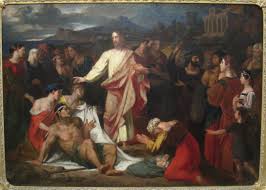
Our Church’s tradition has promoted the practice of lectio divina, i.e., a meditative reading of Scripture. We would do well to follow in these footsteps by examining the Beatitudes, today’s Gospel, which open the Sermon on the Mount, the discourse in which Jesus presents the new covenant replacing that which Moses brought down to the people from Mount Sinai.
The word, “blessed,” first invites our attention. The English language, usually rich in vocabulary and nuance, fails us here because “blessed” has two quite distinct meanings. It can mean praiseworthy as when we say, “blessed be God” and “blessed be his holy name,” i.e., “praised be God and his holy name.” But blessed can also mean fortunate as when I say that I was blessed with good parents or with good health. Which of these two meanings is used in the Beatitudes? We can answer that question by examining the original text of the Bible, which is in Greek, for Greek has two different words corresponding to the two meanings of “blessed” in English. The Greek word for praiseworthy has come into English as “eulogy,” as when someone who has died is praised at his funeral with a eulogy. But the other Greek word, for which there is no English equivalent is the one found in the Beatitudes. It’s makarios, and it means fortunate. It remains, then, for us to examine why the people described in the Beatitudes are fortunate, lucky. Given the richness of the text, I shall content myself with considering only one of them, the sixth: “Blessed are the pure in heart, for they shall see God.”
The reward—“to see God”—should excite in us a desire to be so fortunate. Purity of heart essentially means singleness of purpose. We are to pursue our goal without distraction, directing all we say and do ultimately to the glory of God. Such a life has the beauty of integrity in that short-term goals—good health, work, family, etc.—are means by which we grow in virtue and in the love of God. For partial goods, to the extent that they are goods, remind us their source in God. And so, what I may term a chaste love for things that pass will be coordinated in a vision that looks on God as their source. It is not surprising, then, that the vision of God himself is their completion.
Some detail may allow us to enter more fully into the significance of this Beatitude. Consider the quest for truth that we find, for example, in scientists. The rigour of their methods and their strict allegiance to honesty – at least in theory – are the source of their remarkable achievements. And as their investigations reveal ever more splendidly the mysterious nature of the physical world, their enthusiasm and their, admittedly, partial success, instill in them a sense of humility that should induce them to contemplate with ever greater reverence God, the Creator. But when the object of scientific investigation is Man himself, the psychiatrist will share with the physicist awe, but here in contemplating the range and depth of human consciousness. If the investigation of the cosmos induces its explorer to kneel before its creator, so too must the equally extensive and mysterious inner universe of the human mind or, better, the soul. But in this case, there is an additional factor to be considered, viz., sin, whether original or actual, that has occasioned the Son of God to come among men as the ultimate remedy for their ills.
A consideration of beauty leads us to the same conclusion, for who can deny the ability of music or the other arts to take us out of ourselves? Only a degenerate society, such as our own, could attempt to dignify with the name of art what is harsh and ugly. On the other hand, to have composed, to take but one example, one of Schubert’s songs would justify a man’s existence; and he wrote more than six hundred. Here, perhaps more than anywhere else, is Man provided with the fulfilment of the promise of the sixth beatitude, that the pure of heart will see God. Even as I enunciate that statement, I realize that it requires qualification. For goodness, moral virtue, transports us even more assuredly into the presence of God. Supreme in this regard is the chaste love of husband and wife by which, Scripture tells us, the very love of Christ for his Church is sacramentally realized. But all forms of affection—friendship, collaboration, filial docility, parental devotion—are goods that exhibit that generous forgetfulness of self that comes closest to the supreme goodness of Jesus in his career of teaching, healing and, through his death and resurrection, redeeming the human race.
These few, random observations on the Christian covenantal charter of the Sermon on the Mount are intended as an incentive to all of you to open your Bibles to the fifth, sixth and seventh chapters of the Gospel of Matthew and to ponder anew the privileges and demands of the Christian state of life. Its severe beauty will be irresistibly attractive to the soul that, touched by divine grace, has become the dwelling place of the Spirit of Jesus. +

Saint Kateri , Canada’s Protectress
This was the title given to Saint Kateri Tekakwitha, by Pope Benedict XVI, when he canonized her on October 28th, 2012, along with six others, in Saint Peter’ Square (she had been beatified by Pope John Paul II back in 1980). With Saint Joseph as our protector, along with the Canadian martyrs, we seem to[…]Continue reading→

Remembering Father Alphonse de Valk
(Today marks the sixth anniversary of the death of Father Alphonse de Valk, C.S.B., a faithful, courageous and indefatigable Basilian priest, pro-life-and-family apostle, and the founder of Catholic Insight magazine. Here is what we wrote those on his entering into eternity five years ago, as we continue to remember him in our prayers and thoughts)[…]Continue reading→

My Name is Bernadette
April 16th is a propitious day, for besides the anniversary of Father de Valk’s death, who founded Catholic Insight in its print form decades ago, and the commemoration of the ‘two Benedicts’, mentioned in accompanying posts, today we also recall Saint Bernadette Soubirous, the young visionary to whom the Virgin Mary appeared numerous times at[…]Continue reading→

Canonizing Sister Faustina and Divine Mercy
HOMILY OF THE HOLY FATHER MASS IN ST PETER’S SQUARE FOR THE CANONIZATION OF SR MARY FAUSTINA KOWALSKA Sunday, 30 April 2000 1. “Confitemini Domino quoniam bonus, quoniam in saeculum misericordia eius”; “Give thanks to the Lord for he is good; his steadfast love endures for ever” (Ps 118: 1). So the Church sings on the Octave of[…]Continue reading→

Divine Mercy Sunday – An Echo of Every Mass
Reach out your hand and put it in my side. Do not doubt but believe’… ‘My Lord and my God!’ (Jn. 20:18)). Today is Divine Mercy Sunday, and as we celebrate the end of the Easter Octave, we contemplate the wounded side of our Saviour, the Church’s source of life. On Good Friday in the[…]Continue reading→

Saint Stanislaus of Szczepanów
We celebrate Saint Stanislaus today (+ April 11, 1079), in light of this Easter Octave, a bishop and martyr who accepted the episcopacy only at the direct order of Pope Alexander II. He proved a wise and courageous leader of his flock, put to death by his own king, Boleslaus, for rebuking the monarch’s ‘immoral[…]Continue reading→

First Holy Communion: Sermon from May 16, 1943
Here is a sermon from the good old days by +Rev. Msgr. Vincent Nicholas Foy (August 14, 1915 – March 13, 2017), from 1943. Readers may recall that Pope Saint Pius X, by the decree Quam Singulari in 1910, lowered the customary age of reception of Holy Communion – after the rigours of the plague[…]Continue reading→

In the Glorious Light of Easter, Alleluia!
Set your minds on things that are above, not on things that are on earth, for you have died, and your life is hidden with Christ in God. When Christ who is your life is revealed, then you also will be revealed with him in glory (Col. 3:3-4). The Resurrection of Our Lord and Saviour[…]Continue reading→

An Ancient Homily for Holy Saturday
The time between Good Friday and Easter Sunday is one of waiting, in silence, as the world wonders – anticipates – what will happen, after the death of Christ. We re-live this time each year in the anamnesis of our liturgy, and in turn look forward to the glorious re-creation of all things at the[…]Continue reading→

Europe’s Long Descent
(As we meditate on this day on Christ’s burial, and His descent into hell, it is fitting to ponder here with contributor Peter Marcus how the world seems to be heading there as well. The difference is that, although God cannot ‘redeem’ hell, nor those therein, He can and did redeem the world. There is[…]Continue reading→