
Some Thoughts From Benedict on the Baptism of the Lord
Pope Benedict XVI’s pontificate was principally marked by his extraordinary gift of teaching. His homilies can be easily seen as catechetical, much on the lines of the great fathers of the Church. This applies to his eight homilies on the Feast of the Baptism of the Lord.
In the homily on this feast, January 8, 2006, the German Pontiff presents baptism as a “Yes to God’s Commandments and a “no” to the culture of death. He said:
They (the Commandments) are a “yes” to a God who gives meaning to life (the first three Commandments); a “yes” to the family (Fourth Commandment); a “yes” to life (Fifth Commandment); a “yes” to responsible love (Sixth Commandment); a “yes” to solidarity, to social responsibility, to justice (Seventh Commandment); a “yes” to the truth (Eighth Commandment); a “yes” to respect for others and for their belongings (Ninth and 10th Commandments). This is the philosophy of life, the culture of life that becomes concrete and practical and beautiful in communion with Christ, the living God, who walks with us in the companionship of his friends, in the great family of the Church. Baptism is a gift of life. It is a “yes” to the challenge of really living life, of saying “no” to the attack of death that presents itself under the guise of life; and it is a “yes” to the great gift of true life that became present on the Face of Christ, who gives himself to us in Baptism and subsequently in the Eucharist.
Baptism is also an experience wherein the Heavenly Father says to every child and adult who receives this sacrament: You are my beloved Son [daughter] (Lk 3:22). In his homily of Sunday, 7 January 2007, Pope Benedict said:
Jesus entered into contact with the Father, Heaven opened above him. At this moment we can think that Heaven has also opened here, above these children of ours who, through the Sacrament of Baptism, come into contact with Jesus. Heaven opens above us in the Sacrament. The more we live in contact with Jesus in the reality of our Baptism, the more Heaven will open above us. And from Heaven – let us return to the Gospel – that day a voice came which said to Jesus: “You are my beloved Son” (Lk 3: 22). In Baptism, the Heavenly Father also repeats these words for each one of these infants. He says: “You are my child”. Baptism is adoption and admission into God’s family, into communion with the Most Holy Trinity, into communion with the Father, the Son and the Holy Spirit. For this very reason, Baptism should be administered in the Name of the Most Holy Trinity. These words are not merely a formula; they are reality. They mark the moment when your children are reborn as children of God. From being the children of human parents, they also become the children of God in the Son of the living God.
Baptism means a new life, thanks to which we can engage ourselves in a personal rapport Our Creator and Saviour forever. The homily of Sunday 13 January 2008 reminds us of this very important fact.
In Baptism, however, the tiny human being receives a new life, the life of grace, which enables him or her to enter into a personal relationship with the Creator for ever, for the whole of eternity. Unfortunately, human beings are capable of extinguishing this new life with their sin, reducing themselves to being in a situation which Sacred Scripture describes as “second death”. Whereas for other creatures who are not called to eternity, death means solely the end of existence on earth, in us sin creates an abyss in which we risk being engulfed for ever unless the Father who is in Heaven stretches out his hand to us. This, dear brothers and sisters, is the mystery of Baptism: God desired to save us by going to the bottom of this abyss himself so that every person, even those who have fallen so low that they can no longer perceive Heaven, may find God’s hand to cling to and rise from the darkness to see once again the light for which he or she was made. We all feel, we all inwardly comprehend that our existence is a desire for life which invokes fullness and salvation. This fullness is given to us in Baptism.
Baptism is the bridge thanks to which Jesus built between himself and us so as to be united with us. In his homily of Sunday 11 January 2009 the Holy Father said: Indeed, by immersion in the waters of the Jordan, Jesus united himself with us. Baptism is, so to speak, the bridge he built between himself and us, the road on which he makes himself accessible to us. It is the divine rainbow over our lives, the promise of God’s great “yes”, the door of hope and, at the same time, the sign that that indicates to us the path to take actively and joyfully in order to encounter him and feel loved by him.
In the homily of Sunday 10 January 2010, Pope Benedict XVI explains Baptism as being illumined with Christ’s light and being changed by that very light of the eternal Saviour. Baptism also implies a serious commitment to let that light burn by the way one lives:
It is the role of Baptism to illumine those being baptized with the light of Christ, to open their eyes to Christ’s splendour and to introduce them to the mystery of God through the divine light of faith. The children who are about to be baptized must walk in this light throughout their lives, helped by the words and example of their parents and their godparents. The latter must strive to nourish with their words and the witness of their lives the torch of the children’s faith so that they may be shining example in this world of ours, all too often groping in the darkness of doubt, and bring it the light of the Gospel which is life and hope. Only in this way, will they be able, as adults, to recite with full awareness the formula at the end of the profession of faith present in the rite: “This is our faith. This is the faith of the Church. We are proud to profess it, in Christ Jesus Our Lord”.
Baptism also means responding to the call of Jesus to following Him to accomplish the Father’s loving plan for each and every one, until He leads us to the eternal happiness in the Heavenly Jerusalem. The homily of Sunday 9 January 2011 reminds us of this when it says:
Today, through the sacrament of Baptism, he consecrates them and calls them to follow Jesus, through the realization of their personal vocation in accordance with that particular plan of love that the Father has in mind for each one of them; the destination of this earthly pilgrimage will be full communion with him in eternal happiness.
Baptism in entry into divine life and the community of Christ’s believers. It is also the first educational decision as witnesses of the faith. In his homily of Sunday, 8 January 2012, Pope Benedict said:
It is always a joy to celebrate this Holy Mass with the baptism of children on the Feast of the Baptism of the Lord. I greet you all with affection, dear parents, godparents and all of you, relatives and friends! You have come here — you said so aloud — so that your newborn babies may receive the gift of God’s grace, the seed of eternal life. You, parents, have desired this. You thought of Baptism even before your child was born. Your duty as Christian parents made you think immediately of the sacrament that marks entry into divine life and into the community of the Church. We can say that this was your first educational decision as witnesses of the faith to your children: it is a fundamental decision!
Finally, Baptism implies being united with Jesus and having God as our Father, making us living members of the Church and charging us with the necessary energy of grace to fulfil our task of living in holiness. In his last homily on Sunday 13 January 2013, Pope Benedict said:
Dear brothers and sisters, what happens in the baptism that I shall shortly be administering to your children? Exactly this: they will be deeply united with Jesus for ever, immersed in the mystery of his power, of his might, namely, in the mystery of his death which is a source of life so as to share in his resurrection, to be reborn to new life. This is the miracle that is repeated today, also for your children: in receiving baptism they are reborn as children of God who share in the filial relationship that Jesus has with the Father, in other words who can address God, calling him with full confidence and trust: “Abba, Father”. The heavens are also opened above your children and God says: these are my children, children in whom I am well pleased. Inserted into this relationship and liberated from original sin, they become living members of the one body that is the Church and are enabled to live their vocation to holiness in fullness, so as to be able to inherit eternal life, obtained for us by Jesus’ Resurrection.
May these insights taken from these eight homilies Pope Benedict XVI preached on the Feast of the Baptism of the Lord help you and I to appreciate more deeply our baptism and grow in our responsibility to live its promises with more commitment and vigour.
A Closed, Unsustainable, Descending Loop
As a follow-up to my thoughts on Payette’s payout, here be a stark image of where are here in Canada. As the graph shows in, well, graphic terms, since 2025, the public sector has contributed to 95.5% of economic growth. The private sector – which funds the public sector, or is supposed to – has[…]Continue reading→
Presidential Pardon of Weronika Krawczyk
As a good news, follow-up to our story from Poland, of the persecution of Weronika Krawczyk for her pro-life views, we heard that she has been granted a presidential pardon. One might still wonder why one needs a presidential pardon for simply holding the long-held belief that the child within the womb is a child,[…]Continue reading→
Pope Leo and a Rosary for Peace
Pope Leo XIV has asked Catholics across the world to join him in a Rosary for peace today, at 18:00 Rome time (6 pm), which would be noon from where I write (EST). If you are able, whether at that time or another, and in whatever way you pray, to join in intercession with the[…]Continue reading→
Payette’s Payout
I was glancing through some headlines, and noticed a mention of Julie Payette – engineer and astronaut and sometime the Queen’s representative in Canada – which brought back vague memories. She was appointed Governor-General by Justin Trudeau in 2017. Ms. Payette resigned in 2021, amidst claims that she created a ‘toxic work environment’, with allegations[…]Continue reading→
Weronika Krawczyk and Injustice in Poland
Catholic Action in Poland has issued a formal statement appealing to the President of the Republic of Poland to pardon Weronika Krawczyk—convicted for warning other women against an abortion-performing gynaecologist. Catholic Action (AK) emphasizes that no apology is owed to a doctor who has performed numerous abortions and proposed others; furthermore, the organization considers the[…]Continue reading→
Saint Isidore of Seville, the Internet and Industriousness
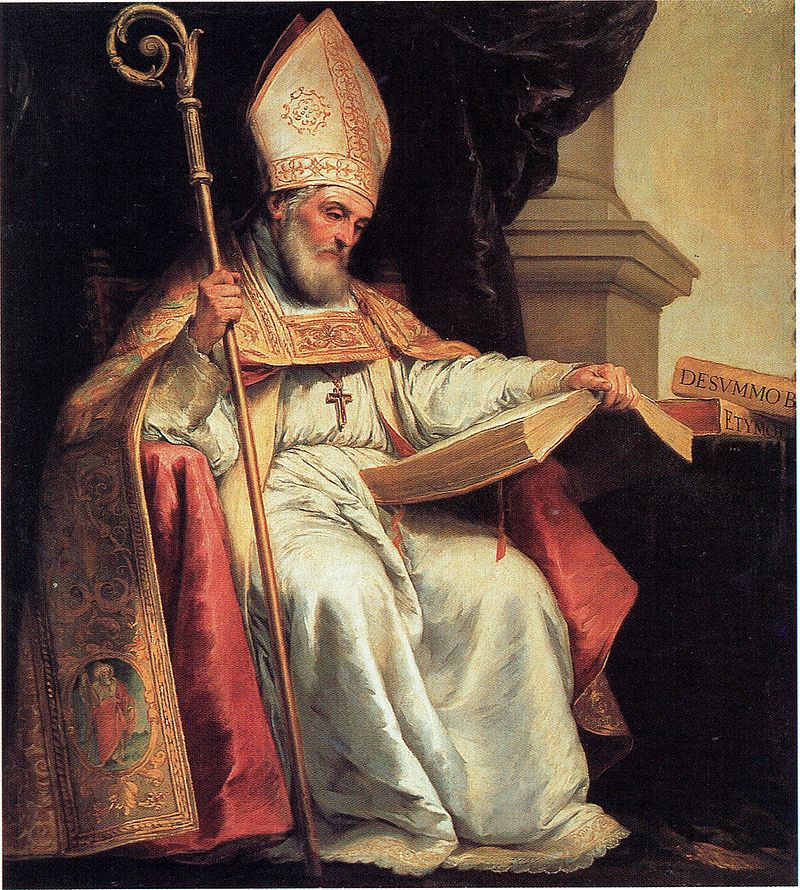
Today, April 4th, muted this year by Holy Saturday, is the commemoration of Saint Isidore of Seville (560-636) a bishop and doctor of the Church during a tumultuous age, when civilization was crumbling, coming apart at its very seams, which may sound sort of au courant. Then again, the form of this world has always[…]Continue reading→
Bishop Fulton Sheen’s 58th Good Friday Reflection
Incredible, at the beginning of this reflection, that the Venerable Bishop Sheen declares that he has given nearly 58 Good Friday reflections – this, as far as I can gather, was his final one, and he seems in full vigour in mind and body. The good bishop and evangelist died in his 84th year on[…]Continue reading→
A Minimal Friar and the Death of a Great Pope
This April the second- overshadowed by Holy Thursday this year – marks the memorial of Saint Francis of Paola (1417-1507), founder of the ‘Minim’ friars, so called for their humility and poverty, who interpreted the rule of Saint Francis of Assisi in quite a literal sense: extreme poverty, trust in God, foregoing all animal and[…]Continue reading→
Woven versus Seamless Garments
The reflection on the worthy project by Magie Dominic was intriguing, and I thought I would offer a brief follow-up commentary. The garment woven out of many pieces is a poignant symbol, even a ‘sacramental’, inspired by prayer and grace. We are all united in some way, and should strive for such unity, wherever we[…]Continue reading→
Bill C-9: Prelude to Persecution?
Well, it happened, as I suppose was inevitable, at least in a secular sense (from God’ perspective, there’s always hope). Bill C-9, the ironically named ‘Combatting Hate Act’ passed the House of Commons with a 186-137 vote. Look on the good side – there’s still over a hundred sane people in parliament who believe in[…]Continue reading→