
Pope Benedict’s Mariology
The new year begins with the Solemnity of Mary, the Mother of God, and, in 2023, with the departure of Pope Emeritus Benedict XVI. We might take this opportunity to appreciate some of his Mariological reflections.
For Benedict, Our Mother Mary is the exemplar of beauty, goodness and purity of heart. Her shining example inspires us to emulate her example to life this life joyfully. In his Angelus address of December 8, 2005 he said: Looking at Mary, how can we, her children, fail to let the aspiration to beauty, goodness and purity of heart be aroused in us? Her heavenly candour draws us to God, helping us to overcome the temptation to live a mediocre life composed of compromises with evil, and directs us decisively towards the authentic good that is the source of joy.
In the view of this Bavarian Pope, Mary is Our Mother precisely to help and support us, both individually and as a Church, to grow in holiness. In the Angelus address of December 8, 2009, Benedict observed: Dear friends, what an immense joy to have Mary Immaculate as our Mother! Every time we experience our frailty and the promptings of evil, we may turn to her and our hearts receive light and comfort. Even in the trials of life, in the storms that cause faith and hope to vacillate, let us recall that we are her children and that our existence is deeply rooted in the infinite grace of God. Although the Church is exposed to the negative influences of the world, she always finds in Mary the star to guide her so that she may follow the route pointed out to her by Christ.
Furthermore, Marian prayer, particularly the Holy Rosary, is a powerful and sure source for meditating with immense spiritual profit on the Bible through its holy mysteries. In his post-synodal apostolic exhortation on the Word of God in the life and mission of the Church, Verbum Domini, Pope Benedict XVI writes: Mindful of the inseparable bond between the word of God and Mary of Nazareth, along with the Synod Fathers I urge that Marian prayer be encouraged among the faithful, above all in life of families, since it is an aid to meditating on the holy mysteries found in the Scriptures. A most helpful aid, for example, is the individual or communal recitation of the Holy Rosary, which ponders the mysteries of Christ’s life in union with Mary, and which Pope John Paul II wished to enrich with the mysteries of light (Verbum Domini, 88).
According to the German Pontiff, Mary is our star of hope par excellence. In his encyclical on Christian hope, Spe Salvi, he makes the subsequent reflection: Who more than Mary could be a star of hope for us? With her “yes” she opened the door of our world to God himself; she became the living Ark of the Covenant, in whom God took flesh, became one of us, and pitched his tent among us (cf. Jn 1:14) (Spe Salvi, 49).
In his Mariology, Benedict sees Mary as the model of what it means to receive Jesus eucharistically. His post-synodal apostolic exhortation on the eucharist as the source and summit of the Church’s life and mission, Sacramentum Caritatis, states: Consequently, every time we approach the Body and Blood of Christ in the eucharistic liturgy, we also turn to her who, by her complete fidelity, received Christ’s sacrifice for the whole Church. The Synod Fathers rightly declared that “Mary inaugurates the Church’s participation in the sacrifice of the Redeemer.” She is the Immaculata, who receives God’s gift unconditionally and is thus associated with his work of salvation. Mary of Nazareth, icon of the nascent Church, is the model for each of us, called to receive the gift that Jesus makes of himself in the Eucharist (Sacramentum Caritatis, 33).
Through her Assumption into Heaven, Mary shows us that God is the human person’s home and through Him the person is closer to other persons too. This beautiful Mariological reflection Pope Benedict developed in his homily of August 15, 2012: But now let us ask ourselves: how does the Assumption of Mary help our journey? The first answer is: in the Assumption we see that in God there is room for man, God himself is the house with many rooms of which Jesus speaks (cf. Jn 14:2); God is man’s home, in God there is God’s space. And Mary, by uniting herself, united to God, does not distance herself from us. She does not go to an unknown galaxy, but whoever approaches God comes closer, for God is close to us all; and Mary, united to God, shares in the presence of God, is so close to us, to each one of us.
Finally, Pope Benedict presented to us Mary’s faith as an act of believing, obeying, giving birth, trusting, following and passing on her same faith. In his apostolic letter “Motu Proprio Data, Porta Fidei (For the Indiction of the year of faith), he thus reasons: By faith, Mary accepted the Angel’s word and believed the message that she was to become the Mother of God in the obedience of her devotion (cf. Lk 1:38). Visiting Elizabeth, she raised her hymn of praise to the Most High for the marvels he worked in those who trust him (cf. Lk 1:46-55). With joy and trepidation she gave birth to her only son, keeping her virginity intact (cf. Lk 2:6-7). Trusting in Joseph, her husband, she took Jesus to Egypt to save him from Herod’s persecution (cf. Mt 2:13-15). With the same faith, she followed the Lord in his preaching and remained with him all the way to Golgotha (cf. Jn 19:25-27). By faith, Mary tasted the fruits of Jesus’ resurrection, and treasuring every memory in her heart (cf. Lk 2:19, 51), she passed them on to the Twelve assembled with her in the Upper Room to receive the Holy Spirit (cf. Acts 1:14; 2:1-4) (Porta Fidei, 13).
Pope Benedict faithfully loved the Lord Jesus and took Our Mother into his spiritual home. He let himself be fashioned into Christ by her outstanding holy example. We are more than right if we ask for his intercession to help us love Jesus and Mother Mary as he marvelously did.
A Closed, Unsustainable, Descending Loop
As a follow-up to my thoughts on Payette’s payout, here be a stark image of where are here in Canada. As the graph shows in, well, graphic terms, since 2025, the public sector has contributed to 95.5% of economic growth. The private sector – which funds the public sector, or is supposed to – has[…]Continue reading→
Presidential Pardon of Weronika Krawczyk
As a good news, follow-up to our story from Poland, of the persecution of Weronika Krawczyk for her pro-life views, we heard that she has been granted a presidential pardon. One might still wonder why one needs a presidential pardon for simply holding the long-held belief that the child within the womb is a child,[…]Continue reading→
Pope Leo and a Rosary for Peace
Pope Leo XIV has asked Catholics across the world to join him in a Rosary for peace today, at 18:00 Rome time (6 pm), which would be noon from where I write (EST). If you are able, whether at that time or another, and in whatever way you pray, to join in intercession with the[…]Continue reading→
Payette’s Payout
I was glancing through some headlines, and noticed a mention of Julie Payette – engineer and astronaut and sometime the Queen’s representative in Canada – which brought back vague memories. She was appointed Governor-General by Justin Trudeau in 2017. Ms. Payette resigned in 2021, amidst claims that she created a ‘toxic work environment’, with allegations[…]Continue reading→
Weronika Krawczyk and Injustice in Poland
Catholic Action in Poland has issued a formal statement appealing to the President of the Republic of Poland to pardon Weronika Krawczyk—convicted for warning other women against an abortion-performing gynaecologist. Catholic Action (AK) emphasizes that no apology is owed to a doctor who has performed numerous abortions and proposed others; furthermore, the organization considers the[…]Continue reading→
Saint Isidore of Seville, the Internet and Industriousness
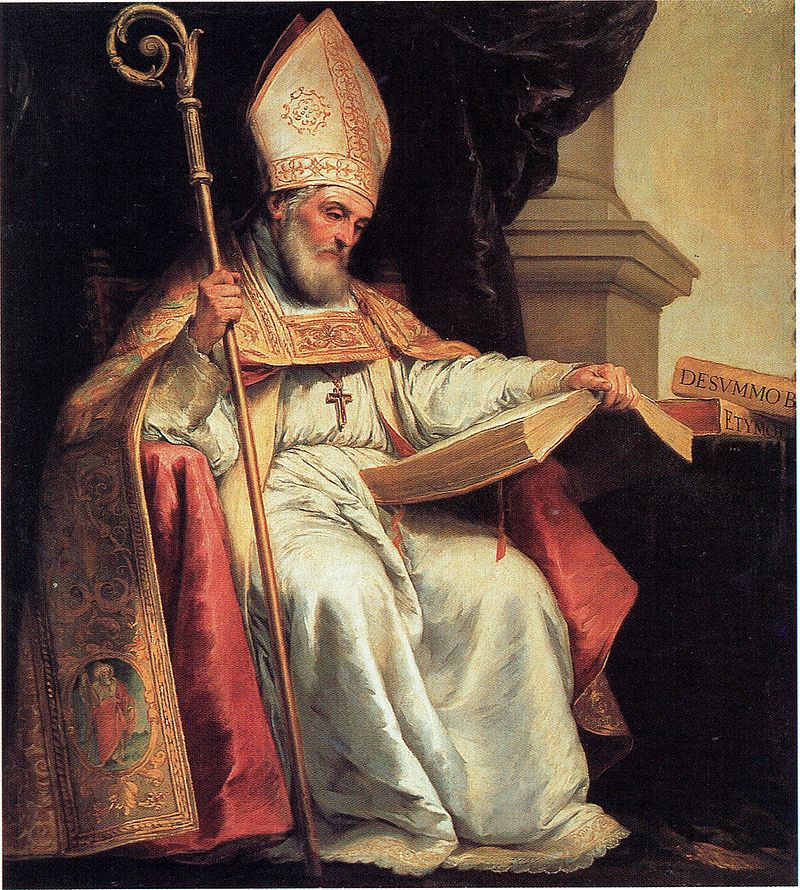
Today, April 4th, muted this year by Holy Saturday, is the commemoration of Saint Isidore of Seville (560-636) a bishop and doctor of the Church during a tumultuous age, when civilization was crumbling, coming apart at its very seams, which may sound sort of au courant. Then again, the form of this world has always[…]Continue reading→
Bishop Fulton Sheen’s 58th Good Friday Reflection
Incredible, at the beginning of this reflection, that the Venerable Bishop Sheen declares that he has given nearly 58 Good Friday reflections – this, as far as I can gather, was his final one, and he seems in full vigour in mind and body. The good bishop and evangelist died in his 84th year on[…]Continue reading→
A Minimal Friar and the Death of a Great Pope
This April the second- overshadowed by Holy Thursday this year – marks the memorial of Saint Francis of Paola (1417-1507), founder of the ‘Minim’ friars, so called for their humility and poverty, who interpreted the rule of Saint Francis of Assisi in quite a literal sense: extreme poverty, trust in God, foregoing all animal and[…]Continue reading→
Woven versus Seamless Garments
The reflection on the worthy project by Magie Dominic was intriguing, and I thought I would offer a brief follow-up commentary. The garment woven out of many pieces is a poignant symbol, even a ‘sacramental’, inspired by prayer and grace. We are all united in some way, and should strive for such unity, wherever we[…]Continue reading→
Bill C-9: Prelude to Persecution?
Well, it happened, as I suppose was inevitable, at least in a secular sense (from God’ perspective, there’s always hope). Bill C-9, the ironically named ‘Combatting Hate Act’ passed the House of Commons with a 186-137 vote. Look on the good side – there’s still over a hundred sane people in parliament who believe in[…]Continue reading→