
Beauty and the Beast-ly
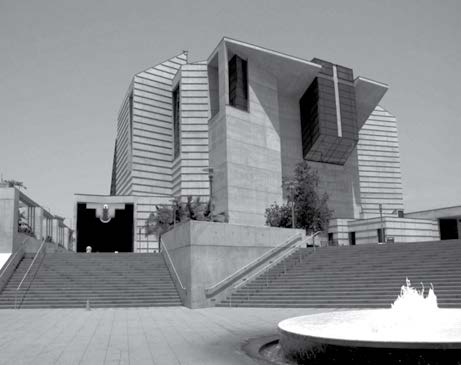
The author asks, Why is Everything So Ugly?, and his answer is an intriguing reflection on the lack of beauty in modern New York. It’s a question we all may have pondered in our perambulations through any number of our modern urban landscape: The shoddiness and crassness of buildings of all sorts, endless homogeneous box stores, and hastily-put-up pre-fab condos, creeping even into once-beautiful and ancient cities and villages in Europe, all of which places a pall over our daily existence, that, like smog, we soon stop noticing, even if its deleterious effects continue. That is, until it is pointed out, and we say, oh, yeah, why is everything so ugly, if not outright repulsive, from music, to movies, to monuments?
The short answer I would offer, which the aforementioned author does not, is that we as a society have lost our Faith, and the sight of God that goes with it. God is not only the ‘most beautiful’ and the ‘source of all beauty’, so it should not surprise us that the further we go from Him, the more ugly things will get.
This is why Saint Thomas describes beauty in his treatise on God, in the Prima Pars of his Summa, question 16. Therein, he distinguishes three hallmarks or criteria that make something beautiful:
Integrity – it must have all of its requisite parts, with nothing necessary missing. One of the humiliating punishments in the Byzantine empire was to slice off someone’s nose, which does indeed spite their face.
Proportion – all of these must fit together well, with none being out of order, too big, too small, the wrong colour, and so on.
And, finally there is clarity, sometimes termed honestas, wherein the interior form or essence of a thing shines forth, with what it is meant to be. The beauty of a woman is not the same as a man, a fact which bears repeating in our confused age; nor is that of, say, a church, the same as a house, or a barn; a swallow, a butterfly and a bison each show forth something of God wonderful creative disposition, as do a scintillating lake, a prairie bedecked with wheat and a snow-capped mountain.
Every natural thing – which is to say, everything created by God – is beautiful, even those we in our own human sensibilities might consider not so. The face of a dung beetle is quite becoming to other dung beetles. All fulfil the three-fold criteria for perfection, and scientists still marvel at the remarkable harmony and symmetry in creation, right down to the subatomic level.
But thou hast arranged all things by measure and number and weight. (Wisdom 11:21)
It is when we turn to the artificial – that is, man-made – that things take a turn for the worse. They need not, of course, for Man in his various arts may follow his Maker, and produce works of great beauty; the history of art is rich with such, and, dare I say, even some modern art may be so described. Should the artist, however, deviate from God’s work, and strive to produce something totally, absolutely ‘new’, to make a ‘statement’, to impress, and only his, personality on the work – in other words, to try to make himself creator – said artist not only devolves into the insipid, but often the downright demonic. Such is the inexorable path without God. It’s Him or Mammon, Christ or the devil – cosmos or chaos.
As Tolkien put it in his own take On Fairy Tales, we can only be sub-creators, fashioning and following God’s creation, but always within limits: moral ones, of course, but also according to the order that the Maker has woven into His own works. That is why past ages of Faith produced far more beautiful art than we who are living through the loss of that Faith. Compare a mediaeval cathedral – even a sacred building of your grandparents’ generation – to your average local parish church, and the contrast is clear. Devolution and entropy have set in, and we have lost the art of art. There is a reason people covet century homes, rather than one of the swathes of little boxes bashed together last year by lackadaisical workmen, all made out of ticky-tacky.
One might retort: What of the ancient pagans, the Romans and Greeks? The pantheon and palaces, whose very ruins evoke their initial majesty and splendour? As Belloc and others have put it, those civilizations did have faith of a sort, in a limited and propaedeutic sense, and were striving towards the ‘unknown god’ evoked by Saint Paul, moving towards the fullness of revelation. Modern neo-paganism, on the other hand, is going backwards, like an old man trying to rediscover his youth; it’s fake and forced, with a thinly disguised, perhaps even blatant, atheism. Without any transcendent vision, it descends into utilitarianism, functionalism, brutalism, and, ultimately, nihilism. How could anything not ugly come out of this, which will only get worse as we as a society drift further from the Faith, not just neglecting God’s salvific truth, but outright hating it and those who profess it?
Beauty will save the world, wrote Dostoyevsky, but what he really said, or so I have heard, was beauty suffering. Whether this happens by the baneful effects of original sin – ageing, suffering, death, all the scars of our toils here in this vale of tears – or by the demonically inspired, who seek only to destroy, not build – matters not that much. A new wave of iconoclasm has been unleashed upon the world. They have begun with beautiful art and the ‘beautiful truths’ of our salvation; they will soon turn to those made ‘like God’, their fellow humans, whom the devil despises, and may make martyrs of many of us yet.
But we should not lose hope. What matters is that the beauty of this world is of a transient sort, and the form of this world – all of its splendour – is passing away. We all must die, like seeds sown in the earth, so that we may rise again with Christ. Our bodies, and all this world, will be re-fashioned in the new heavens and new earth, whose glory we can scarcely begin to imagine. We should all be quite looking forward to it. Maran tha, Lord Jesus, which sounds a bit like a marathon, and, on that note, run the race, and fight the good fight to the end.
Behold, I make all things new +

Carney’s Amoral Majority
After five defections – euphemistically described as ‘crossing the floor’ – and three by-elections, Mark Carney and his Liberals how have their coveted majority. One wonders what bowls of pottage were offered in back-room deals. In the archaic monarchical system that is the Dominion of Canada, this majority allows the newly-minted Prime Minister to rule[…]Continue reading→
A Closed, Unsustainable, Descending Loop
As a follow-up to my thoughts on Payette’s payout, here be a stark image of where are here in Canada. As the graph shows in, well, graphic terms, since 2025, the public sector has contributed to 95.5% of economic growth. The private sector – which funds the public sector, or is supposed to – has[…]Continue reading→

Remembering Father Alphonse de Valk
(Today marks the sixth anniversary of the death of Father Alphonse de Valk, C.S.B., a faithful, courageous and indefatigable Basilian priest, pro-life-and-family apostle, and the founder of Catholic Insight magazine. Here is what we wrote those on his entering into eternity five years ago, as we continue to remember him in our prayers and thoughts)[…]Continue reading→

A Tale of Two Benedicts
A grace-filled Holy Week to all our readers! As we await and prepare for the Resurrection about to dawn upon us, we might keep in mind two Benedicts: Pope Emeritus Benedict XVI, requiescat in pace, elected on this day in 2005; and today’s commemoration of the mystic pilgrim, Benedict Joseph Labre, who died on this[…]Continue reading→
Presidential Pardon of Weronika Krawczyk
As a good news, follow-up to our story from Poland, of the persecution of Weronika Krawczyk for her pro-life views, we heard that she has been granted a presidential pardon. One might still wonder why one needs a presidential pardon for simply holding the long-held belief that the child within the womb is a child,[…]Continue reading→

Saint Lydwina of Schiedam and Suffering Joyfully
Saint Lydwina of Schiedam (1380 – 1433) was one of the countless and glorious ‘victim souls’ in the history of the Church, those whose lives are filled with suffering, often of an unimaginable intensity, but who suffer joyfully. She was a fifteen-year old Dutch girl, out skating one day, when she fell and broke one[…]Continue reading→

The Glorious Martyrdoms of Martin and Maximus
As we enter into Eastertide, we recall on this 13th of April Pope Saint Martin I (+655), one of the noblest, if most tragic, of the successors of Saint Peter. Born in Umbria, Italy, he was of noble lineage, with great intelligence combined with charity and love of the poor and the Church. While still[…]Continue reading→
Pope Leo and a Rosary for Peace
Pope Leo XIV has asked Catholics across the world to join him in a Rosary for peace today, at 18:00 Rome time (6 pm), which would be noon from where I write (EST). If you are able, whether at that time or another, and in whatever way you pray, to join in intercession with the[…]Continue reading→
Payette’s Payout
I was glancing through some headlines, and noticed a mention of Julie Payette – engineer and astronaut and sometime the Queen’s representative in Canada – which brought back vague memories. She was appointed Governor-General by Justin Trudeau in 2017. Ms. Payette resigned in 2021, amidst claims that she created a ‘toxic work environment’, with allegations[…]Continue reading→

Saint Stanislaus of Szczepanów
We celebrate Saint Stanislaus today (+ April 11, 1079), in light of this Easter Octave, a bishop and martyr who accepted the episcopacy only at the direct order of Pope Alexander II. He proved a wise and courageous leader of his flock, put to death by his own king, Boleslaus, for rebuking the monarch’s ‘immoral[…]Continue reading→