
All Souls Day In Light of the Liturgy of the Hours
The Liturgy of the hours is a great source of spiritual formation and teaching. Pope Saint John Paul II dedicated entire catecheses on the psalms and canticles of the Office. This he did to encourage and help all to pray with the same words used by Jesus, which have been present for thousands of years in the prayer of Israel and of the Church.
In today’s solemn celebration which commemorates the Faithful Departed we notice doctrines which are intimately attached to this celebration, some aspects of which we may mention. To begin with, in the All Souls celebration we come to realise our true origin as people. In the first stanza of the hymn of the Office of Readings we pray: Almighty Father, from earth’s clay/ You fashioned all mankind; Endowed with sense each human heart,/ Its destined bliss to find. We must never lose sight of our origins, from the earth’s clay. In that way we live our lives humbly by depending, in everything, on the One who fashioned us, who created and saved us.
All Souls’ celebration is also a powerful reminder to us of God’s unfathomable goodness. His response to our sin was the sending of his Son to save us. What an awesome answer to Adam’s eating of the fatal fruit. Thus, we pray: When Adam ate the fatal fruit,/Your boundless love revealed/ A yet more lavish gift whereby/ His fate might be repealed. Your only Son should hang for us,/ Thorn-crowned upon a tree;/ To gather us like ripened fruit,/ Our endless bliss to be.
In the first antiphon of the Office of Readings we glean the hope that the Lord raises us up on the last day. The text says: You made me from the clay of the earth; you gave me a body of flesh. Lord, raise me up on the last day. Already, the fact that we are made of clay shows our weakness. That is why, in the antiphon prior to the second psalm of the Office of Readings, we pray to the Lord to come to help us. It says: O Lord, come to my rescue, Lord, come to my aid.
The third antiphon of the Office of Readings, which is connected with Psalm 41, literally speaks about this longing for the psalmist to be in the Lord’s temple to see his face. But, spiritually and ecclesially, it can also be interpreted as the soul’s thirst to be united with God eternally in the Heavenly glory. The text says: My soul is thirsting for the God of my life: when can I enter and see the face of God?
As we move along and enter into the first reading from the Office of Readings, from the First Letter to the Corinthians, we encounter a very important point: if Christ was not raised from the dead we shall be perishing with Him. Thus St Paul puts it:
Now if Christ raised from the dead is what has been preached, how can some of you be saying that there is no resurrection of the dead? If there is no resurrection of the dead, Christ himself cannot have been raised, and if Christ has not been raised then our preaching is useless and your believing it is useless; indeed, we are shown up as witnesses who have committed perjury before God, because we swore in evidence before God that he had raised Christ to life. For if the dead are not raised, Christ has not been raised, and if Christ has not been raised, you are still in your sins. And what is more serious, all who have died in Christ have perished. If our hope in Christ has been for this life only, we are the most unfortunate of all people.
On the other hand, Christ has been indeed risen from the dead, which means that we all shall be raised up. Christ is the very opposite of Adam. Through the latter came death but through Christ, the New Adam, resurrection as life in abundance has come to us. Moreover, by his resurrection Christ subjected death to his authority and dominion. Thus writes St Paul:
But Christ has in fact been raised from the dead, the first-fruits of all who have fallen asleep. Death came through one man and in the same way the resurrection of the dead has come through one man. Just as all men die in Adam, so all men will be brought to life in Christ; but all of them in their proper order: Christ as the first-fruits and then, after the coming of Christ, those who belong to him. After that will come the end, when he hands over the kingdom to God the Father, having done away with every sovereignty, authority and power. For he must be king until he has put all his enemies under his feet and the last of the enemies to be destroyed is death, for everything is to be put under his feet. – Though when it is said that everything is subjected, this clearly cannot include the One who subjected everything to him. And when everything is subjected to him, then the Son himself will be subject in his turn to the One who subjected all things to him, so that God may be all in all.
In the second reading, taken from St Ambrose’s book on the death of his brother Satyrus, we come to realise that if we die with Christ we live with Christ. But how in Christ’s death are we to find our life? St Ambrose writes:
What more need be said? It was by the death of one man that the world was redeemed. Christ did not need to die if he did not want to, but he did not look on death as something to be despised, something to be avoided, and he could have found no better means to save us than by dying. Thus his death is life for all. We are sealed with the sign of his death; when we pray we preach his death; when we offer sacrifice we proclaim his death. His death is victory; his death is a sacred sign; each year his death is celebrated with solemnity by the whole world.
In Christ’s death we find the reason for our hope to live eternally. Thanks to Christ’s salvific death for us, death now becomes a remedy to a fallen humanity. Christ’s death is the password for our eternal life with God. That is why St Ambrose says:
Death was not part of nature; it became part of nature. God did not decree death from the beginning; he prescribed it as a remedy. Human life was condemned because of sin to unremitting labour and unbearable sorrow and so began to experience the burden of wretchedness. There had to be a limit to its evils; death had to restore what life had forfeited. Without the assistance of grace, immortality is more of a burden than a blessing.
Let us then turn our gaze to Heavenly Jerusalem. Let our existence be entirely oriented towards it. Again, St Ambrose reminds us:
The soul has to turn away from the aimless paths of this life, from the defilement of an earthly body; it must reach out to those assemblies in heaven (though it is given only to the saints to be admitted to them) to sing the praises of God. We learn from Scripture how God’s praise is sung to the music of the harp: Great and wonderful are your deeds, Lord God Almighty; just and true are your ways, King of the nations. Who will not revere and glorify your nature? You alone are holy; all nations will come and worship before you. The soul must also desire to witness your nuptials, Jesus, and to see your bride escorted from earthly to heavenly realities, as all rejoice and sing: All flesh will come before you. No longer will the bride be held in subjection to this passing world but will be made one with the spirit.
Grant, Lord, we pray that as our faith is built on the Risen Christ, so too our hope may be steadfast as we await the resurrection of all the faithful departed. Through our Lord Jesus Christ, your Son, who lives and reigns with you in the unity of the Holy Spirit, God, for ever and ever.
A Closed, Unsustainable, Descending Loop
As a follow-up to my thoughts on Payette’s payout, here be a stark image of where are here in Canada. As the graph shows in, well, graphic terms, since 2025, the public sector has contributed to 95.5% of economic growth. The private sector – which funds the public sector, or is supposed to – has[…]Continue reading→
Presidential Pardon of Weronika Krawczyk
As a good news, follow-up to our story from Poland, of the persecution of Weronika Krawczyk for her pro-life views, we heard that she has been granted a presidential pardon. One might still wonder why one needs a presidential pardon for simply holding the long-held belief that the child within the womb is a child,[…]Continue reading→
Pope Leo and a Rosary for Peace
Pope Leo XIV has asked Catholics across the world to join him in a Rosary for peace today, at 18:00 Rome time (6 pm), which would be noon from where I write (EST). If you are able, whether at that time or another, and in whatever way you pray, to join in intercession with the[…]Continue reading→
Payette’s Payout
I was glancing through some headlines, and noticed a mention of Julie Payette – engineer and astronaut and sometime the Queen’s representative in Canada – which brought back vague memories. She was appointed Governor-General by Justin Trudeau in 2017. Ms. Payette resigned in 2021, amidst claims that she created a ‘toxic work environment’, with allegations[…]Continue reading→
Weronika Krawczyk and Injustice in Poland
Catholic Action in Poland has issued a formal statement appealing to the President of the Republic of Poland to pardon Weronika Krawczyk—convicted for warning other women against an abortion-performing gynaecologist. Catholic Action (AK) emphasizes that no apology is owed to a doctor who has performed numerous abortions and proposed others; furthermore, the organization considers the[…]Continue reading→
Saint Isidore of Seville, the Internet and Industriousness
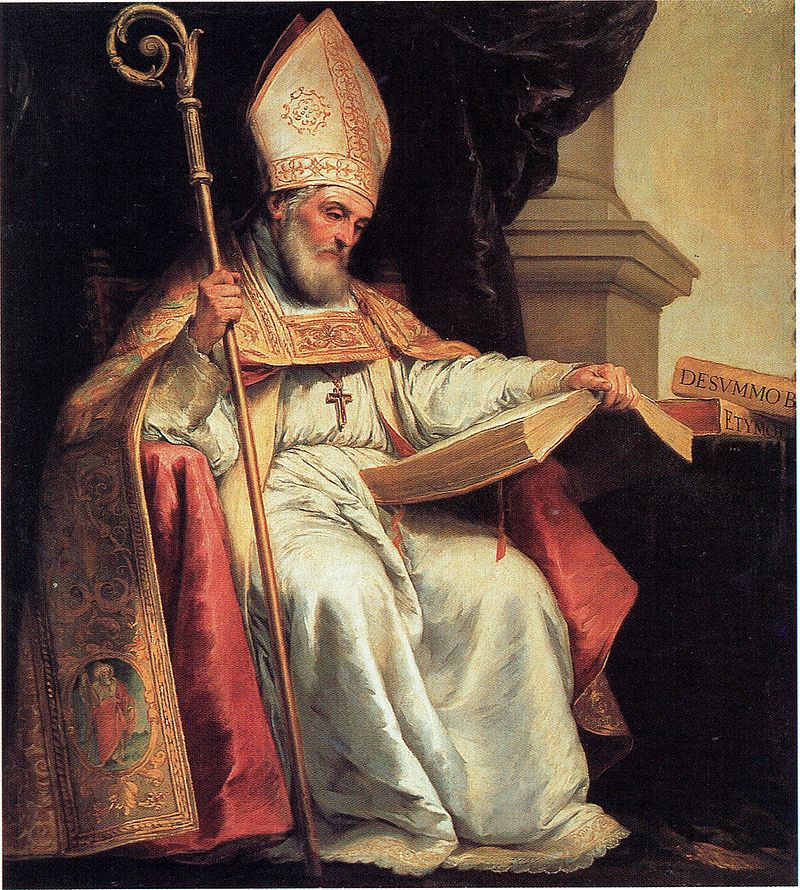
Today, April 4th, muted this year by Holy Saturday, is the commemoration of Saint Isidore of Seville (560-636) a bishop and doctor of the Church during a tumultuous age, when civilization was crumbling, coming apart at its very seams, which may sound sort of au courant. Then again, the form of this world has always[…]Continue reading→
Bishop Fulton Sheen’s 58th Good Friday Reflection
Incredible, at the beginning of this reflection, that the Venerable Bishop Sheen declares that he has given nearly 58 Good Friday reflections – this, as far as I can gather, was his final one, and he seems in full vigour in mind and body. The good bishop and evangelist died in his 84th year on[…]Continue reading→
A Minimal Friar and the Death of a Great Pope
This April the second- overshadowed by Holy Thursday this year – marks the memorial of Saint Francis of Paola (1417-1507), founder of the ‘Minim’ friars, so called for their humility and poverty, who interpreted the rule of Saint Francis of Assisi in quite a literal sense: extreme poverty, trust in God, foregoing all animal and[…]Continue reading→
Woven versus Seamless Garments
The reflection on the worthy project by Magie Dominic was intriguing, and I thought I would offer a brief follow-up commentary. The garment woven out of many pieces is a poignant symbol, even a ‘sacramental’, inspired by prayer and grace. We are all united in some way, and should strive for such unity, wherever we[…]Continue reading→
Bill C-9: Prelude to Persecution?
Well, it happened, as I suppose was inevitable, at least in a secular sense (from God’ perspective, there’s always hope). Bill C-9, the ironically named ‘Combatting Hate Act’ passed the House of Commons with a 186-137 vote. Look on the good side – there’s still over a hundred sane people in parliament who believe in[…]Continue reading→