
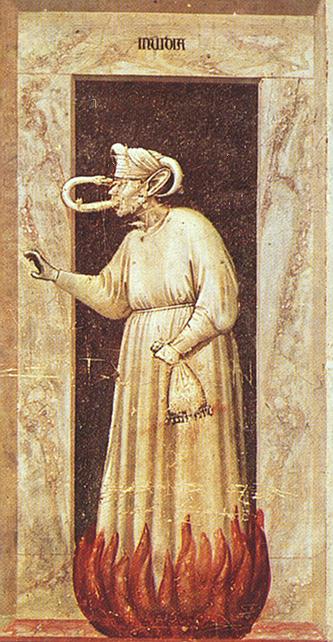
Banishing Envy
The final words of today’s second reading, from Saint Paul’s letter to the Colossians, like their parallel in Galatians, are much resorted today:
Here there cannot be Greek and Jew, circumcised and uncircumcised, barbarian, Scythian, slave, free man, but Christ is all, and in all.[1]
There is neither Jew nor Greek, there is neither slave nor free, there is neither male nor female; for you are all one in Christ Jesus.[2]
Why are these passages so popular? Is it because we are virtuous, unprejudiced people whose lives are completely governed by the Gospel? I hope so; but there could be another, less flattering reason. Dorothy Sayers, in her commentary on Dante’s Divine Comedy, accounted for our liking these texts. She said, we like them because of a perverted understanding of democracy prevalent among people today. She made the point indirectly by saying that the second level of Purgatory is crowded with souls expiating the besetting sin of our generation. And what sin, you may ask, is being punished there? (There are so many possibilities!) One might have though it would be greed or, perhaps, lust, but she identifies it as envy. Her view of envy as a great evil is confirmed by some strong biblical texts:
- Then I saw that all toil and all skill in work come from a man’s envy of his neighbour. This also is vanity and a striving after wind.[3]
- Through the devil’s envy death entered the world, and those who belong to his party experience it.[4]
- Now the works of the flesh are plain: fornication, impurity, licentiousness, idolatry, sorcery, enmity, strife, jealousy, anger, selfishness, dissension, party spirit, envy, drunkenness, carousing, and the like.[5]
- When they had gathered, Pilate said to them, “Whom do you want me to release for you, Barabbas or Jesus who is called Christ?” For he knew that it was out of envy that they had delivered him up.[6]
Envy, a characteristic of our society, is an unpleasant by-product of democracy—and if there is one thing Canadians pride themselves on it’s being democratic. For the fact is that democracy can encourage a small-mindedness, as we see in the following statements that are typical of an envious person:
“Who does he think he is?”
“He’s no better than anyone else.”
“Anybody could do that.”
As a consequence, there is, generally speaking, a denial of order in society, of any notion of a hierarchy: there is no head of a family; there is no leader—civil or ecclesiastical—who cannot be readily criticized. The visit of Pope Francis to Canada vividly demonstrates that fact. Nothing that he said or did, or could say or do, would be enough to satisfy his—and our—critics.
What precisely is envy? It is “a feeling of sadness or grief at another’s possessing something good, something worth having.”[7] The envious person wishes to see the object of his envy loose that good quality or possession. Hence, merely admiring someone’s talent or wishing one had its equal is not envy. “I wish I could play the piano like him,” or “I’m going to start training to win the marathon next year” are not sins of envy because they are not based on depriving the other of his accomplishment. Ultimately, envy is foolish as well as sinful: “. . . envy does not associate with wisdom.”[8] Consider the rich man in today’s Gospel, with all his barns. Our Lord called him a fool. Why would anyone envy him?
What, then, did Saint Paul mean in today’s scriptural passage, which seemingly obliterates all distinction? It’s a way of recognizing that, although we have manifold and differing gifts, they have all the same source: the Spirit that come to us through the saving work of Jesus Christ.
- Now there are varieties of gifts, but the same Spirit; and there are varieties of service, but the same Lord; and there are varieties of working, but it is the same God who inspires them all in every one.[9]
- Let us have no self-conceit, no provoking of one another, no envy of one another.[10]
All of our virtuous actions, different as they may be, arise out of charity, the love for God and from God. The true and faithful follower of Jesus rejoices in the accomplishments of his fellow Christians and, indeed, of any virtuous act: “charity envieth not.”[11] Hence there is an underlying unity in the love of God, which makes our differing gifts pleasing to him, but also pleasing to one another. “The fruit of the Spirit is love, joy, peace, patience, kindness, goodness, fidelity, gentleness, self-control.”[12] These are the gifts of the Holy Spirit that will deliver us from destructive and hateful envy.
[1] Col 3.11.
[2] Gal 3.28.
[3] Eccles 4.4.
[4] Wis 2.24
[5] Gal 5.19-21
[6] Matt 27.17-18.
[7] Saint Thomas Aquinas, Summa theologiae, IIaIIae.36.1. I.
[8] Wis 6.23.
[9] 1 Cor 12.4-6; a trinitarian passage.
[10] Gal 5.26.
[11] 1Cor 13.4.
[12] Gal 5.22-23.

Saint Kateri , Canada’s Protectress
This was the title given to Saint Kateri Tekakwitha, by Pope Benedict XVI, when he canonized her on October 28th, 2012, along with six others, in Saint Peter’ Square (she had been beatified by Pope John Paul II back in 1980). With Saint Joseph as our protector, along with the Canadian martyrs, we seem to[…]Continue reading→

Remembering Father Alphonse de Valk
(Today marks the sixth anniversary of the death of Father Alphonse de Valk, C.S.B., a faithful, courageous and indefatigable Basilian priest, pro-life-and-family apostle, and the founder of Catholic Insight magazine. Here is what we wrote those on his entering into eternity five years ago, as we continue to remember him in our prayers and thoughts)[…]Continue reading→

My Name is Bernadette
April 16th is a propitious day, for besides the anniversary of Father de Valk’s death, who founded Catholic Insight in its print form decades ago, and the commemoration of the ‘two Benedicts’, mentioned in accompanying posts, today we also recall Saint Bernadette Soubirous, the young visionary to whom the Virgin Mary appeared numerous times at[…]Continue reading→

Canonizing Sister Faustina and Divine Mercy
HOMILY OF THE HOLY FATHER MASS IN ST PETER’S SQUARE FOR THE CANONIZATION OF SR MARY FAUSTINA KOWALSKA Sunday, 30 April 2000 1. “Confitemini Domino quoniam bonus, quoniam in saeculum misericordia eius”; “Give thanks to the Lord for he is good; his steadfast love endures for ever” (Ps 118: 1). So the Church sings on the Octave of[…]Continue reading→

Divine Mercy Sunday – An Echo of Every Mass
Reach out your hand and put it in my side. Do not doubt but believe’… ‘My Lord and my God!’ (Jn. 20:18)). Today is Divine Mercy Sunday, and as we celebrate the end of the Easter Octave, we contemplate the wounded side of our Saviour, the Church’s source of life. On Good Friday in the[…]Continue reading→

Saint Stanislaus of Szczepanów
We celebrate Saint Stanislaus today (+ April 11, 1079), in light of this Easter Octave, a bishop and martyr who accepted the episcopacy only at the direct order of Pope Alexander II. He proved a wise and courageous leader of his flock, put to death by his own king, Boleslaus, for rebuking the monarch’s ‘immoral[…]Continue reading→

First Holy Communion: Sermon from May 16, 1943
Here is a sermon from the good old days by +Rev. Msgr. Vincent Nicholas Foy (August 14, 1915 – March 13, 2017), from 1943. Readers may recall that Pope Saint Pius X, by the decree Quam Singulari in 1910, lowered the customary age of reception of Holy Communion – after the rigours of the plague[…]Continue reading→

In the Glorious Light of Easter, Alleluia!
Set your minds on things that are above, not on things that are on earth, for you have died, and your life is hidden with Christ in God. When Christ who is your life is revealed, then you also will be revealed with him in glory (Col. 3:3-4). The Resurrection of Our Lord and Saviour[…]Continue reading→

An Ancient Homily for Holy Saturday
The time between Good Friday and Easter Sunday is one of waiting, in silence, as the world wonders – anticipates – what will happen, after the death of Christ. We re-live this time each year in the anamnesis of our liturgy, and in turn look forward to the glorious re-creation of all things at the[…]Continue reading→

Europe’s Long Descent
(As we meditate on this day on Christ’s burial, and His descent into hell, it is fitting to ponder here with contributor Peter Marcus how the world seems to be heading there as well. The difference is that, although God cannot ‘redeem’ hell, nor those therein, He can and did redeem the world. There is[…]Continue reading→