
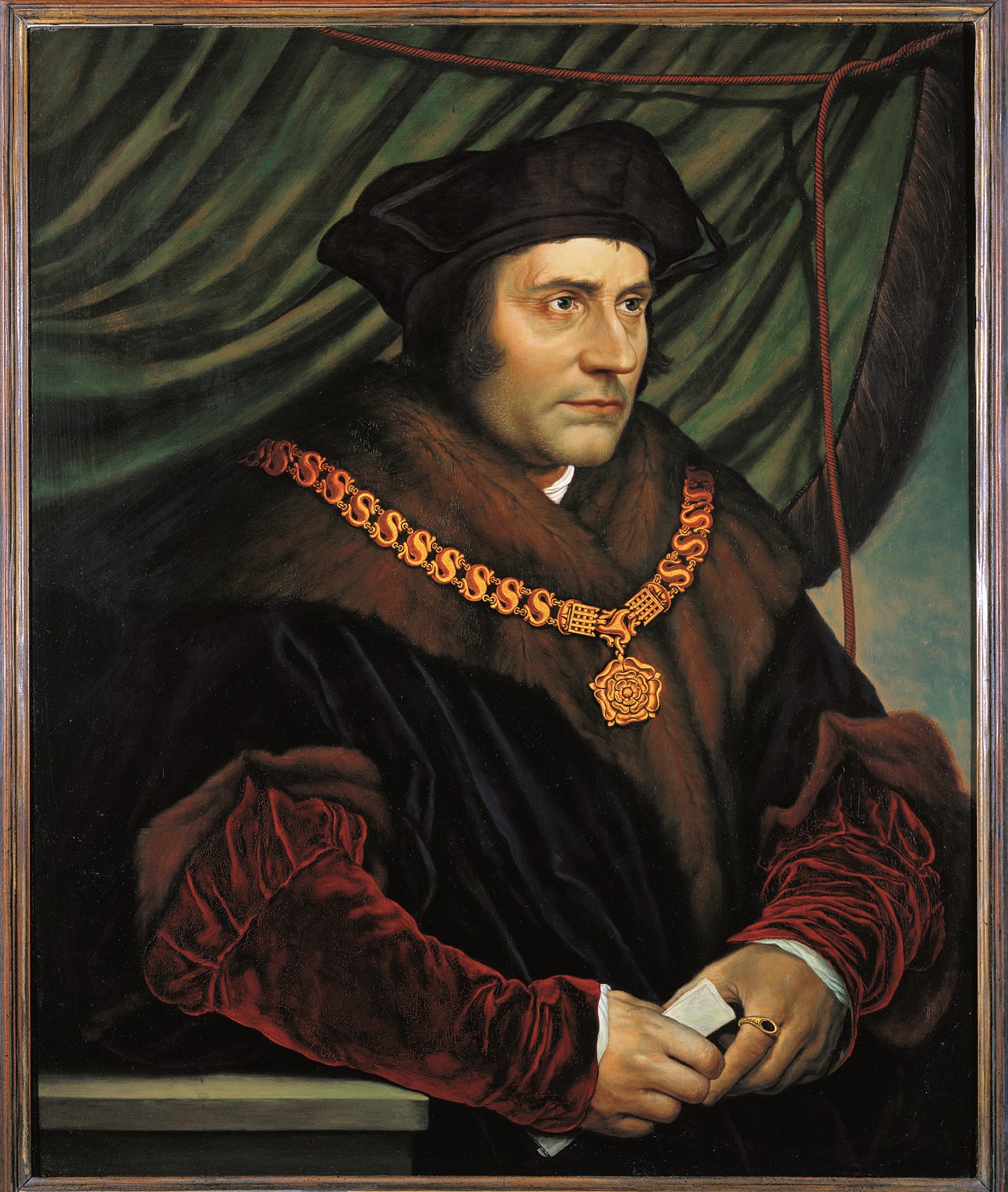
Thomas More’s Option: Soul First, Then the Body
“If thou wilt be perfect, go sell what thou hast, and give to the poor, and thou shalt have treasure in heaven” (Mt.19:21).
Have I sold everything I possess? Or, on the other hand, have I opted to “sell” only spiritually? There is a difficulty in answering this particular call, though I believe that it is an answer to the perennial human question: how can we escape this earthly finitude—or in other words, “what good shall I do that I may have life everlasting?” (Mt. 19:16), so asks the young man to Christ. Yet, how must we interpret Christ’s answer? Here, I will turn to the life and teaching of St. Thomas More to reflect on how we must feed this human desire for eternity.
Thomas More is a particularly relevant saint. He is a man, a fervent worker of this earth, and an unwavering seeker of Heaven. He is not a man who attains sainthood through isolation from the world, nor was he a devotee of the world in the expense of his sanctity. Analogically, there are two ways to take Christ’s call, “go sell what thou hast.” First, one may in the literal sense sell everything that one owns, like Sts. Benedict and Francis, or like Buddhist asceticism at the extreme. On the other hand, one may take it strictly in its spiritual sense: Christ only asks the young man to surrender his spiritual devotion to God, not all of his material possessions.
In which camp does Thomas More fall? Neither, it seems to me, and I will turn to his works to explore the saint’s ethics. More wrote an unfinished treatise on the Scripture passage which writes “remember the last things and thou shalt never sin” (Ecclus. 7). Here, he attempts to defend the literal meaning of this passage and thus argues that by remembering the “last things,” namely “death, doom, pain, and joy,” one will in fact cease to sin. In other words, the four last things form a shortcut to holiness. The rationale behind this claim is rooted in his understanding of holiness:
“And thus shalt thou well see that thou hast no cause to look upon thy death as a thing far off, but a thing undoubtedly nigh thee, and ever walking with thee. By which, not a false imagination but a very true contemplation, thou shalt … take occasion to flee vain pleasures of the flesh that keep out the very pleasures of the soul.”
One may object to this ethics: More seems to bifurcate body and soul, and thus worldly activities are shunned for the sake of spiritual contemplation of the last things. However, is this a true representation of More’s view? It is reasonable to always be cautious of the flesh, but to what extent must one renounce it?
Another lesser-known work, More’s The Life of Pico, sheds further light on his philosophy. Much of this book is, in fact, not More’s own writing, but rather his translation of letters and other’s biographies of Pico della Mirandola, an Italian Renaissance philosopher (a controversial one), into English. Yet, the most crucial aspect of this book is More’s extensive abridgement weaved in between his translation. One example is the warning of a friend concerning Pico’s reclusive devotion to study, which originally reads: “I don’t want you to embrace Martha to such an extent that you give up Mary entirely”—with Martha scripturally representing the active life, whereas Mary the contemplative. To this More adds (in italics): “It’s fine with me that you study, but I would have you engaged with the world around you as well. I don’t want you to embrace Martha to such an extent that you give up Mary entirely. Love them and do them both: study and worldly business.” Now, we hear More’s subtle voice: the “worldly business” needs not to be diametrically opposed to the “true contemplation.”
What, then, can we gather from More’s writings? First, he is ever critical of worldly affairs, and so too must we be, especially of those that “keep out the very pleasures of the soul.” Second, however, More does not shun the world unconditionally. He still loves and does both the contemplative and active lives. For More, worldly pleasures do not necessarily negate heavenly delights, but may be ordained thereto. In fact, contemplation or “pleasures of the soul” per se may be disoriented as they are in Pico’s “proud ambition.” In sum, by fixing our eyes at the last things, we must become not haters of the flesh, but rather its lovers—not for its own sake, but for the sake of heavenly life.
What good shall I do that I may have life everlasting? How must I sell everything I have? More has taught and exemplified through his life this principle: love both the spiritual and worldly lives, yet only insofar as they help us soar heavenward; sell everything that pulls us earthward. This “middle-way” ethics, nonetheless, does not contradict the lives of other saints, like St. Benedict, but rather presents to us yet another way to holiness. We may tend to think that the “Benedict Option” is the only shelter from the evils of the world. I have lived in a community of which More is the dear patron, and I am convinced that the life of St. Thomas More, embracing both “Martha” and “Mary,” serves as both a sword against the evils of the world, and a nod to Christ’s call to eternity. This I take to be the “More Option.”
S. Thomas More, ora pro nobis!
(This article first appeared in 2019, but perhaps more relevant than ever)

Saint Kateri , Canada’s Protectress
This was the title given to Saint Kateri Tekakwitha, by Pope Benedict XVI, when he canonized her on October 28th, 2012, along with six others, in Saint Peter’ Square (she had been beatified by Pope John Paul II back in 1980). With Saint Joseph as our protector, along with the Canadian martyrs, we seem to[…]Continue reading→

Remembering Father Alphonse de Valk
(Today marks the sixth anniversary of the death of Father Alphonse de Valk, C.S.B., a faithful, courageous and indefatigable Basilian priest, pro-life-and-family apostle, and the founder of Catholic Insight magazine. Here is what we wrote those on his entering into eternity five years ago, as we continue to remember him in our prayers and thoughts)[…]Continue reading→

My Name is Bernadette
April 16th is a propitious day, for besides the anniversary of Father de Valk’s death, who founded Catholic Insight in its print form decades ago, and the commemoration of the ‘two Benedicts’, mentioned in accompanying posts, today we also recall Saint Bernadette Soubirous, the young visionary to whom the Virgin Mary appeared numerous times at[…]Continue reading→

Canonizing Sister Faustina and Divine Mercy
HOMILY OF THE HOLY FATHER MASS IN ST PETER’S SQUARE FOR THE CANONIZATION OF SR MARY FAUSTINA KOWALSKA Sunday, 30 April 2000 1. “Confitemini Domino quoniam bonus, quoniam in saeculum misericordia eius”; “Give thanks to the Lord for he is good; his steadfast love endures for ever” (Ps 118: 1). So the Church sings on the Octave of[…]Continue reading→

Divine Mercy Sunday – An Echo of Every Mass
Reach out your hand and put it in my side. Do not doubt but believe’… ‘My Lord and my God!’ (Jn. 20:18)). Today is Divine Mercy Sunday, and as we celebrate the end of the Easter Octave, we contemplate the wounded side of our Saviour, the Church’s source of life. On Good Friday in the[…]Continue reading→

Saint Stanislaus of Szczepanów
We celebrate Saint Stanislaus today (+ April 11, 1079), in light of this Easter Octave, a bishop and martyr who accepted the episcopacy only at the direct order of Pope Alexander II. He proved a wise and courageous leader of his flock, put to death by his own king, Boleslaus, for rebuking the monarch’s ‘immoral[…]Continue reading→

First Holy Communion: Sermon from May 16, 1943
Here is a sermon from the good old days by +Rev. Msgr. Vincent Nicholas Foy (August 14, 1915 – March 13, 2017), from 1943. Readers may recall that Pope Saint Pius X, by the decree Quam Singulari in 1910, lowered the customary age of reception of Holy Communion – after the rigours of the plague[…]Continue reading→

In the Glorious Light of Easter, Alleluia!
Set your minds on things that are above, not on things that are on earth, for you have died, and your life is hidden with Christ in God. When Christ who is your life is revealed, then you also will be revealed with him in glory (Col. 3:3-4). The Resurrection of Our Lord and Saviour[…]Continue reading→

An Ancient Homily for Holy Saturday
The time between Good Friday and Easter Sunday is one of waiting, in silence, as the world wonders – anticipates – what will happen, after the death of Christ. We re-live this time each year in the anamnesis of our liturgy, and in turn look forward to the glorious re-creation of all things at the[…]Continue reading→

Europe’s Long Descent
(As we meditate on this day on Christ’s burial, and His descent into hell, it is fitting to ponder here with contributor Peter Marcus how the world seems to be heading there as well. The difference is that, although God cannot ‘redeem’ hell, nor those therein, He can and did redeem the world. There is[…]Continue reading→