
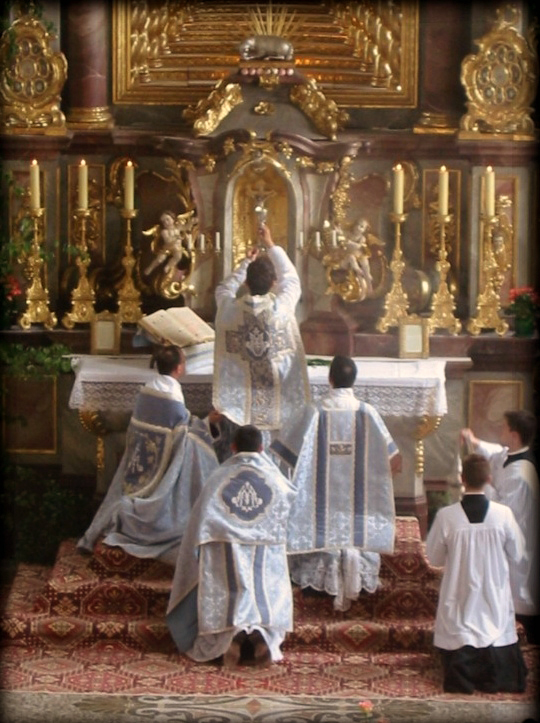
Amoris, Traditionis and the Dubia
What is one to say, that has not already been said, of the December 18th response to the eleven dubia, raised in light of Traditionis Custodes? There is the intriguing swiftness of the brusque and brutal directives, in contrast to the still-unaswered dubia of Amoris Laetitia, a half decade on.
There are calls for open defiance, to ignoring the law, to careful discernment in the Holy Spirit, to invoking Canon law, or all of the above. Here are just a few thoughts: The dubia following upon Amoris had to do with fundamental moral principles, without the keeping of which we cannot attain heaven. Yet unlike Christ’s clear and direct reply to the rich young man – keep the Commandments! – the lack of a reaffirmation of Christ’s clarion call leaves one free floating.
On the contrary, the recent dubia had to do with disciplinary matters of Liturgy, and, here, the Magisterium responds clearly and swiftly, leaving little room for doubt that their aim is to isolate the pre-conciliar Liturgy, so that it dies to die from sheer attrition, even strangulation.
One may think they have their priorities out of order – crushing the ‘gnats’ of the miniscule minority of the Church’s membership constituting the TLMers, while turning a blind eye to the ‘camels’ of grave violations of the moral law – but, upon deeper reflection, perhaps not.
For one thing, the TLM community, although small, is zealous. Even if they are 1% of the Church, nearly 100% of them attend Mass, at least every Sunday, often daily. Those numbers are nearly reversed for the vast majority for the Novus Ordo.
Also, they are having lots more children. And making converts, not least in these bizarre covidian days. So the threat from those attached to the ‘old ways’, to those who think the ‘new ways’ are all that there must be, everything else null and void, is not so miniscule.
At a deeper metaphysical level, we should recall that there are three aspects to living out the Christian path: Lex orandi, lex credendi and lex vivendi. The law of praying, the law of believing and the law of living, in that order. We live, as we believe, and we believe, as we pray.
In other words, prayer comes first. And the highest form of prayer, is the Liturgy. And the source and summit of the Liturgy, is the holy sacrifice of the Mass. The Mass is the primary link between this world and the next, earth and heaven, our soul and God. It may not seem like it from a worldly perspective, but God’s ways are not ours, and how we celebrate and pray at Mass shapes, forms and directs everything else, in life, in society, in the world.
There was some development required in the Liturgy after the Council – analogously to the ongoing development of doctrine, there is also required some development in Liturgy – but even a brief perusal of the minimal tweaks called for by the constitution Sacrosanctum Concilium shows they went too far. And praxis – the way the Mass is actually celebrated – has gone even farther still, so that many Masses signify, if still valid, not the holy sacrifice of Christ on the altar, but a festal community gathering, a hymn-song, a glee club, with the Consecration – the Eucharistic Prayer – tucked in there somewhere, often the shortest option.
Hence, Benedict XVI urged the traditional Mass to inform the Novus Ordo, to provide a lodestone and exemplar, to keep the New Mass on the right track. It is still possible – and to my mind, ideal in the Novus Ordo – to celebrate the Mass much like the old Mass, ad orientem, the Roman canon, with proper chants, even in Latin.
Yes, one rarely, if ever, sees that – the aptly, if sadly, termed ‘unicorn Mass’’ – which is a big part of the problem, one which may only get worse if the Old Mass (mostly) disappears. What will hold the centre together then, and will things fall apart?
Whatever path we choose, or are able to choose, in whatever milieu we find ourselves, the Liturgy is God’s work, and we must trust in Him to see that the Mass of the ages will never go away – underground, perhaps, kept alive here and there, like sparks amongst the worldly stubble and chaff. But those sparks will one day again become a glorious and cleansing fire.
Christ is on His way, with winnowing fork in hand.
Carney’s Amoral Majority
After five defections – euphemistically described as ‘crossing the floor’ – and three by-elections, Mark Carney and his Liberals how have their coveted majority. One wonders what bowls of pottage were offered in back-room deals. In the archaic monarchical system that is the Dominion of Canada, this majority allows the newly-minted Prime Minister to rule[…]Continue reading→
A Closed, Unsustainable, Descending Loop
As a follow-up to my thoughts on Payette’s payout, here be a stark image of where are here in Canada. As the graph shows in, well, graphic terms, since 2025, the public sector has contributed to 95.5% of economic growth. The private sector – which funds the public sector, or is supposed to – has[…]Continue reading→

Remembering Father Alphonse de Valk
(Today marks the sixth anniversary of the death of Father Alphonse de Valk, C.S.B., a faithful, courageous and indefatigable Basilian priest, pro-life-and-family apostle, and the founder of Catholic Insight magazine. Here is what we wrote those on his entering into eternity five years ago, as we continue to remember him in our prayers and thoughts)[…]Continue reading→
A Tale of Two Benedicts
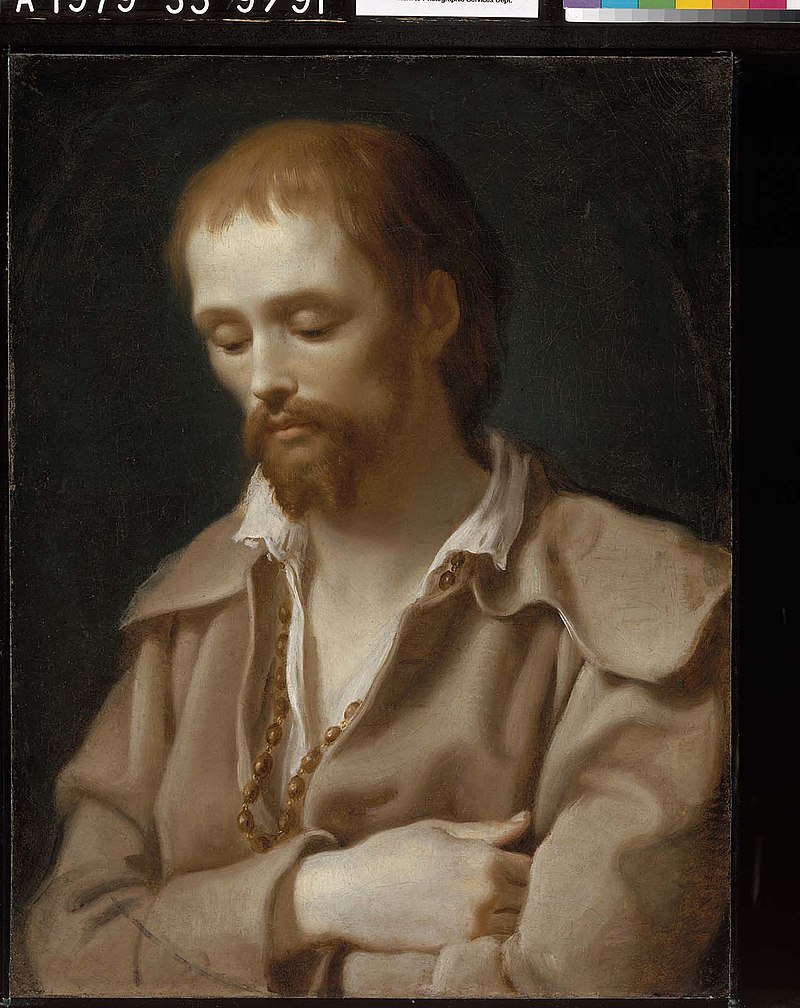
A grace-filled Holy Week to all our readers! As we await and prepare for the Resurrection about to dawn upon us, we might keep in mind two Benedicts: Pope Emeritus Benedict XVI, requiescat in pace, elected on this day in 2005; and today’s commemoration of the mystic pilgrim, Benedict Joseph Labre, who died on this[…]Continue reading→
Presidential Pardon of Weronika Krawczyk
As a good news, follow-up to our story from Poland, of the persecution of Weronika Krawczyk for her pro-life views, we heard that she has been granted a presidential pardon. One might still wonder why one needs a presidential pardon for simply holding the long-held belief that the child within the womb is a child,[…]Continue reading→
Saint Lydwina of Schiedam and Suffering Joyfully
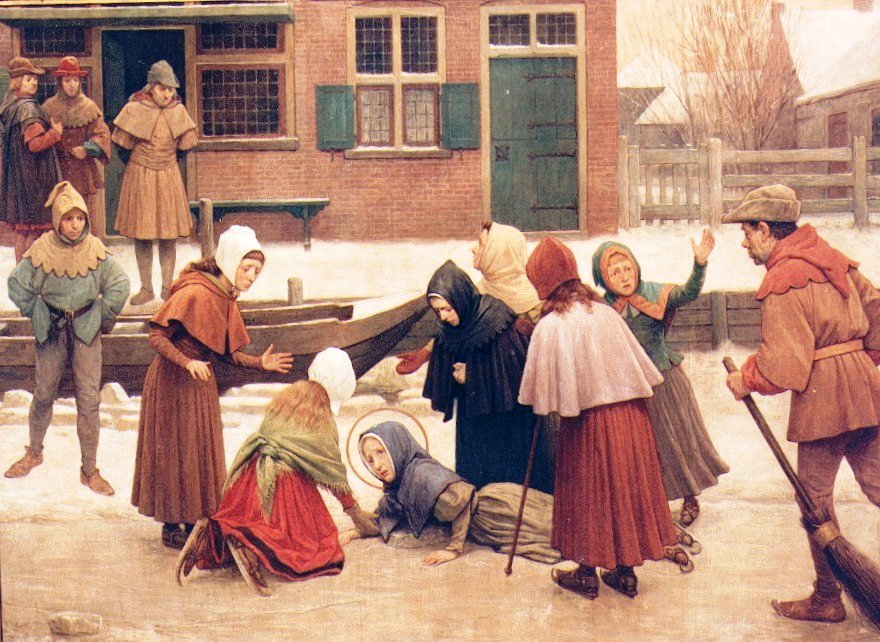
Saint Lydwina of Schiedam (1380 – 1433) was one of the countless and glorious ‘victim souls’ in the history of the Church, those whose lives are filled with suffering, often of an unimaginable intensity, but who suffer joyfully. She was a fifteen-year old Dutch girl, out skating one day, when she fell and broke one[…]Continue reading→
The Glorious Martyrdoms of Martin and Maximus
As we enter into Eastertide, we recall on this 13th of April Pope Saint Martin I (+655), one of the noblest, if most tragic, of the successors of Saint Peter. Born in Umbria, Italy, he was of noble lineage, with great intelligence combined with charity and love of the poor and the Church. While still[…]Continue reading→
Pope Leo and a Rosary for Peace
Pope Leo XIV has asked Catholics across the world to join him in a Rosary for peace today, at 18:00 Rome time (6 pm), which would be noon from where I write (EST). If you are able, whether at that time or another, and in whatever way you pray, to join in intercession with the[…]Continue reading→
Payette’s Payout
I was glancing through some headlines, and noticed a mention of Julie Payette – engineer and astronaut and sometime the Queen’s representative in Canada – which brought back vague memories. She was appointed Governor-General by Justin Trudeau in 2017. Ms. Payette resigned in 2021, amidst claims that she created a ‘toxic work environment’, with allegations[…]Continue reading→

Saint Stanislaus of Szczepanów
We celebrate Saint Stanislaus today (+ April 11, 1079), in light of this Easter Octave, a bishop and martyr who accepted the episcopacy only at the direct order of Pope Alexander II. He proved a wise and courageous leader of his flock, put to death by his own king, Boleslaus, for rebuking the monarch’s ‘immoral[…]Continue reading→