
Virtue and the Eucharistic Life
‘Listen to me, all of you, and understand there is nothing outside a person that by going in can defile them, but things that come out of a person are what defile them. For it is from the human heart that evil intentions come’ (Mk. 7:20). ⧾
The lessons of the Mass of the 22nd Sunday speak to us very clearly of the essence of religious observance and its transformative effect on our lives. St. James summarises very succinctly: Religion that is pure and undefiled before God, the Father, is this: to care for orphans and widows in their distress and to keep oneself unstained by the world (Jm. 1:27). His metaphorical definition of religion expresses the need for charity, that is, sacrificial love and the need for personal integrity. These are what make religion a matter of the heart. Through the Prophet Ezekiel, the Lord God declares: I will give you a new heart and put a new spirit in you; I will remove from you your heart of stone and give you a new heart of flesh (36:26). Through the Prophet Jeremiah the Lord God promises: Then I will give you shepherds after my own heart, who will lead you with knowledge and understanding (Jer. 3:15). Sacred Scripture makes it very clear that those who worship God in spirit and in truth must grow in God’s own likeness, from one degree of glory to another (2 Cor. 3:18).
When human beings are not seen to be in the image and likeness of God they lose their meaning. This may help us to understand why and how atrocities committed in the name of a false god can be justified in the name of the same false god by the most zealous of this false creed’s followers. Closer to home, this may also help us to understand the disregard for our freedoms that our governing classes have increasingly manifested during this pandemic. We have no meaning as far as they are concerned. This state of affairs is the result of the loss of Christian culture – however superficial the culture may be. There are consequences to our apostasy and we are beginning to feel the full brunt of the repudiation of the Faith on such a large scale. Our weekly celebration of the Holy Sacrifice of the Mass however, is, perhaps most especially now, a bold affirmation of our meaning and dignity. Sadly, without indulging in conspiracy theories that are always more and more plausible, this may also explain why our churches were closed and why there continue to be limitations on attendance. The struggle of our times is definitely a conflict between the many who have come to believe that we are a human collective, a faceless and malleable mass; and the few who still uphold the biblical understanding of the human person created in the image and likeness of the living God. ‘For my thoughts are not your thoughts, neither are your ways my ways,’ declares the Lord (Is. 55:8). We must then strive all the more to know the mind of God; and conform ourselves to the heart of God. As those who have gone before us, we must be encouraged and emboldened by this timely exhortation: Let us hold fast the confession of our hope, without wavering, for he who promised is faithful; and let us consider how to stir up one another to love and good works, not neglecting to meet together, as is the habit of some, but encouraging one another, and all the more as you see the Day drawing near (Heb. 10:23-25).
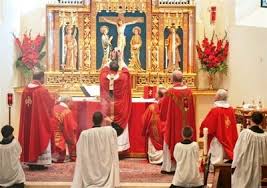
We firmly believe that the Son of God who died for our salvation nourishes us with His own life; and that human life, created in the image of God, is destined to share in the divine life by grace, here and for all eternity. By living an intensely Eucharistic life, each one of us can become a powerful witness to this profound mystery of human life. The mysteries of God as well as His truths are best revealed not by arguments but by people. It seems to me that the time for talking is over. If we make the celebration of the Eucharistic Mystery the centre of our life, especially at this specific time in history, the effects of this will manifest themselves in in the perfection of Christian charity which defines holiness and in the necessary but gradual transformation of our culture. This has always been the pattern at work in the proclamation of the true faith. By the power of God’s grace we must live fearlessly among the fearful; and never cease to assert the dignity, rights and freedoms given to us by God. If God is for us, who can be against us? (Rom. 8:31).
This however, is not possible unless we assert and defend the traditional understanding of personal virtue as the key to a happy life, and in view of our circumstances, a safe and sane life. The promotion of vice that in many countries – including our own – has become stated government policy has created false expectations; and human beings, deprived of their meaning, most especially the vulnerable, are victimized. In his Abolition of Man, in the first chapter titled “Men without Chests”, C. S. Lewis explains that “the Chest” is one of the indispensable liaison officers between cerebral man and visceral man. It may even be said that it is by this middle element that man is man; for by his intellect he is mere spirit and by his appetite mere animal. Evidently, he is speaking of the heart. What good is a man or a woman without a heart? Is there anything more offensive than to be described as heartless? Our Lord’s words are worth repeating: ‘Listen to me, all of you, and understand there is nothing outside a person that by going in can defile them, but things that come out of a person are what defile them. For it is from the human heart that evil intentions come: fornication, theft, murder, adultery, avarice, wickedness, deceit, licentiousness, envy, slander, pride, folly. All these evil things come from within, and they defile a person’ (Mk. 7:20-23).
The only path to true human happiness is the virtuous path of love and devotion to the God who created and redeemed every one of us. In many ways we who subscribe to this belief have become a little flock, not unlike the Israelites of old who received these words of admonishment and encouragement: Now, Israel, give heed to the statutes and ordinances that I am teaching you to observe….You must neither add anything to what I command you nor take away anything from it, but keep the commandments of the Lord your God….You must observe them diligently, for this will show your wisdom and discernment to the peoples. (Deut. 4:1-6). St. Paul addressed similar words to the small community of believers in Philippi, encouraging them to shine as lights in the world, holding fast to the word of life (Phil. 2:15).
We must never lose sight of the fact that our discipleship is an intensely personal undertaking. The solution to a crisis is ultimately personal. Each one of us therefore must cultivate a personal faith, integrity and holiness. Religion that is pure and undefiled before God, the Father, is this: to care for orphans and widows in their distress and to keep oneself unstained by the world (Jm. 1:27). If we wish to provide a solution, humility before God must be our fundamental attitude in relation to God and to His law. We worship God; not the state. Our prayer must be accompanied by daily spiritual education, that is to say, an effort to deepen our knowledge of the faith through ongoing instruction in the faith (like the Sunday homily); so that we might hand on the authentic faith to our young people, and keep the faith, as a service to others. Our daily rosary is no less an exercise in this ongoing instruction for we are contemplating the mysteries of salvation. Above all, and perhaps against all odds today, we must both practice and teach virtue. The evidence of human history is very clear: the world divorced from the God who created and redeemed it inevitably comes to a bad end. Nevertheless, we are ever mindful of and consoled by the words of Our loving Saviour: ‘Fear not, little flock, for it is your Father’s good pleasure to give you the kingdom’ (Lk. 12:32). ⧾

Saint Kateri , Canada’s Protectress
This was the title given to Saint Kateri Tekakwitha, by Pope Benedict XVI, when he canonized her on October 28th, 2012, along with six others, in Saint Peter’ Square (she had been beatified by Pope John Paul II back in 1980). With Saint Joseph as our protector, along with the Canadian martyrs, we seem to[…]Continue reading→

Remembering Father Alphonse de Valk
(Today marks the sixth anniversary of the death of Father Alphonse de Valk, C.S.B., a faithful, courageous and indefatigable Basilian priest, pro-life-and-family apostle, and the founder of Catholic Insight magazine. Here is what we wrote those on his entering into eternity five years ago, as we continue to remember him in our prayers and thoughts)[…]Continue reading→

My Name is Bernadette
April 16th is a propitious day, for besides the anniversary of Father de Valk’s death, who founded Catholic Insight in its print form decades ago, and the commemoration of the ‘two Benedicts’, mentioned in accompanying posts, today we also recall Saint Bernadette Soubirous, the young visionary to whom the Virgin Mary appeared numerous times at[…]Continue reading→

Canonizing Sister Faustina and Divine Mercy
HOMILY OF THE HOLY FATHER MASS IN ST PETER’S SQUARE FOR THE CANONIZATION OF SR MARY FAUSTINA KOWALSKA Sunday, 30 April 2000 1. “Confitemini Domino quoniam bonus, quoniam in saeculum misericordia eius”; “Give thanks to the Lord for he is good; his steadfast love endures for ever” (Ps 118: 1). So the Church sings on the Octave of[…]Continue reading→

Divine Mercy Sunday – An Echo of Every Mass
Reach out your hand and put it in my side. Do not doubt but believe’… ‘My Lord and my God!’ (Jn. 20:18)). Today is Divine Mercy Sunday, and as we celebrate the end of the Easter Octave, we contemplate the wounded side of our Saviour, the Church’s source of life. On Good Friday in the[…]Continue reading→

Saint Stanislaus of Szczepanów
We celebrate Saint Stanislaus today (+ April 11, 1079), in light of this Easter Octave, a bishop and martyr who accepted the episcopacy only at the direct order of Pope Alexander II. He proved a wise and courageous leader of his flock, put to death by his own king, Boleslaus, for rebuking the monarch’s ‘immoral[…]Continue reading→

First Holy Communion: Sermon from May 16, 1943
Here is a sermon from the good old days by +Rev. Msgr. Vincent Nicholas Foy (August 14, 1915 – March 13, 2017), from 1943. Readers may recall that Pope Saint Pius X, by the decree Quam Singulari in 1910, lowered the customary age of reception of Holy Communion – after the rigours of the plague[…]Continue reading→

In the Glorious Light of Easter, Alleluia!
Set your minds on things that are above, not on things that are on earth, for you have died, and your life is hidden with Christ in God. When Christ who is your life is revealed, then you also will be revealed with him in glory (Col. 3:3-4). The Resurrection of Our Lord and Saviour[…]Continue reading→

An Ancient Homily for Holy Saturday
The time between Good Friday and Easter Sunday is one of waiting, in silence, as the world wonders – anticipates – what will happen, after the death of Christ. We re-live this time each year in the anamnesis of our liturgy, and in turn look forward to the glorious re-creation of all things at the[…]Continue reading→

Europe’s Long Descent
(As we meditate on this day on Christ’s burial, and His descent into hell, it is fitting to ponder here with contributor Peter Marcus how the world seems to be heading there as well. The difference is that, although God cannot ‘redeem’ hell, nor those therein, He can and did redeem the world. There is[…]Continue reading→