
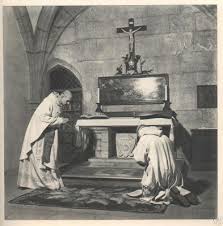
Saint Bonaventure: Contemplatio in Actione
Who is this saint, Bonaventure of Bagnoregio, whose feast collect aptly describes him as a man of great learning and having the ardor of … charity?
Undoubtedly, Saint Bonaventure is a central figure within our Franciscan Family. He was born around 1217 in Bagnoregio, which is close to Orvieto, Italy. After graduating with an Arts degree, he discerned his vocation and joined the Order in 1245. By doing so Bonaventure was influenced by Alexander of Hales, who himself decided to make his important life transition from the academic world to the Franciscan way of life. With his erudition and great capacity to teach, Bonaventure was eventually made a Master of Theology in Paris in 1255. (Which meant far more back then than it does now)
Two years later Bonaventure was elected as Minister General of the Franciscans, and in 1272 he was appointed Cardinal Bishop of Albano, bearing the huge responsibility of preparing for the Council of Lyons. Unfortunately he died on July 15, 1274 while the Council was not yet started. Bonaventure’s complete works, the Opera Omnia, were published and are now contained in 9 volumes spanning from 1882 till 1902 by the Quaracchi friars.
Saint Bonaventure offers us some very relevant points of thought and action for our lives. First of all, throughout his writings he teaches us that spiritual life is not simply what I ‘feel’ but it also and essentially begs for that precious space called “discernment”. In fact, in their letter celebrating the eight centenary of the birth of St Bonaventure of Bagnoregio, written by the General Ministers of the First Order and of the TOR (Third Order Regular), of 14 July 2017, Vigil of the Feast of St Bonaventure, they say that “among the many worthy points he makes, one is particularly emphasized: in the spiritual life, love of God cannot be reduced to pure emotionalism and affective instincts. It needs models and well thought out processes that dispose of the soul to wonder. Without an ordered ascetical process, the human soul will find it difficult to find the necessary quiet and tranquility that allows it to hear, see, taste, smell, and touch the mystery of God. For Bonaventure, it is not a question of ‘conquering’ God, but of ‘allowing oneself to be found’ — by being open to the unimaginable surprise of an encounter with God”.
Another important point mentioned by the General Ministers of the First Order and of the TOR is that our world desperately needs “spiritual masters”. We, as Franciscans, are to seriously listen to this call and do our utmost, aided throughout by God’s grace, to fulfil this apostolate both in our life within the Church as well as in that within the world in which we are living. This makes perfect sense, particularly in this time wherein the spiritual and moral compass is being seriously derailed by the uncontrolled crave for what is material and instant. They write:
“Bonaventure also reminds us, as Religious, of a second important element: in the past and in the present the world has always needed ‘spiritual masters’ — men and women who through the witness of their life are able to help others in the process of journeying towards an experience of God. However, this proposal of providing ‘spiritual formation’ must be founded in real, deep personal experiences, thus giving a truly Franciscan flavor to the spiritual journey. Yes, the world needs contemplatives, but they must be able to proclaim the joy of the Gospel and the beauty of living the Franciscan charism in fraternity. Our spiritual tradition, built up through holy places and extraordinary examples of holiness and learning, has a richness that today’s world recognizes as being genuinely effective in the attainment of true spiritual growth.”
Being a university professor himself, Saint Bonaventure knew exactly the crucial relevance of intelligence. However, he was realistic enough in admitting that without its essential openness to wisdom, intelligence is destined to be crushed by itself in error simply because it is closed in itself. That is why dialogue and openness to God are so important to spare intelligence from ending up being a prey of its short-sightedness, thus being completely devoid of wisdom.
“Intelligence is the way to wisdom, but if it closes in on itself, it inevitably falls into error. Bonaventure offers two basic strategies … in a world dominated by scientific and technological knowledge that is hugely powerful, expansive, and seemingly indifferent to the Other and the Beyond. First, he asks us to take on an attitude of dialogue that is real and engaged, having a positive outlook and great respect for human capabilities, recognizing that they are a sure manifestation of the beauty that God has given to creation and to the human person. … At the same time, with regard to this world, he also invites us to develop a sense of openness to the transcendent, reminding people of today of two important and encouraging truths. First, every thought process leads the human person towards a deeper truth; towards that truth which unites scattered fragments and directs us to a fullness and fulfilment that goes beyond the intellectual, and that requires love. To deliberately close ourselves to the infinite would condemn the human person to science and technology that is soulless and lacking in hope. In addition, the Trinitarian mystery of divine love is what brings life to all of our efforts to approach the One, the True, and the Good. With faith giving us certainty, we should proclaim that the redemptive mystery of Christ is at work in every effort to bring about a better and more humane world, and that Christ gives himself without reserve to every person at all times”.
Personally speaking, I consider St Bonaventure an outstanding teacher of the Holy Spirit’s leadership in our spiritual lives. In his Journey of the mind to God St Bonaventure writes:
“Christ is both the way and the door. Christ is the staircase and the vehicle, like the “throne of mercy over the Ark of the Covenant,” and “the mystery hidden from the ages.” A man should turn his full attention to this throne of mercy, and should gaze at him hanging on the cross, full of faith, hope and charity, devoted, full of wonder and joy, marked by gratitude, and open to praise and jubilation. Then such a man will make with Christ a “pasch,” that is, a passing-over. Through the branches of the cross he will pass over the Red Sea, leaving Egypt and entering the desert. There he will taste the hidden manna, and rest with Christ in the sepulchre, as if he were dead to things outside. He will experience, as much as is possible for one who is still living, what was promised to the thief who hung beside Christ: “Today you will be with me in paradise.”
For this ‘passover’ to be perfect, we must suspend all the operations of the mind and we must transform the peak of our affections, directing them to God alone. This is a sacred mystical experience. It cannot be comprehended by anyone unless he surrenders himself to it; nor can he surrender himself to it unless he longs for it; nor can he long for it unless the Holy Spirit, whom Christ sent into the world, should come and inflame his innermost soul. Hence the Apostle says that this mystical wisdom is revealed by the Holy Spirit.”
Was this not Saint Francis’ way of seeing the Holy Spirit? Is this not Francis’ loving warmth of Jesus through the Holy Spirit? Is this not a demonstration of a highly developed ability to reason and a practical devotion to the Persons of the Holy Trinity? Is this not a great proof of love for the Church? Is this not the theological and spiritual exercise of the Seraphic Doctor, St Bonaventure? Is this not his contemplation in action?

Saint Kateri , Canada’s Protectress
This was the title given to Saint Kateri Tekakwitha, by Pope Benedict XVI, when he canonized her on October 28th, 2012, along with six others, in Saint Peter’ Square (she had been beatified by Pope John Paul II back in 1980). With Saint Joseph as our protector, along with the Canadian martyrs, we seem to[…]Continue reading→

Remembering Father Alphonse de Valk
(Today marks the sixth anniversary of the death of Father Alphonse de Valk, C.S.B., a faithful, courageous and indefatigable Basilian priest, pro-life-and-family apostle, and the founder of Catholic Insight magazine. Here is what we wrote those on his entering into eternity five years ago, as we continue to remember him in our prayers and thoughts)[…]Continue reading→

My Name is Bernadette
April 16th is a propitious day, for besides the anniversary of Father de Valk’s death, who founded Catholic Insight in its print form decades ago, and the commemoration of the ‘two Benedicts’, mentioned in accompanying posts, today we also recall Saint Bernadette Soubirous, the young visionary to whom the Virgin Mary appeared numerous times at[…]Continue reading→
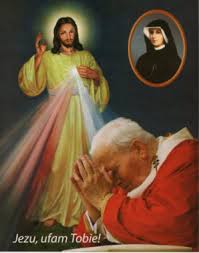
Canonizing Sister Faustina and Divine Mercy
HOMILY OF THE HOLY FATHER MASS IN ST PETER’S SQUARE FOR THE CANONIZATION OF SR MARY FAUSTINA KOWALSKA Sunday, 30 April 2000 1. “Confitemini Domino quoniam bonus, quoniam in saeculum misericordia eius”; “Give thanks to the Lord for he is good; his steadfast love endures for ever” (Ps 118: 1). So the Church sings on the Octave of[…]Continue reading→

Divine Mercy Sunday – An Echo of Every Mass
Reach out your hand and put it in my side. Do not doubt but believe’… ‘My Lord and my God!’ (Jn. 20:18)). Today is Divine Mercy Sunday, and as we celebrate the end of the Easter Octave, we contemplate the wounded side of our Saviour, the Church’s source of life. On Good Friday in the[…]Continue reading→

Saint Stanislaus of Szczepanów
We celebrate Saint Stanislaus today (+ April 11, 1079), in light of this Easter Octave, a bishop and martyr who accepted the episcopacy only at the direct order of Pope Alexander II. He proved a wise and courageous leader of his flock, put to death by his own king, Boleslaus, for rebuking the monarch’s ‘immoral[…]Continue reading→

First Holy Communion: Sermon from May 16, 1943
Here is a sermon from the good old days by +Rev. Msgr. Vincent Nicholas Foy (August 14, 1915 – March 13, 2017), from 1943. Readers may recall that Pope Saint Pius X, by the decree Quam Singulari in 1910, lowered the customary age of reception of Holy Communion – after the rigours of the plague[…]Continue reading→
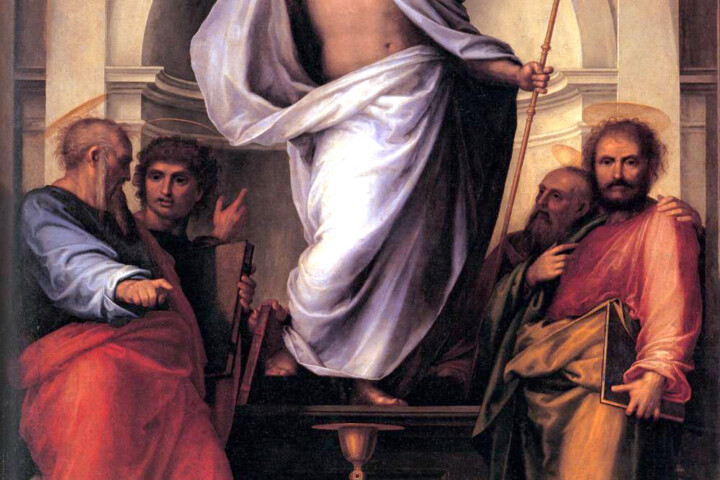
In the Glorious Light of Easter, Alleluia!
Set your minds on things that are above, not on things that are on earth, for you have died, and your life is hidden with Christ in God. When Christ who is your life is revealed, then you also will be revealed with him in glory (Col. 3:3-4). The Resurrection of Our Lord and Saviour[…]Continue reading→
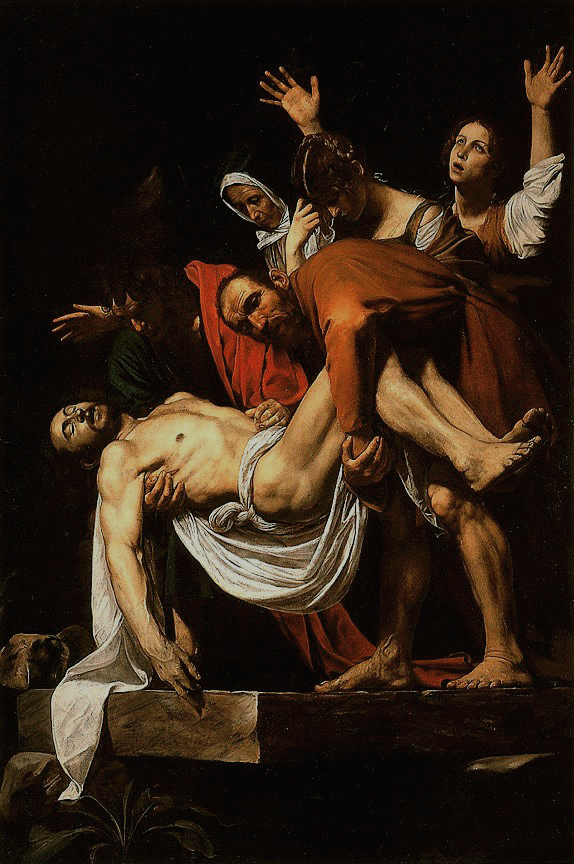
An Ancient Homily for Holy Saturday
The time between Good Friday and Easter Sunday is one of waiting, in silence, as the world wonders – anticipates – what will happen, after the death of Christ. We re-live this time each year in the anamnesis of our liturgy, and in turn look forward to the glorious re-creation of all things at the[…]Continue reading→
Europe’s Long Descent
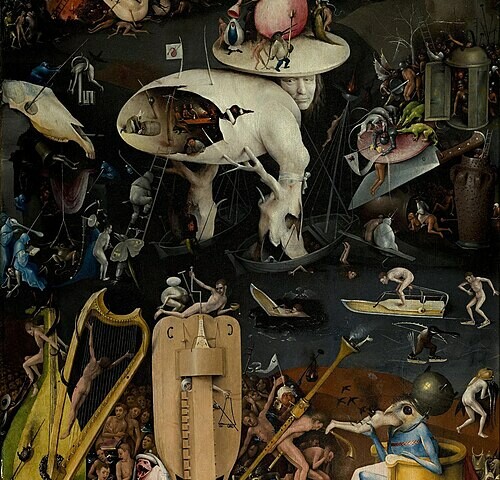
(As we meditate on this day on Christ’s burial, and His descent into hell, it is fitting to ponder here with contributor Peter Marcus how the world seems to be heading there as well. The difference is that, although God cannot ‘redeem’ hell, nor those therein, He can and did redeem the world. There is[…]Continue reading→