
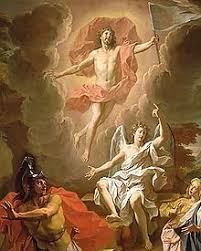
He Is Risen Indeed, Alleluia!
The fifty days between Easter and Pentecost are devoted to meditation on the mystery of the resurrection, which is the foundation of Christianity. Just how much that is so came home to me when I was called upon to give an address on the faith of the apostolic Church. To begin with, I realized as never before how thoroughly Jewish primitive Christianity was. There is nothing really surprising in this fact, given that the Jewish dispensation was established by God as a preliminary to the full revelation of Christ, or simply that the first disciples were all Jews. What set me thinking more deeply about this matter was Saint Paul’s discussion of the resurrection in 1 Corinthians 15. At first glance, his logic seems faulty. Where we would expect him to have written, “If Christ has not been raised, then there is no resurrection from the dead,” we find that he actually writes, “If there is no resurrection from the dead, then Christ has not been raised” (15.13), a point he iterates at 15.16: “If the dead are not raised, then Christ has not been raised.” We are surely right in staying with what Saint Paul said rather than with what we think he should have said.
A clue to his meaning is found in 15.20: “Christ has been raised from the dead, the first fruits of those who have fallen asleep.” The point is that, according to the teaching of the Pharisees—who, sitting on the chair of Moses, spoke the truth (Mt 23.2)—there will at the end of time be a general resurrection followed by judgement, heaven, and hell (cf. Acts 23.6-8). This was a teaching that developed late in Judaism, as we see in the Book of Daniel: “Many of those who sleep in the dust of the earth shall awake, some to everlasting life, and some to shame and everlasting contempt” (12.2). Another Jewish, non-scriptural document from the second century B.C.—The Book of Enoch—describes the final judgement, heaven, and hell. (It was ascribed to Enoch for obvious reasons; cf. Gen5.22):
Then Raphael answered, “These hollow places have been created that the spirits of the souls of the dead should assemble therein until the great judgement comes upon… The spirits of those who have died in righteousness shall live and rejoice. Woe to sinners. Their souls will be made to descend into Sheol. Into darkness and chains and a burning flame…and the great judgement shall be for all the generations of the world. 22.3-4; 103.4-8
This judgement was the climax of God’s interventions in history when, once and for all, he would put things right by revealing his will for all mankind. The point is that judgement had to come at the end of time, once God’s plan had been perfectly and definitively accomplished. According to this scheme, no one has any business rising from the dead—as opposed to being merely resuscitated—in the ongoing course of human history, for the general resurrection is the final event. Given this view of the end of time, one can appreciate the disbelief and then the confusion of the disciples who heard from the holy women about an empty tomb and visions of angels. Resurrection was not supposed to be an individual matter but something that all men would share. There was to be no resurrection apart from the universal one, and it was obvious to the straightforward minds of the disciples that the general resurrection was not in progress.
The incontrovertible fact that Jesus had risen required, therefore, a radical rethinking of the nature of God’s final act in human history. Given that the general resurrection was the beginning of this definitive event, the resurrection of Jesus was interpreted as an anticipation of the final state of things; and this interpretation, to return to our starting point, is the origin of Saint Paul’s saying that Jesus is “the first fruits of those who have died,” an earnest of the rising of the dead at the end of time. Paul’s criticism of his opponents follows: “If Christ is preached as raised from the dead, how can some of you say that there is no resurrection of the dead?” (1 Cor 15.12). If there is no general resurrection, then there is nothing for Christ to anticipate: “our preaching is in vain . . . and we are of all men most to be pitied” (1 Cor 15.14,19). It is always pleasing to find a correspondence between Saint Paul and Saint John, the two great theologians of the Apostolic Church, and nowhere is it more satisfying than in this fundamental datum of revelation. At the raising of Lazarus, Martha invokes the general resurrection at the end of time: “Jesus said to her, ‘Your brother will rise again.’ Martha said to him, ‘I know that he will rise again in the resurrection at the last day.’” The reply of Jesus makes the point: “‘I am the resurrection and the life; he who believes in me, though he die, yet shall he live, and whoever lives and believes in me shall never die. Do you believe this?’” May Martha’s reply be ours: “She said to him, ‘Yes, Lord; I believe that you are the Christ, the Son of God, he who is coming into the world.’”
One can imagine what was going on in the minds of the Apostles who spent fifty days and more pondering the significance of the astounding event they had experienced. The resurrection signaled the apocalyptic event, God’s definitive and final act in human history. God’s purpose in creation, therefore, was somehow revealed in the resurrection of Jesus and, by implication, in all the events of his life. By accomplishing everything that God willed to happen, he represents the final state of things; he reveals what God is like and even who God is. The upshot was that the disciples could no longer think about God without including the words and the actions of Jesus, who had become an essential element in their concept of God. It was not that they denied what they knew as Jews about there being one and only one God, but now they had to incorporate into their prayers and preaching the figure of Jesus. This realization gave new meaning to every aspect of their previous religious experience. The Son of God, the Son of Man, Messiah: these familiar terms from the Old Testament suddenly took on new dimensions. Now were made available insights into the entire history of Israel because the followers of Jesus had come to know the goal toward which that history was progressing. Adam, Abraham, Moses, David, the Suffering Servant: precisely because these figures, and all the others, were part of God’s purpose for mankind, they revealed something about the completion of that purpose in Christ: “God foretold by the mouths of all his prophets that his Christ should suffer” (Acts 3.18). Nascent in all of these insights was a belief in the full divinity of Jesus. The disciples could not, of course, say baldly to a Jew that Jesus was God because such a statement would have been interpreted as meaning that Jesus was God the Father. An explicit formulation of the belief in the divinity of Jesus took some time; in a way the process continues even today. But our belief is present in germ in the proclamation that formed Christianity and which we often repeat during the fifty days of Easter: “Christ is risen! Christ is risen, indeed! Alleluia!

Remembering Father Alphonse de Valk
(Today marks the sixth anniversary of the death of Father Alphonse de Valk, C.S.B., a faithful, courageous and indefatigable Basilian priest, pro-life-and-family apostle, and the founder of Catholic Insight magazine. Here is what we wrote those on his entering into eternity five years ago, as we continue to remember him in our prayers and thoughts)[…]Continue reading→

Divine Mercy Sunday – An Echo of Every Mass
Reach out your hand and put it in my side. Do not doubt but believe’… ‘My Lord and my God!’ (Jn. 20:18)). Today is Divine Mercy Sunday, and as we celebrate the end of the Easter Octave, we contemplate the wounded side of our Saviour, the Church’s source of life. On Good Friday in the[…]Continue reading→

Saint Stanislaus of Szczepanów
We celebrate Saint Stanislaus today (+ April 11, 1079), in light of this Easter Octave, a bishop and martyr who accepted the episcopacy only at the direct order of Pope Alexander II. He proved a wise and courageous leader of his flock, put to death by his own king, Boleslaus, for rebuking the monarch’s ‘immoral[…]Continue reading→
First Holy Communion: Sermon from May 16, 1943
Here is a sermon from the good old days by +Rev. Msgr. Vincent Nicholas Foy (August 14, 1915 – March 13, 2017), from 1943. Readers may recall that Pope Saint Pius X, by the decree Quam Singulari in 1910, lowered the customary age of reception of Holy Communion – after the rigours of the plague[…]Continue reading→
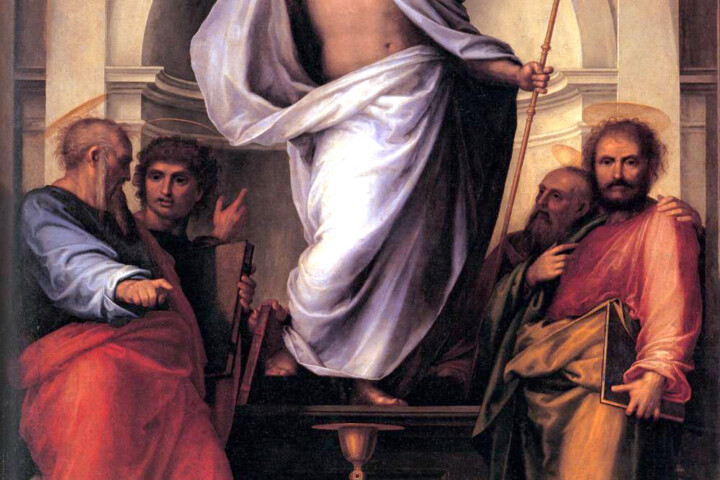
In the Glorious Light of Easter, Alleluia!
Set your minds on things that are above, not on things that are on earth, for you have died, and your life is hidden with Christ in God. When Christ who is your life is revealed, then you also will be revealed with him in glory (Col. 3:3-4). The Resurrection of Our Lord and Saviour[…]Continue reading→
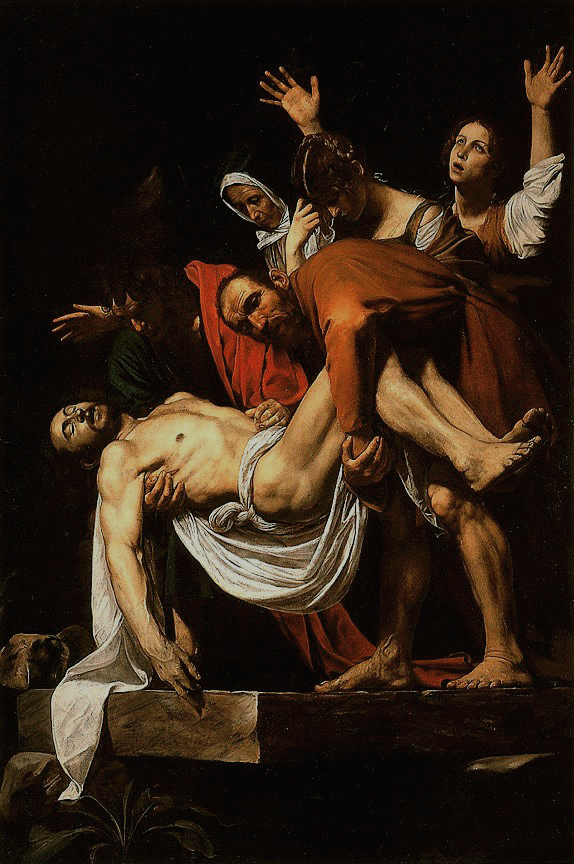
An Ancient Homily for Holy Saturday
The time between Good Friday and Easter Sunday is one of waiting, in silence, as the world wonders – anticipates – what will happen, after the death of Christ. We re-live this time each year in the anamnesis of our liturgy, and in turn look forward to the glorious re-creation of all things at the[…]Continue reading→
Europe’s Long Descent
(As we meditate on this day on Christ’s burial, and His descent into hell, it is fitting to ponder here with contributor Peter Marcus how the world seems to be heading there as well. The difference is that, although God cannot ‘redeem’ hell, nor those therein, He can and did redeem the world. There is[…]Continue reading→
Pope Saint John Paul II’s First Good Friday Homily
ADDRESS OF HIS HOLINESS JOHN PAUL II AT THE CONCLUSION OF THE STATIONS OF THE CROSS AT THE COLOSSEUM Good Friday, 13 April 1979 When we make the Way of the Cross from one station to the next, in spirit we are always at the spot wherethis journey had its “historical” place: where it[…]Continue reading→
A Meditation for Good Friday: How To Undo the Effects of Sin?
Cardinal Newman, now Saint John Henry Newman, was a towering figure of nineteenth-century Catholicism who is almost universally admired. I say “almost” because not everyone likes him. I knew a priest once, Arthur Caulkins, who has become disenchanted with Newman. As an undergraduate Arthur had been enamoured of Newman, and this interest continued when he[…]Continue reading→
Pope Benedict’s Last Holy Thursday Homily
MASS OF THE LORD’S SUPPER HOMILY OF HIS HOLINESS BENEDICT XVI Basilica of St John Lateran Holy Thursday, 5 April 2012 Photo Gallery (Video) Dear Brothers and Sisters! Holy Thursday is not only the day of the institution of the Most Holy Eucharist, whose splendour bathes all else and in some ways draws it to[…]Continue reading→