
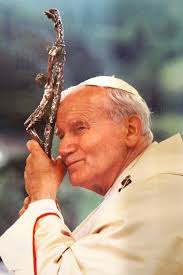
A Clarification on Pope John Paul II’s Call for An International Order versus a ‘New World Order’
In reference to Pope Saint John Paul II and the concept of a ‘new world order’ – to which his name is sometimes attached – we should be clear that the Pontiff himself, called for “a new international order” but he did not use the expression “world order”. The term world order would seem to imply a world government, but an international order would rather imply a coalition of independent States. While the world order could be under a totalitarian regime the international order would have to issue from an agreement achieved by all the nations. Furthermore, the latter new order would rest on the principle of subsidiarity.
Pope John Paul ll explains these two requirements in his 1981 Apostolic Exhortation : Familiaris Consortio
Grace and responsibility of the Christian family
- The social role proper to every family is also, in a new and particular way, that of the Christian family, founded on the sacrament of marriage. By assuming the human reality of conjugal love in its dimensions, the sacrament makes Christian spouses and parents capable of living their vocation as lay people, and it is their responsibility therefore of “seeking the reign of God precisely through the stewardship of temporal things which they order according to God ”. ” ‘
The social and political role is part of the royal mission, a mission of service, in which Christian spouses participate by virtue of the sacrament of marriage, receiving both a command from which they cannot escape and a grace which sustains and leads them.
This is how the Christian family is called to give before all, the testimony of a generous and disinterested dedication in the face of social problems, choosing as a priority the poor and the marginalized. And that is why, in following the Lord in a special love for all the poor, she must have particularly at heart those who are hungry, those who are destitute, the elderly, those who are sick, drugged, without family.
For a new international order
- Faced with the global dimension which today characterizes the various social problems, the family is seeing the expansion, in a completely new way, of its role in the development of society: it is also a question of cooperating in the realization of a new international order, because it is only through world solidarity that one can envisage and solve the enormous and dramatic problems of justice in the world, of the freedom of peoples, of the peace of humanity.
The spiritual communion of Christian families, rooted in common faith and hope and vivified by charity, constitutes an interior energy from which justice, reconciliation, fraternity and peace between men spring, spread and grow. As a “small” Church, the Christian family is called, like the “great” Church, to be a sign of unity for the world, and to exercise in this sense its prophetic role, witnessing to the Kingdom. and the peace of Christ, to which the whole world is marching.
This, Christian families will be able to achieve through their educational service, that is to say by offering children a model of life based on the values of truth, freedom, justice and love, as also in ”engaging itself in an active and responsible way for a truly human growth of society and its institutions, or by supporting in various ways the associations which are devoted primarily to the problems of the international order.
***********************
- … In this regard, families must be increasingly aware of being the “protagonists” of what is called “family policy” and that they take responsibility for transforming society; otherwise, they will be the first victims of the evils that they were content to observe with indifference. The invitation of the Second Vatican Council to go beyond individualistic ethics therefore also concerns the family as such.
Society at the service of the family
- The close relationship between family and society requires, on the one hand, the openness and participation of the family in society and its development, but on the other hand it obliges society to never fail in its fundamental duty to respect and promote the family.
It is certain that the family and society have complementary roles in the defence and promotion of the goods common to all men and to all men. But society, and more precisely the State, must recognize that the family is a “society enjoying its own and primordial right” and they therefore have a serious obligation, as regards their relations with the family, to do so. adhere to the principle of subsidiarity.
By virtue of this principle, the State cannot and must not take away from families the tasks which they can very well accomplish alone or by freely associating with other families; but on the contrary, it must arouse and encourage responsible initiatives by families as much as possible. The public authorities, convinced of the fact that the good of the family is for the civil community an indispensable value that cannot be renounced, must do their utmost to provide families with all the help, economic, social, educational, political, cultural, which they need to fulfill all of their obligations in a truly human way.
- The reciprocal action of support and progress between the family and the society is an ideal often contradicted, and even seriously, by the reality of the facts where one notes their separation, even their opposition.
In fact, as the Synod has continually pointed out, the situation of very many families in various countries is very problematic, when it is not frankly evil: the laws and institutions disregard, against all justice, the inviolable rights of family and even the human person; and society, far from putting itself at the service of the family, attacks it violently in its values and in its fundamental requirements. Thus the family which, according to God’s plan, is the basic unit of society, subject of rights and duties prior to those of the State and of any other community, finds itself the victim of society, of its slowness and delays of its interventions and even more of its flagrant injustices. …

Saint Kateri , Canada’s Protectress
This was the title given to Saint Kateri Tekakwitha, by Pope Benedict XVI, when he canonized her on October 28th, 2012, along with six others, in Saint Peter’ Square (she had been beatified by Pope John Paul II back in 1980). With Saint Joseph as our protector, along with the Canadian martyrs, we seem to[…]Continue reading→

Remembering Father Alphonse de Valk
(Today marks the sixth anniversary of the death of Father Alphonse de Valk, C.S.B., a faithful, courageous and indefatigable Basilian priest, pro-life-and-family apostle, and the founder of Catholic Insight magazine. Here is what we wrote those on his entering into eternity five years ago, as we continue to remember him in our prayers and thoughts)[…]Continue reading→

My Name is Bernadette
April 16th is a propitious day, for besides the anniversary of Father de Valk’s death, who founded Catholic Insight in its print form decades ago, and the commemoration of the ‘two Benedicts’, mentioned in accompanying posts, today we also recall Saint Bernadette Soubirous, the young visionary to whom the Virgin Mary appeared numerous times at[…]Continue reading→

Canonizing Sister Faustina and Divine Mercy
HOMILY OF THE HOLY FATHER MASS IN ST PETER’S SQUARE FOR THE CANONIZATION OF SR MARY FAUSTINA KOWALSKA Sunday, 30 April 2000 1. “Confitemini Domino quoniam bonus, quoniam in saeculum misericordia eius”; “Give thanks to the Lord for he is good; his steadfast love endures for ever” (Ps 118: 1). So the Church sings on the Octave of[…]Continue reading→

Divine Mercy Sunday – An Echo of Every Mass
Reach out your hand and put it in my side. Do not doubt but believe’… ‘My Lord and my God!’ (Jn. 20:18)). Today is Divine Mercy Sunday, and as we celebrate the end of the Easter Octave, we contemplate the wounded side of our Saviour, the Church’s source of life. On Good Friday in the[…]Continue reading→

First Holy Communion: Sermon from May 16, 1943
Here is a sermon from the good old days by +Rev. Msgr. Vincent Nicholas Foy (August 14, 1915 – March 13, 2017), from 1943. Readers may recall that Pope Saint Pius X, by the decree Quam Singulari in 1910, lowered the customary age of reception of Holy Communion – after the rigours of the plague[…]Continue reading→

In the Glorious Light of Easter, Alleluia!
Set your minds on things that are above, not on things that are on earth, for you have died, and your life is hidden with Christ in God. When Christ who is your life is revealed, then you also will be revealed with him in glory (Col. 3:3-4). The Resurrection of Our Lord and Saviour[…]Continue reading→

An Ancient Homily for Holy Saturday
The time between Good Friday and Easter Sunday is one of waiting, in silence, as the world wonders – anticipates – what will happen, after the death of Christ. We re-live this time each year in the anamnesis of our liturgy, and in turn look forward to the glorious re-creation of all things at the[…]Continue reading→

Europe’s Long Descent
(As we meditate on this day on Christ’s burial, and His descent into hell, it is fitting to ponder here with contributor Peter Marcus how the world seems to be heading there as well. The difference is that, although God cannot ‘redeem’ hell, nor those therein, He can and did redeem the world. There is[…]Continue reading→
Pope Saint John Paul II’s First Good Friday Homily
ADDRESS OF HIS HOLINESS JOHN PAUL II AT THE CONCLUSION OF THE STATIONS OF THE CROSS AT THE COLOSSEUM Good Friday, 13 April 1979 When we make the Way of the Cross from one station to the next, in spirit we are always at the spot wherethis journey had its “historical” place: where it[…]Continue reading→