
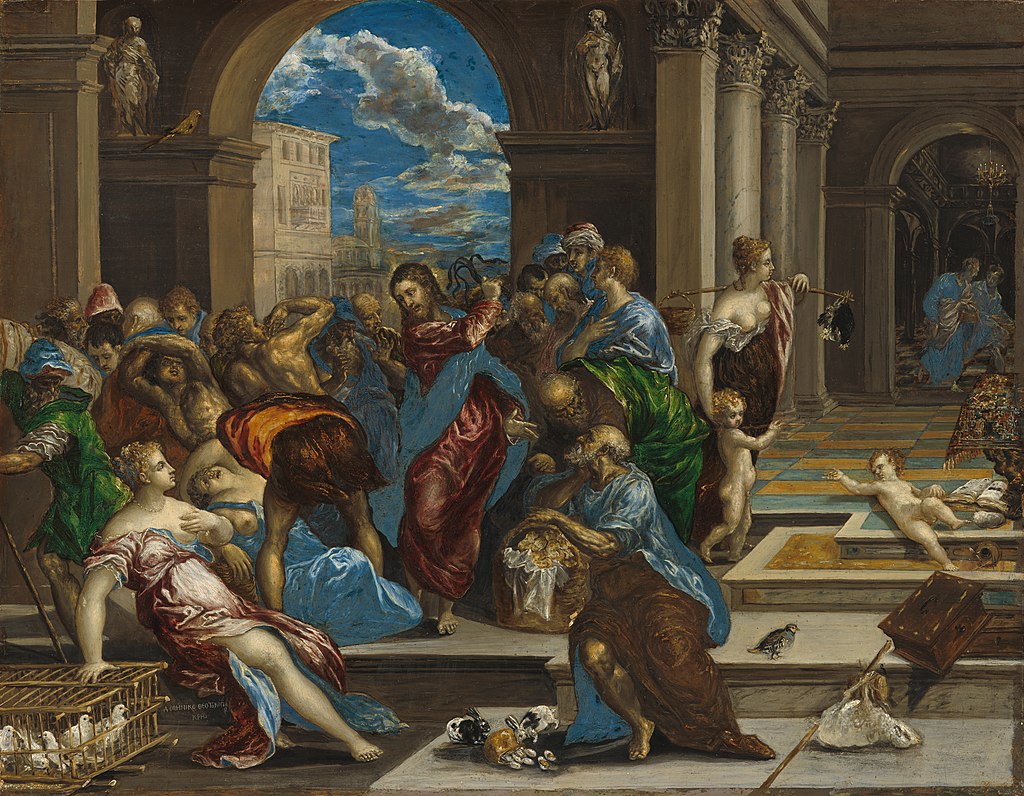
Third Sunday: Purifying the House of the Father
‘Take these things out of here! Stop making my Father’s house a marketplace! (Jn. 2:16).
The cleansing of the Temple speaks to the nature and purpose of worship and by extension, places of worship; our churches. To engage in the act of worship implies the recognition of something or someone greater than we are. This Someone is the living God who has fully and definitively revealed Himself in Christ Jesus Our Lord. Our response to this revelation is a religious response; and religion rightly ordered and practised elevates our human nature and causes us to ask questions that take us beyond the here and now. We ask why and to what end? These questions take us outside ourselves; and in worship that is rightly transcendent and therefore reverent, this is exactly what takes place: we are taken beyond our selves and we strain towards God and the very life of God. These questions are definitively answered by God Himself who through His revelation and the gift of grace offers us what we do not possess by nature; salvation and a partaking in His own life. Prayer nurtures and deepens this life. This is the purpose of worship and this may help us to understand Our Lord’s anger: Take these things out of here! Stop making my Father’s house a marketplace! (Jn. 2:16).
All four Gospels record the cleansing of the Temple and scholars tell us that the cleansing took place in what was known as the Court of the Gentiles or the outer court of the Temple. Those selling cattle, sheep and doves, as well as the money changers, were providing a legitimate service for pilgrims to the Temple because the Temple tax that had to be paid by any adult male over the age of twenty, and this had to be made with a Jewish coin. Hence the money changers were needed for those coming from elsewhere; and the availability of sacrificial animals was also convenient and necessary. The necessary commerce for the Temple sacrifices however, had been brought within the Temple precincts and this veritable marketplace had replaced the intended purpose of to the outer court or the Court of the Gentiles.
As its name indicates, the Court of the Gentiles (atrium gentium) was a space that everyone could enter and remain in, regardless of culture, language or religious profession It was a place where the rabbis and the teachers of the law gathered, ready to listen to people’s questions and to respond to these questions. It was a place of religious inquiry, and not intended as a place for commerce. The cleansing of the Temple, at a personal level, rightly invites each one of us to ask ourselves what our dispositions are when we come to Mass: Am I properly disposed to pray, to listen, to worship, to be formed by divine teaching? Do we offer God worship that is reverent? Do we endeavour to make it beautiful? Collectively, we might ask, is our worship in need of purification? These questions are certainly more than timely during the holy season of Lent.
It is important for us who live in a time in history when the sense of the sacred has been lost, to understand that when we come together to assist at the Holy Sacrifice of the Mass we come to worship God first and foremost. This is the stated purpose of this sacred temple and of every church or chapel where the Holy Sacrifice is offered. The words of the psalmist come to mind: I have loved, O Lord, the beauty of thy house; and the place where thy glory dwelleth (Ps. 26:8). Especially in view of the travesties imposed on our sacred worship by the circumstances of our times we must do all that we can to preserve and to instill a greater sense of the sacred because above all else, this is of the essence for a truly devout and holy life; a life in which we grow in God’s own likeness. As we worship so we become. The imposition of strictures and limitations imposed on our sacred worship by the health dictatorship have made a mockery of what passes for worship in so many churches. The sight of sacred ministers masked and muzzled in the holy presence of God, especially in the sacred precincts of the sanctuary is repellant to anyone with even a smidgeon of sensitivity for the sacred.
Reverence for the things of God, all of them individually and together produces in us a respect and reverence for ourselves and others and for the precious gift of life. How things are done in the worship of God is not a matter of taste and preference as recent history may have led us to believe. What we need to ask is what does God want in the way of Catholic worship? The answer is given by Our Lord Himself: But the hour is coming and now is, when the true worshippers will worship the Father in spirit and in truth, for such the Father seeks to worship Him (Jn. 4:22-23). This is why we have come to this temple, a consecrated and sacred edifice that foreshadows the Heavenly Jerusalem. We are here at the Saviour’s command, to be formed by divine teaching. Our Gospel text challenges each of us, especially during this Lenten season, to examine our own dispositions as we seek to know and to worship the living God. Is our attitude here one of reverence, of attentiveness of love for God? The nature and purpose of our worship is twofold: we are here to adore the living God who shares His life with us, and to deepen our life in Christ through our prayerful dialogue with Him, expressed through the living Word of God that is proclaimed and explained, through sacred hymns and canticles and through the ancient rites of the Church.
A few years ago, Robert Cardinal Sarah, the now former Prefect of the Congregation of Divine Worship wrote: We have just celebrated the centenary of Fatima and we are encouraged in waiting for the sure triumph of the Immaculate Heart of Mary that, in the end, the truth about the liturgy will also triumph. A lot has happened in the world and in the Church by consequence since these words were written. It would seem that, if anything, the sacred liturgy has been further violated and because of the lockdowns many Catholics, especially the nominal ones and the lukewarm have been further distanced from the Church and most importantly, the very heart of the Church, the Holy Sacrifice of the Mass. Communion services are no substitute for the Holy Sacrifice of the Mass and separation of Communion from the Sacrifice has done great harm generally speaking to a laity that has a weak sense of the sacred. This is to say nothing of the irreverence that has become a feature in the distribution of Holy Communion. There is a great need for reparation.
The truth about the liturgy more than anything is what the Church needs today: our poor Church, weakened as she is by the indifference and confusion of so many of her wayward children. The truth about the liturgy is the truth about God. Here He is truly Emmanuel, God with us; truly, substantially present and if we adore Him and here learn to love Him with all our heart and soul and mind and strength, then all be well. If our reception of the Eucharist includes adoration the graces we receive will be manifold. In His mercy, may God grant us a deeper spirit of humility and reverence in His presence; and may our reception of the Holy Eucharist so transform our lives that they may radiate with the knowledge, love and beauty of God; for beauty is at the heart of the Catholic understanding of everything (Paul Krause).

Saint Kateri , Canada’s Protectress
This was the title given to Saint Kateri Tekakwitha, by Pope Benedict XVI, when he canonized her on October 28th, 2012, along with six others, in Saint Peter’ Square (she had been beatified by Pope John Paul II back in 1980). With Saint Joseph as our protector, along with the Canadian martyrs, we seem to[…]Continue reading→

Remembering Father Alphonse de Valk
(Today marks the sixth anniversary of the death of Father Alphonse de Valk, C.S.B., a faithful, courageous and indefatigable Basilian priest, pro-life-and-family apostle, and the founder of Catholic Insight magazine. Here is what we wrote those on his entering into eternity five years ago, as we continue to remember him in our prayers and thoughts)[…]Continue reading→

My Name is Bernadette
April 16th is a propitious day, for besides the anniversary of Father de Valk’s death, who founded Catholic Insight in its print form decades ago, and the commemoration of the ‘two Benedicts’, mentioned in accompanying posts, today we also recall Saint Bernadette Soubirous, the young visionary to whom the Virgin Mary appeared numerous times at[…]Continue reading→
Canonizing Sister Faustina and Divine Mercy
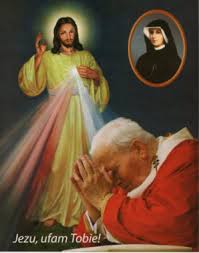
HOMILY OF THE HOLY FATHER MASS IN ST PETER’S SQUARE FOR THE CANONIZATION OF SR MARY FAUSTINA KOWALSKA Sunday, 30 April 2000 1. “Confitemini Domino quoniam bonus, quoniam in saeculum misericordia eius”; “Give thanks to the Lord for he is good; his steadfast love endures for ever” (Ps 118: 1). So the Church sings on the Octave of[…]Continue reading→

Divine Mercy Sunday – An Echo of Every Mass
Reach out your hand and put it in my side. Do not doubt but believe’… ‘My Lord and my God!’ (Jn. 20:18)). Today is Divine Mercy Sunday, and as we celebrate the end of the Easter Octave, we contemplate the wounded side of our Saviour, the Church’s source of life. On Good Friday in the[…]Continue reading→

Saint Stanislaus of Szczepanów
We celebrate Saint Stanislaus today (+ April 11, 1079), in light of this Easter Octave, a bishop and martyr who accepted the episcopacy only at the direct order of Pope Alexander II. He proved a wise and courageous leader of his flock, put to death by his own king, Boleslaus, for rebuking the monarch’s ‘immoral[…]Continue reading→
First Holy Communion: Sermon from May 16, 1943
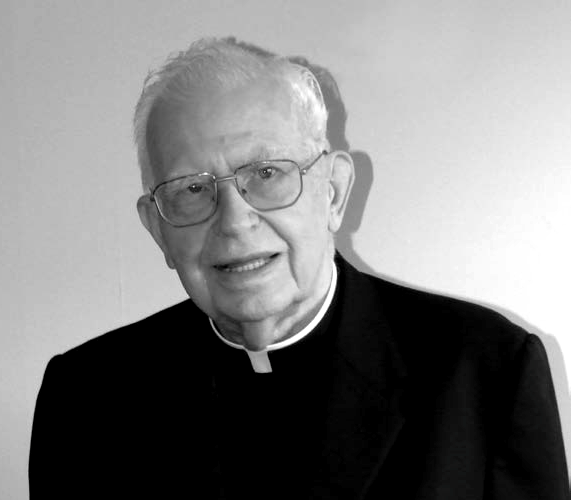
Here is a sermon from the good old days by +Rev. Msgr. Vincent Nicholas Foy (August 14, 1915 – March 13, 2017), from 1943. Readers may recall that Pope Saint Pius X, by the decree Quam Singulari in 1910, lowered the customary age of reception of Holy Communion – after the rigours of the plague[…]Continue reading→

In the Glorious Light of Easter, Alleluia!
Set your minds on things that are above, not on things that are on earth, for you have died, and your life is hidden with Christ in God. When Christ who is your life is revealed, then you also will be revealed with him in glory (Col. 3:3-4). The Resurrection of Our Lord and Saviour[…]Continue reading→

An Ancient Homily for Holy Saturday
The time between Good Friday and Easter Sunday is one of waiting, in silence, as the world wonders – anticipates – what will happen, after the death of Christ. We re-live this time each year in the anamnesis of our liturgy, and in turn look forward to the glorious re-creation of all things at the[…]Continue reading→
Europe’s Long Descent
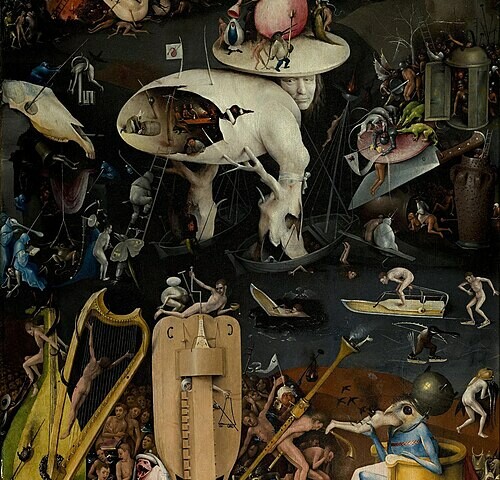
(As we meditate on this day on Christ’s burial, and His descent into hell, it is fitting to ponder here with contributor Peter Marcus how the world seems to be heading there as well. The difference is that, although God cannot ‘redeem’ hell, nor those therein, He can and did redeem the world. There is[…]Continue reading→