
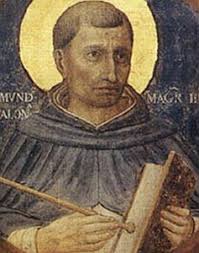
Saint Raymond, Pope Benedict and the Code of Canon Law
Today is the feast of Saint Raymond of Penyafort (1175-1275), one of the first Dominicans (officially known as the Order of Preachers) eventually becoming the third Master General of the Order (after Saint Dominic himself, and Jordan of Saxony), and a fellow Dominican with his even-more famous confrere, Thomas Aquinas, with whom he was contemporaneous (1225-1274). It was Raymond who encouraged Friar Thomas to write his Summa Contra Gentiles for the conversion of the ‘Moors’ (Spanish Muslims). Saint Raymond was one of the first modern compilers and codifiers of the Code of Canon Law, which before his time was scattered in numerous documents. The Code which he formulated, decreed by Pope Gregory IX (hence, known as the Decretals of Gregory IX), became the authoritative law of the Church for 700 years, until reformulated under the impetus of Pope St. Pius X and Benedict XV in 1917, then again under Pope Saint John Paul II in 1983. The current Code of Canon Law was promulgated that year on January 25. In honour of Saint Raymond, and the approaching anniversary, here is a meditation from 2008 on the beauty and purpose of Canon Law to clarify doctrine and discipline, by then-Pope Benedict XVI, who helped write the current Code. (Editor)
ADDRESS OF HIS HOLINESS BENEDICT XVI
TO THE PARTICIPANTS IN THE STUDY CONGRESS
ORGANIZED BY THE PONTIFICAL COUNCIL
FOR LEGISLATIVE TEXTS
ON THE OCCASION OF THE 25th ANNIVERSARY
OF THE PROMULGATION OF THE CODE OF CANON LAW
Hall of Blessings
Friday, 25 January 2008
Your Eminences,
Venerable Brothers in the Episcopate and in the Priesthood,
Distinguished Professors, Legal Professionals and All who Promote Canon Law,
I am delighted to be present at these last moments of the Study Congress organized by the Pontifical Council for Legislative Texts on the occasion of the 25th anniversary of the promulgation of the Code of Canon Law. You have reflected on: “Canon law in the life of the Church. Investigations and perspectives in keeping with the recent Papal Magisterium”. I cordially greet each one of you and in particular the President of the Pontifical Council, Archbishop Francesco Coccopalmerio, whom I thank for his courteous words to me on behalf of you all and for his reflections on the Code and on Church law. I likewise extend my thanks to the entire Pontifical Council, with its Members and Consultors, for the valuable collaboration it has offered to the Pope in the juridical and canonical context: in fact, the Dicastery is watchful in order to ensure that the Church’s legislation is complete, current and consistent. I take pleasure in recalling with deep gratitude to the Lord that I too contributed to the drafting of the Code, having been appointed by the Servant of God John Paul II, while I was Archbishop of Munich and Freising, a member of the Commission for the Revision of the Code of Canon Law, at whose promulgation on 25 January 1983 I was present.
The Congress that is being celebrated on this important anniversary treats a theme of great interest because it highlights the close link that exists between canon law and Church life in accordance with the desire of Jesus Christ. On this occasion I am therefore anxious to reaffirm a fundamental concept that imbues canon law. The ius ecclesiae is not only a body of norms formulated by the Ecclesial Legislator for this special people who form the Church of Christ. It is, in the first place, the authoritative declaration on the part of the Ecclesial Legislator of the duties and rights that are based in the sacraments and are therefore born from the institution by Christ himself. This series of juridical realties treated by the Code forms a wonderful mosaic in which are portrayed the faces of all the faithful, lay people and Pastors and all the communities, from the universal Church to the particular Churches. I am pleased here to quote Bl. Antonio Rosmini’s truly incisive words: “The human person is the essence of law” (Filosofia del diritto, Part I, bk I, ch. 3). What this great philosopher said with profound insight of human law, we must with all the more reason reassert for canon law: the essence of canon law is the Christian person in the Church.
Moreover, the Code of Canon Law contains the norms formulated by the Ecclesial Legislator for the good of the person and of the communities of the whole Mystical Body which is the Holy Church. As my beloved Predecessor John Paul II said in promulgating theCode of Canon Law on 25 January 1983, the Church is constituted as a social and visible structure; as such: The Church “must also have norms: in order that her hierarchical and organic structure be visible; in order that the exercise of the functions divinely entrusted to her, especially that of sacred power and of the administration of the sacraments, may be adequately organized; in order that the mutual relations of the faithful may be regulated according to justice based upon charity, with the rights of individuals guaranteed and well defined; in order, finally, that common initiatives undertaken for an ever more perfect Christian life may be sustained, strengthened and fostered by canonical norms” (Apostolic Constitution Sacrae disciplinae leges, 1983). The Church thus recognizes in her laws the nature as well as the means and pastoral function for pursuing her own end, which – as is well known – is the achievement of the “salus animarum”. “Canon law is thus shown to be related to the Church’s very nature; it is essential for the proper exercise of the munus pastorale…” (John Paul II, At the 10th Anniversary of the Promulgation of the Code of Canon Law, 23 April 1993, n. 6; ORE, 28 April, p. 2).
If canon law is to fulfil this invaluable service it must first of all be a well-structured law. In other words, on the one hand it must be bound to the theological foundation that gives it reasonableness and is an essential title of ecclesial legitimacy; on the other, it must keep up with the changing circumstances of the historical reality of the People of God. Furthermore, it must be formulated clearly, without ambiguity, and must always be in harmony with the rest of the Church’s laws.
It is therefore necessary to abrogate norms that prove antiquated; to modify those in need of correction; to interpret – in light of the Church’s living Magisterium – those that are doubtful, and lastly, to fill possible lacunae legis. As Pope John Paul II said to the Roman Rota: “The very many expressions of that flexibility which has always marked canon law, precisely for pastoral reasons, must be kept in mind and applied” (Address to the Roman Rota, 18 January 1990, n. 4). It is your task in the Pontifical Council for Legislative Texts to ensure that the work of the various bodies in the Church that are required to dictate norms for the faithful always reflects, all together, the unity and communion that are proper to the Church.
Since canon law outlines the rules necessary for the People of God to orient themselves effectively to their own end, one understands how important it is that this law be loved and observed by all the faithful. Church law is first and foremost lex libertatis: a law that sets us free to adhere to Jesus. It is therefore necessary to be able to present to the People of God, to the new generations and to all who are called to make canon law respected, its concrete bond with the life of the Church, in order to safeguard the delicate interests of the things of God and to protect the rights of the weakest, of those who have no other means by which to make their presence felt, and also in defence of those delicate “goods” which every member of the faithful has freely received – the gift of faith, of God’s grace, first of all -, which the Church cannot allow to be deprived of adequate protection on the part of the Law.
In the overall scheme outlined here, the Pontifical Council for Legislative Texts is required to be of assistance to the Roman Pontiff, the Supreme Legislator, in his task as the principal upholder, guarantor and interpreter of the Church’s law. In the fulfilment of this important office of yours, you can count on the Pope’s confidence as well as his prayers as he accompanies your work with his affectionate Blessing.

Carney’s Amoral Majority
After five defections – euphemistically described as ‘crossing the floor’ – and three by-elections, Mark Carney and his Liberals how have their coveted majority. One wonders what bowls of pottage were offered in back-room deals. In the archaic monarchical system that is the Dominion of Canada, this majority allows the newly-minted Prime Minister to rule[…]Continue reading→
A Closed, Unsustainable, Descending Loop
As a follow-up to my thoughts on Payette’s payout, here be a stark image of where are here in Canada. As the graph shows in, well, graphic terms, since 2025, the public sector has contributed to 95.5% of economic growth. The private sector – which funds the public sector, or is supposed to – has[…]Continue reading→

A Tale of Two Benedicts
A grace-filled Holy Week to all our readers! As we await and prepare for the Resurrection about to dawn upon us, we might keep in mind two Benedicts: Pope Emeritus Benedict XVI, requiescat in pace, elected on this day in 2005; and today’s commemoration of the mystic pilgrim, Benedict Joseph Labre, who died on this[…]Continue reading→
Presidential Pardon of Weronika Krawczyk
As a good news, follow-up to our story from Poland, of the persecution of Weronika Krawczyk for her pro-life views, we heard that she has been granted a presidential pardon. One might still wonder why one needs a presidential pardon for simply holding the long-held belief that the child within the womb is a child,[…]Continue reading→

Saint Lydwina of Schiedam and Suffering Joyfully
Saint Lydwina of Schiedam (1380 – 1433) was one of the countless and glorious ‘victim souls’ in the history of the Church, those whose lives are filled with suffering, often of an unimaginable intensity, but who suffer joyfully. She was a fifteen-year old Dutch girl, out skating one day, when she fell and broke one[…]Continue reading→

The Glorious Martyrdoms of Martin and Maximus
As we enter into Eastertide, we recall on this 13th of April Pope Saint Martin I (+655), one of the noblest, if most tragic, of the successors of Saint Peter. Born in Umbria, Italy, he was of noble lineage, with great intelligence combined with charity and love of the poor and the Church. While still[…]Continue reading→
Pope Leo and a Rosary for Peace
Pope Leo XIV has asked Catholics across the world to join him in a Rosary for peace today, at 18:00 Rome time (6 pm), which would be noon from where I write (EST). If you are able, whether at that time or another, and in whatever way you pray, to join in intercession with the[…]Continue reading→
Payette’s Payout
I was glancing through some headlines, and noticed a mention of Julie Payette – engineer and astronaut and sometime the Queen’s representative in Canada – which brought back vague memories. She was appointed Governor-General by Justin Trudeau in 2017. Ms. Payette resigned in 2021, amidst claims that she created a ‘toxic work environment’, with allegations[…]Continue reading→

Saint Stanislaus of Szczepanów
We celebrate Saint Stanislaus today (+ April 11, 1079), in light of this Easter Octave, a bishop and martyr who accepted the episcopacy only at the direct order of Pope Alexander II. He proved a wise and courageous leader of his flock, put to death by his own king, Boleslaus, for rebuking the monarch’s ‘immoral[…]Continue reading→

Saint Gemma Galgani
On this April 11th, in 1903 – the same year that the Italian Guiseppe Sarto was elected Pope later that summer as Pius X – a lovely, young Italian woman died, by the name of Gemma Galgani. She lived a brief life of 24 years, as did a number of other young saints, including Pier[…]Continue reading→