
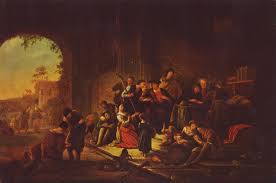
Who are the Workers in the Vineyard?
. . . the rabbis said: “Solomon had three thousand parables to illustrate each and every verse [of Scripture], and a thousand and five interpretations for each and every parable”—which computes to a total of three million fifteen thousand interpretations for every scriptural verse.[1]
Suppose we were to apply this statement to the Gospel about the labourers called to work in the vineyard at intervals throughout the day.
- To begin with, one could apply the different summons to various moments of conversion, the earliest corresponding to cradle Catholics and the last to a death-bed conversion. In this reading, that everyone received the same wage would correspond to the fact that the faithful Christian and the repentant sinner receive essentially the same reward, namely, the beatific vision.
- A second interpretation might note that the men that worked the entire day were better off than those that stood “idle all day in the market place.” Which is to be preferred: someone with a secure job and assured income or someone out of work, with no prospect of earning anything to care for his family? Surely the former.
- Perhaps Jesus wants each of us to realize that he is the one taken on at five in the afternoon, and hour before closing time. We are “unprofitable servants”[2] but amply rewarded by a merciful God.
- Or, again, we could note that some move rapidly along the road to sanctity, covering in an hour ground that other require a whole day to achieve. Thus, we see that Thérèse of Lisieux, who died at twenty-four, is as great a saint as John Henry Newman, who lived to be eighty-nine.
- Could we read the parable as a precis of the history of salvation, with the hard-working labourers compared to the Christians of the first centuries, who were austere in practice and faithful in trials that we softies could hardly bear. Perhaps, as a time line suggests, the first hour corresponds to the Apostolic Church; the nine o’clock would be the patristic period; noon, the Middle Ages, three in the afternoon, today. The five o’clock would then represent the end of time, when the final reckoning will take place: the wages.
- I wonder, too, if there is not a trinitarian allusion, by which the owner of the vineyard would correspond to the Father, the foreman to the Son, and the mysterious growth of the vines to the presence of the Holy Spirit. Granting this, we could interpret the vineyard as creation as a whole. It has to be worked on man as a sub-creator commissioned by God who is to bring forth what lies latent in the physical world in the various civilizations that have flourished across history. The foreman calls upon others to help according to their various abilities.
- Another approach would be to see the vineyard as representing the Church, as Our Lord himself suggested: “The harvest is plentiful, but the labourers are few; pray therefore the Lord of the harvest to send out labourers into his harvest.”[3] The fact that the labourers are in a vineyard suggest the Eucharist, with the clergy as the workers providing the super-substantial bread and wine of salvation.
- Surely, too, the various times of day have their significance, as in the monastic schedule. The monks assemble to sing the divine office every three hours, with Lauds at dawn, terce at six, prime at nine, sext at noon, none at three and vespers at five. Saint Benedict, in his Rule that governs monastic way of life referred to the Office as “working for God,” Opus Dei, and the monk is encouraged to come to each hour as if he were beginning to pray for the first time.
- More imaginatively, I may consider all the workers as representing me, at various times of my life. I am hired at dawn, at the beginning of my life when I was baptized, with all the energy of a young child. But I am summoned anew at nine, corresponding to the enthusiasm of youth. Noon would point to another new start, my maturity, when I shoulder successfully the responsibilities of my state in life. Three p.m., then, could point to retirement and the final hour to old age and, at the end my death.
- I see that I have said nothing about the querulous workers who complained when latecomers received a full day’s wage. The Pharisees of the Gospels come to mind, in their continual carping at the words and deeds of Jesus. We must note, however, that they embody the temptation of everyone who practises virtue, for the temptation to spiritual pride is the most insidious of all sins, in that it corrupts the very actions that should produce holiness. If you are reading this, it may be that you, like me, have difficulty in admitting that someone, late in life, could have an equal, if not greater, commitment to and love for Christ as we do.
Here, then, are ten of the 4,015,000 possible readings of the parable; I leave you, at your leisure, to come up with the other 4,014,990.
[1] Gerald L. Bruns, “Midrash and Allegory: The Beginnings of Scriptural Interpretation,” in The Literary Guide to the Bible, edited by Robert Alter and Frank Kermode (Cambridge [MS]: Harvard University Press, 1987), p. 630.
[2] Lk 17.10
[3] Matt 9.37-38.

Remembering Father Alphonse de Valk
(Today marks the sixth anniversary of the death of Father Alphonse de Valk, C.S.B., a faithful, courageous and indefatigable Basilian priest, pro-life-and-family apostle, and the founder of Catholic Insight magazine. Here is what we wrote those on his entering into eternity five years ago, as we continue to remember him in our prayers and thoughts)[…]Continue reading→

Divine Mercy Sunday – An Echo of Every Mass
Reach out your hand and put it in my side. Do not doubt but believe’… ‘My Lord and my God!’ (Jn. 20:18)). Today is Divine Mercy Sunday, and as we celebrate the end of the Easter Octave, we contemplate the wounded side of our Saviour, the Church’s source of life. On Good Friday in the[…]Continue reading→

Saint Stanislaus of Szczepanów
We celebrate Saint Stanislaus today (+ April 11, 1079), in light of this Easter Octave, a bishop and martyr who accepted the episcopacy only at the direct order of Pope Alexander II. He proved a wise and courageous leader of his flock, put to death by his own king, Boleslaus, for rebuking the monarch’s ‘immoral[…]Continue reading→
First Holy Communion: Sermon from May 16, 1943
Here is a sermon from the good old days by +Rev. Msgr. Vincent Nicholas Foy (August 14, 1915 – March 13, 2017), from 1943. Readers may recall that Pope Saint Pius X, by the decree Quam Singulari in 1910, lowered the customary age of reception of Holy Communion – after the rigours of the plague[…]Continue reading→
In the Glorious Light of Easter, Alleluia!
Set your minds on things that are above, not on things that are on earth, for you have died, and your life is hidden with Christ in God. When Christ who is your life is revealed, then you also will be revealed with him in glory (Col. 3:3-4). The Resurrection of Our Lord and Saviour[…]Continue reading→
An Ancient Homily for Holy Saturday
The time between Good Friday and Easter Sunday is one of waiting, in silence, as the world wonders – anticipates – what will happen, after the death of Christ. We re-live this time each year in the anamnesis of our liturgy, and in turn look forward to the glorious re-creation of all things at the[…]Continue reading→
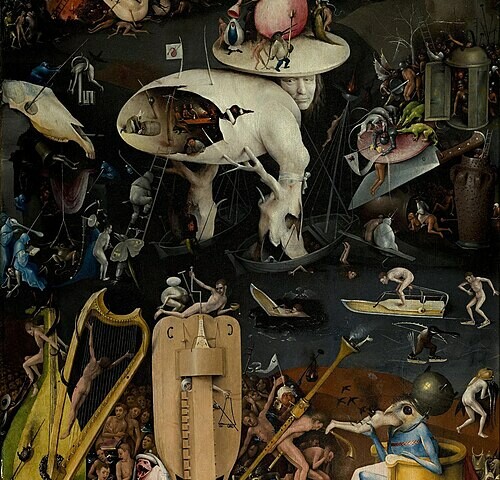
Europe’s Long Descent
(As we meditate on this day on Christ’s burial, and His descent into hell, it is fitting to ponder here with contributor Peter Marcus how the world seems to be heading there as well. The difference is that, although God cannot ‘redeem’ hell, nor those therein, He can and did redeem the world. There is[…]Continue reading→
Pope Saint John Paul II’s First Good Friday Homily
ADDRESS OF HIS HOLINESS JOHN PAUL II AT THE CONCLUSION OF THE STATIONS OF THE CROSS AT THE COLOSSEUM Good Friday, 13 April 1979 When we make the Way of the Cross from one station to the next, in spirit we are always at the spot wherethis journey had its “historical” place: where it[…]Continue reading→
A Meditation for Good Friday: How To Undo the Effects of Sin?
Cardinal Newman, now Saint John Henry Newman, was a towering figure of nineteenth-century Catholicism who is almost universally admired. I say “almost” because not everyone likes him. I knew a priest once, Arthur Caulkins, who has become disenchanted with Newman. As an undergraduate Arthur had been enamoured of Newman, and this interest continued when he[…]Continue reading→
Pope Benedict’s Last Holy Thursday Homily
MASS OF THE LORD’S SUPPER HOMILY OF HIS HOLINESS BENEDICT XVI Basilica of St John Lateran Holy Thursday, 5 April 2012 Photo Gallery (Video) Dear Brothers and Sisters! Holy Thursday is not only the day of the institution of the Most Holy Eucharist, whose splendour bathes all else and in some ways draws it to[…]Continue reading→