
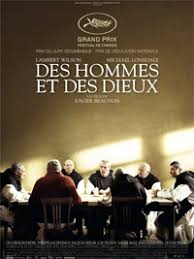
Contrasting Two Films: Of Gods and Men, and The Way
Of Gods and Men (2010), Directed by Xavier Beauvois, Written by Xavier Beauvois and Étienne Comar
The Way (2011), Directed by Emilio Estevez, Written by Emilio Estevez and Jack Hitt
It’s an axiom of literature and the cinema that bad characters are more interesting than good. What would Vanity Fair be without Becky Sharp or Batman without the Joker? It follows that traditional hagiography is often dull because there is no tension in the leading character. Old-fashioned saints are portrayed as consistently good and sure of themselves; the conflicts are all external. Even Maurice Cloche’s great film on Saint Vincent de Paul—Monsieur Vincent (1947)—has to work hard to surmount this unavoidable barrier. The two films here under review avoid this dramatic pitfall, each in its own way: Of Gods and Men by presenting the turmoil occasioned among a group of Christian monks by Algerian terrorists, and The Way by drawing a parallel between the pilgrim’s path to Santiago de Compostela and the road to conversion . . . of a sort.
In Into the Great Silence (2005), a compelling documentary on the Carthusians filmed at the Grande Chartreuse, the monks are real. Of Gods and Men,[1] on the other hand, uses actors to replicate the kidnapping and murder in 1996 of a group of Cistercian monks in Algeria by members of the GIA (Armed Islamic Group). Because of the skill of the actors, however, as well as their being relatively unknown to English-speaking audiences, the film is utterly convincing.
The French were in Algeria from the 1830s until independence in 1962. In one scene, the exploitation of Algeria by the French is cited by an official as the remote cause of the continuing terrorism, but the action of the film shows other aspects of the interaction between Europe and Africa: French is an almost universal second language, and the monks are a vital and beloved part of the Moslem community that has grown up around the monastery and looks upon it as a safeguard against the terrorists. The fact that the filming took place in a Trappist monastery in Morocco is another indication that the French presence was not exclusively self-serving. The action of the film, once the harmonious nature of the monks’ life inside and outside of the monastery walls has been established, occurs between the first, relatively benign irruption of the GIA and their murderous return. The spectre of “martyrdom” looms large and each monk reacts to it in his own way, from the phlegmatic “I’m staying” of avuncular old Brother Luc, the pharmacist/medic of the village, to the nuanced testament of the Abbot, Dom Christian, which was found after his death and is quoted in full at the end of the film.
S’il m’arrivait un jour—et ça pourrait être aujourd’hui—d’être victime du terrorisme qui semble vouloir englober maintenant tous les étrangers vivant en Algérie, j’aimerais que ma communauté, mon Église, ma famille, se souviennent que ma vie était DONNÉE à Dieu et à ce pays. . . .
(Should it ever befall me—and it could be today—to be a victim of the terrorism which seems now to want to engulf all the foreigners living in Algeria, I would desire that my community, my Church, my family remember that my life was GIVEN to God and to this country. . . .)
Twice in the film Dom Christian speaks at some length, once to the youngest monk, Christophe, who is unable to find strength or peace in prayer, and the second time to the monks gathered to decide whether to stay or to leave. To Christophe, he invokes an image from the third-century Egyptian desert where monasticism began: the monk dies when he enters the monastery, so that a radical separation from family, possessions and even, properly nuanced, from choice itself results. The love of God (beautifully invoked by Brother Luc in a conversation with a young Moslem woman) is a call to life, not death, and to hope, not despair. Then, to the group, Dom Christian describes the strength conferred by the monastic routine, coupled with the love of their Moslem neighbours, faithfully followed day by day. They serve the Prince of Peace, as we see in the strikingly elegant celebration of Midnight Mass that followed their first encounter with the terrorists. In this scene as throughout, the liturgical texts comment on the story, repeatedly reminding the monks of the cost in human terms of following a crucified Saviour: “he who loses his life will save it.” The beauty of the chant and the simplicity of the chapel demonstrate the strength that the monks derive from their faith, with the implication that gradual and non-violent change might have brought Algeria to a harmonious and stable independence without the ongoing violence that has marred the history of that country, as it has many of its northern African and Near-Eastern neighbours. The serenity of Dom Christian’s testament, written in the sure expectation of a violent death, i.e., of martyrdom, is an eloquent expression of what the monks had accomplished and of what the GIA destroyed:
Voici que je pourrai s’il plaît à Dieu, plonger mon regard dans celui du Père pour contempler avec lui ses enfants de l’Islam tels qu’il les voit, tout illuminés de la gloire du Christ, fruits de sa Passion, investis par le don de l’Esprit dont la joie secrète sera toujours d’établir la communion et de rétablir la ressemblance, en jouant avec les différences.
(This is what I shall be able to do, God willing: immerse my gaze in that of the Father, to contemplate with him his children of Islam, just as he sees them, all shining with the glory of Christ, the fruit of his Passion, filled with the gift of the Spirit, whose secret joy will always be to establish communion and restore the likeness, playing with the differences.)
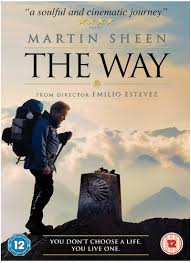
The Way threatens at every step to fall into a ditch labelled “cliché.” The motif of a journey has been exploited by artists since Abraham left Ur for Canaan or Odysseus, Troy for Ithaca. Thus, we know before we enter the theatre that healing will be sought and to some extent acquired on the pilgrimage and that there will be an interesting variety both in the characters, who will coalesce into a group, and also in incidents on the road, in this case, to Santiago de Compostela. These facts do not necessarily weaken a movie; they simply describe the challenge to the director, as one of the pilgrims—Jack, a madcap Irishman with writer’s block—actually tells us from the screen when we first meet him. A serious topic invites endless treatment; a triviality is exhausted at one go. There are still innumerable representations of the Madonna and Child to be made, whereas every Mickey Mouse is the mere repetition of a gigantic cultural fraud.
Jack has three ill-assorted companions: Sarah, a Canadian nicotine addict, Joost, a jolly fat Dutchman, and Tom (played by Martin Sheen), an American ophthalmologist whose son had died at the beginning of his own pilgrimage. Suspicion and even animosity give way to camaraderie, as we gradually learn the real reasons for the journey: Sarah has had an abortion she regrets; Joost’s marriage is troubled; Jack has had to abandon his serious literary ambitions; Tom had not appreciated his son, Daniel, especially in his desire to wander the world. “You don’t choose a life. You live one,” he had once told his father. In a clever touch, Martin Sheen’s biological son, Emilio Estevez, who also directed the film, plays the son in flashbacks, but also in silent apparitions along the way, smiling encouragement to his struggling father and even, towards the end of the movie, acting as one of the tiraboleiros—the men who have the honour of pulling the rope that sets in motion the enormous thurible of the shrine.
Thus, at the beginning, none of the four is ready to answer the frequently posed question, “Why are you on the camino to Santiago? Religion is not an immediate motive for any of them, as Tom points out to a priest who nevertheless gives him a rosary. And yet they severally experience something that helps them respond with reverence as they enter the magnificent church. Following custom, they continue on to the ocean shrine of Our Lady at Muxía, where we realize that the pilgrims have faced and presumably resolved the deeper troubles that had brought them to Spain. Sarah lights up as she turns back with a smile, Joost accepts himself as he is, flab and all, and Jack has in his notepad a book waiting to be assembled. Tom, the central character, finally lays his son to rest by spreading his remaining ashes on the stones beside the turbulent waters of the Atlantic. This is the final step of his journey during which he had symbolically adopted the persona of his son by scattering his ashes along the route. The silent presence of Daniel here and there along the way brings a resurrection theme to the movie that is realized in the final short scene. Tom is shown struggling through a crowd of Arabs, probably in Morocco, heeding at last his son’s advice, “You don’t choose a life. You live one.”
The United States, as everyone knows, is a religious country in a way that secularized France is not. It may seem surprising, therefore, that the American film sidesteps anything specifically religious even when our pilgrims enter the shrine. There’s a glimpse of Mass going on, and we watch the censer flying along its arced path, nothing more. Nor do they en route participate in any ceremony; in fact they see hardly any other pilgrims at all. The four of them are alone as they jostle against one another, eventually establishing an intense, if short-lived friendship of the sort that can spring up on an ocean cruise. The French film on the Algerian monk-martyrs, in contrast, is saturated with Catholicism. Given the topic, it could hardly be otherwise, but, nevertheless, the topic was chosen and brought to fruition in France. The difference may be accounted for on historical grounds. France was a thoroughly Catholic country, and remains so in the sense that whether religion is honoured or mocked, Catholicism will necessarily be the target. In the melting pot of the United States, however, religion has entered the cultural atmosphere as an elusive scent can pervade the ambience of a room. Thus, in an American film religious and moral values will be honoured, but left intentionally vague. Sarah’s monologue about her lost baby is a good illustration of the difference. In no other western country has the pro-life cause anything like the political respectability it has in the States, so that in no other country could a character in a movie have spoken as she did. But her speech has no follow-up, such as going to confession, publicly professing her faith in Jesus, or any other action by which she could have been assured of reconciliation with God. The healing is portrayed as completely inward, with the implication that religion is more sentiment than fact, useful in situations of moral distress in that it provides relief from guilt, but without requiring radical change; Sarah, as we see, continues to smoke. Tom at least keeps his backpack on as he heads into the unknown, searching for a mysterious something, represented by Daniel, that will allow him truly to live. The Way thus suggests that the modern mode of life at best functions as a propaedeutic to the Gospel. Of Gods and Men reveals what Tom and his friends should have found at the end of the camino to Santiago de Compostela.
[1] The title comes from Psalm 81 (82): “I say you are gods, sons of the Most High, all of you. Nevertheless, you shall die like men.”

Saint Kateri , Canada’s Protectress
This was the title given to Saint Kateri Tekakwitha, by Pope Benedict XVI, when he canonized her on October 28th, 2012, along with six others, in Saint Peter’ Square (she had been beatified by Pope John Paul II back in 1980). With Saint Joseph as our protector, along with the Canadian martyrs, we seem to[…]Continue reading→

Remembering Father Alphonse de Valk
(Today marks the sixth anniversary of the death of Father Alphonse de Valk, C.S.B., a faithful, courageous and indefatigable Basilian priest, pro-life-and-family apostle, and the founder of Catholic Insight magazine. Here is what we wrote those on his entering into eternity five years ago, as we continue to remember him in our prayers and thoughts)[…]Continue reading→

My Name is Bernadette
April 16th is a propitious day, for besides the anniversary of Father de Valk’s death, who founded Catholic Insight in its print form decades ago, and the commemoration of the ‘two Benedicts’, mentioned in accompanying posts, today we also recall Saint Bernadette Soubirous, the young visionary to whom the Virgin Mary appeared numerous times at[…]Continue reading→

Canonizing Sister Faustina and Divine Mercy
HOMILY OF THE HOLY FATHER MASS IN ST PETER’S SQUARE FOR THE CANONIZATION OF SR MARY FAUSTINA KOWALSKA Sunday, 30 April 2000 1. “Confitemini Domino quoniam bonus, quoniam in saeculum misericordia eius”; “Give thanks to the Lord for he is good; his steadfast love endures for ever” (Ps 118: 1). So the Church sings on the Octave of[…]Continue reading→

Divine Mercy Sunday – An Echo of Every Mass
Reach out your hand and put it in my side. Do not doubt but believe’… ‘My Lord and my God!’ (Jn. 20:18)). Today is Divine Mercy Sunday, and as we celebrate the end of the Easter Octave, we contemplate the wounded side of our Saviour, the Church’s source of life. On Good Friday in the[…]Continue reading→

Saint Stanislaus of Szczepanów
We celebrate Saint Stanislaus today (+ April 11, 1079), in light of this Easter Octave, a bishop and martyr who accepted the episcopacy only at the direct order of Pope Alexander II. He proved a wise and courageous leader of his flock, put to death by his own king, Boleslaus, for rebuking the monarch’s ‘immoral[…]Continue reading→
First Holy Communion: Sermon from May 16, 1943
Here is a sermon from the good old days by +Rev. Msgr. Vincent Nicholas Foy (August 14, 1915 – March 13, 2017), from 1943. Readers may recall that Pope Saint Pius X, by the decree Quam Singulari in 1910, lowered the customary age of reception of Holy Communion – after the rigours of the plague[…]Continue reading→
In the Glorious Light of Easter, Alleluia!
Set your minds on things that are above, not on things that are on earth, for you have died, and your life is hidden with Christ in God. When Christ who is your life is revealed, then you also will be revealed with him in glory (Col. 3:3-4). The Resurrection of Our Lord and Saviour[…]Continue reading→
An Ancient Homily for Holy Saturday
The time between Good Friday and Easter Sunday is one of waiting, in silence, as the world wonders – anticipates – what will happen, after the death of Christ. We re-live this time each year in the anamnesis of our liturgy, and in turn look forward to the glorious re-creation of all things at the[…]Continue reading→
Europe’s Long Descent
(As we meditate on this day on Christ’s burial, and His descent into hell, it is fitting to ponder here with contributor Peter Marcus how the world seems to be heading there as well. The difference is that, although God cannot ‘redeem’ hell, nor those therein, He can and did redeem the world. There is[…]Continue reading→