
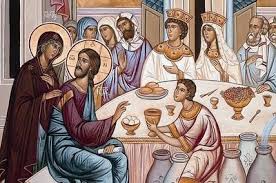
The Persistent Virtue of Woman
A Canaanite woman . . . cried out, “Have mercy on me, O Lord, Son of David; my daughter is severely possessed by a demon.” . . .He answered, “I was sent only to the lost sheep of the house of Israel.” . . . It is not fair to take the children’s bread and throw it to the dogs.” She said, “Yes, Lord, yet even the dogs eat the crumbs that fall from their masters’ table.” Then Jesus answered her, “O woman, great is your faith! Be it done for you as you desire.”[1]
It would be a brave man indeed who would dare say anything about feminism, especially from the pulpit in a Catholic church, but today’s Gospel makes the topic unavoidable. The Canaanite woman strikes me as the epitome of what is most attractive in women. Not only that, she plays an important role in the history of salvation, for she was—humanly speaking—the means by which Jesus changed his mind and, for the first time, welcomed gentiles into the kingdom. No long is it,” I was sent only to the lost sheep of the house of Israel”; now we hear him say, “O woman, great is your faith!”
What magic did she work to effect this change? It’s all there, in this brief passage from Saint Matthew: she’s charming, highly motivated and witty, even cheeky. When Jesus insults her—not too strong a term—by comparing her to a dog[2] that would snatch the children’s food, she replies, in effect, “I may be like a dog; but all I want is, really, merely a crumb.” One can almost picture Jesus’ amused smile, delighted at her ready wit. But the quintessential feminine quality that won the day is none of these. Women gain what they want by persistence. I am not as rash as to say this on my own. Rather, I invoke one of the most widely recognized and highly esteemed of female thinkers who has herself identified persistence as the trait most characteristic of women. I refer to none other than Jane Austen. In her last novel, Persuasion, the heroine, Anne Elliot, has a debate with a Captain Harville on the differences between men and women, specifically concerning the ways in which men and women experience love. Anne clinches her position with the following statement:
I believe you [men] equal to every important exertion . . . so long as . . . you have an object. I mean, while the woman you love lives, and lives for you. All the privilege I claim for my own sex (it is not a very enviable one, you need not covet it) is that of loving longest, when existence or when hope is gone.[3]
The insight here expressed is confirmed over and over again in the New Testament where the persistence of women is recognized and honoured. Do you recall the widow whose unrelenting demands wore down the resistance of the unjust judge? Or Our Lady, at Cana when the wine ran out? Or Mary Magdalene who remained at the tomb after the Apostles had left, and was rewarded with the first appearance of the risen Lord? Or the woman who swept and cleaned until she found the coin she had lost? Or, for that matter, the Canaanite woman of today’s Gospel?
Psychologists like to remind us that everyone has qualities of both sexes: there’s a feminine side to the most macho of men and a masculine element in every woman. We are further, insistently told that women are equal to men. But before feminism, it was widely held that women were not equal to men; they were superior. Dante knew it, with Beatrice and Shakespeare with Rosalind; G. K. Chesterton recognized it in his wife, Frances, and Irving Berlin in Annie, Get Your Gun (1946), where Annie Oakley out-sings her male rival: “Anything you can do, I can do better.” Even as far back as the days of the Roman Empire, the poet Horace wrote a charming ode in which two former lovers exchange barbs; the woman betters the man each time.[4] Well, it’s time, is it not, that men strive to rise to the level of women, and to achieve equality by learning to persevere “even when existence, or when hope [seems] gone.” For there is an object that commands our love with all the powers and permanence we can muster: our Saviour, Jesus Christ, in whom “all the fulness of God was pleased to dwell.”[5]
[1] Matt 15.23-28
[2] Biblical scholars have noted that the word used for “dog” in the Greek text is a diminutive, which can be seen as softening the harsh reference to pagans.
[3] Chapter 23.
[4] Odes, III.9
[5] Col 1.19.

Saint Kateri , Canada’s Protectress
This was the title given to Saint Kateri Tekakwitha, by Pope Benedict XVI, when he canonized her on October 28th, 2012, along with six others, in Saint Peter’ Square (she had been beatified by Pope John Paul II back in 1980). With Saint Joseph as our protector, along with the Canadian martyrs, we seem to[…]Continue reading→

Remembering Father Alphonse de Valk
(Today marks the sixth anniversary of the death of Father Alphonse de Valk, C.S.B., a faithful, courageous and indefatigable Basilian priest, pro-life-and-family apostle, and the founder of Catholic Insight magazine. Here is what we wrote those on his entering into eternity five years ago, as we continue to remember him in our prayers and thoughts)[…]Continue reading→

My Name is Bernadette
April 16th is a propitious day, for besides the anniversary of Father de Valk’s death, who founded Catholic Insight in its print form decades ago, and the commemoration of the ‘two Benedicts’, mentioned in accompanying posts, today we also recall Saint Bernadette Soubirous, the young visionary to whom the Virgin Mary appeared numerous times at[…]Continue reading→

Canonizing Sister Faustina and Divine Mercy
HOMILY OF THE HOLY FATHER MASS IN ST PETER’S SQUARE FOR THE CANONIZATION OF SR MARY FAUSTINA KOWALSKA Sunday, 30 April 2000 1. “Confitemini Domino quoniam bonus, quoniam in saeculum misericordia eius”; “Give thanks to the Lord for he is good; his steadfast love endures for ever” (Ps 118: 1). So the Church sings on the Octave of[…]Continue reading→

Divine Mercy Sunday – An Echo of Every Mass
Reach out your hand and put it in my side. Do not doubt but believe’… ‘My Lord and my God!’ (Jn. 20:18)). Today is Divine Mercy Sunday, and as we celebrate the end of the Easter Octave, we contemplate the wounded side of our Saviour, the Church’s source of life. On Good Friday in the[…]Continue reading→

Saint Stanislaus of Szczepanów
We celebrate Saint Stanislaus today (+ April 11, 1079), in light of this Easter Octave, a bishop and martyr who accepted the episcopacy only at the direct order of Pope Alexander II. He proved a wise and courageous leader of his flock, put to death by his own king, Boleslaus, for rebuking the monarch’s ‘immoral[…]Continue reading→

First Holy Communion: Sermon from May 16, 1943
Here is a sermon from the good old days by +Rev. Msgr. Vincent Nicholas Foy (August 14, 1915 – March 13, 2017), from 1943. Readers may recall that Pope Saint Pius X, by the decree Quam Singulari in 1910, lowered the customary age of reception of Holy Communion – after the rigours of the plague[…]Continue reading→
In the Glorious Light of Easter, Alleluia!
Set your minds on things that are above, not on things that are on earth, for you have died, and your life is hidden with Christ in God. When Christ who is your life is revealed, then you also will be revealed with him in glory (Col. 3:3-4). The Resurrection of Our Lord and Saviour[…]Continue reading→
An Ancient Homily for Holy Saturday
The time between Good Friday and Easter Sunday is one of waiting, in silence, as the world wonders – anticipates – what will happen, after the death of Christ. We re-live this time each year in the anamnesis of our liturgy, and in turn look forward to the glorious re-creation of all things at the[…]Continue reading→

Europe’s Long Descent
(As we meditate on this day on Christ’s burial, and His descent into hell, it is fitting to ponder here with contributor Peter Marcus how the world seems to be heading there as well. The difference is that, although God cannot ‘redeem’ hell, nor those therein, He can and did redeem the world. There is[…]Continue reading→