
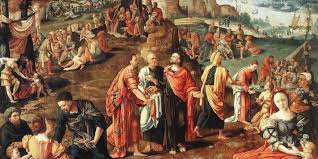
Eighteenth Sunday: Earthly and Heavenly Eutopia
The feast described by the prophet Isaiah in today’s first reading, with its “wine, milk and rich food,” was for the Jews a symbol of the messianic era in which Solomon’s kingdom would be re-established by the long-awaited Messiah.[1] This expectation points to something deeply rooted in the human psyche in the near-universal desire for an ideal society. Where there is no confidence that God will one day bring it about, man sets about attempting to achieve it in the here and now, with disastrous results. Hitler’s thousand-year Reich ended after ten years of bloodshed and cruelty on an –until then—unimaginable scale. Communism, too, wherever it has taken over, continues in power by coercion, brutality and injustice. Even capitalist America, starting with the Pilgrim Fathers, has viewed itself as the promised land and “the city on the hill,”[2] a conviction that has had a long history—“The promised kingdom is America now”[3]—and continues to be honoured even amidst the turmoil of civil unrest.
Monasticism is a Christian method of realizing the messianic era in the present age, but with radically different principles. It is an ideal society in that it realizes on earth the heavenly existence, the angelic life of Matthew 22.30: “For in the resurrection they neither marry nor are given in marriage, but are like angels in heaven.” The separation from society required of monasticism finds a parallel in sects such as the Amish. Their starting point, however, is radically different from that of monasticism, which sees itself as an anticipation of heaven, and hence as a sign of hope for all believers who, one day we pray, will join the monks in praising God for all eternity. The Amish, on the other hand, want to build God’s kingdom on earth by separating those predestined to heaven from the “City of Destruction,”[4] i.e., from the predestined to eternal damnation.[5]
Today’s Gospel, certainly a version of the messianic banquet, is a corrective to any false messianism. The point is that Isaiah’s ideal prophecy is only partially fulfilled in the multiplication of the loaves and fishes. We know that from the fact that, although 5,000 men were fed, not counting women and children, twelve baskets of fragments were collected and therefore remain for future use. The number twelve indicated fullness, as in the twelve months of the year and, more significantly, the twelve tribes of Israel, with their counterpart in the twelve Apostles. The twelve baskets, therefore, contain enough to feed everyone, whether from the old Israel or the new, what Saint Paul termed “the Israel of God.”[6]
Surely the bread that the 5,000 ate was the best bread they had ever tasted! Besides that, it has a purpose that interests us today, in that the people were hungry and far from home: it was food for the journey, that is, viaticum. You may have heard this term used for Holy Communion administered to a dying person, where it is indeed food for a journey, from this life into eternity. But the Eucharist is also food for all of us on our journey through life. Without it, we must faint on the way, but once fed with the “bread of God”,[7] the manna from heaven, we can say with Saint Paul:
For I am sure that neither death, nor life, nor angels, nor principalities, nor things present, nor things to come, nor powers, nor height, nor depth, nor anything else in all creation, will be able to separate us from the love of God in Christ Jesus our Lord.[8]
[1] Shiite Islam has adopted, and adapted, this element of Judaism: “He [the Imam Muhammad al-Muntazar] would return as a messianic figure, the Mahdi [the expected one], at the end of the world to vindicate his loyal followers, restore the community to its rightful place, and usher in a perfect Islamic society in which truth and justice will prevail.” John L. Esposito, Islam: The Straight Path (London: Oxford University Press, 1988), pp. 46-47.
[2] Matt 5.14.
[3] David Lyle Jeffrey, People of the Book: Christian Identity and Literary Culture (Grand Rapids [MI]: Wm. B. Eerdmans, 1996), p. 333, quoting a televangelist.
[4] Is 19.18, John Bunyan’s source for its use in The Pilgrim’s Progress.
[5] John Calvin’s Geneva is another instance of a society composed of the elect, a theocracy under Calvin, God’s appointee. Cf. David Foxgrover, “Calvin as a Reformer: Christ’s Standard-Bearer,” in Leaders of the Reformation, ed. Richard L. DeMolen (London: Associated University Press, 1984), p. 178-200.
[6] Gal 6.16.
[7] Jn 6.33.
[8] Rom 8.38-39; from the second reading.

Remembering Father Alphonse de Valk
(Today marks the sixth anniversary of the death of Father Alphonse de Valk, C.S.B., a faithful, courageous and indefatigable Basilian priest, pro-life-and-family apostle, and the founder of Catholic Insight magazine. Here is what we wrote those on his entering into eternity five years ago, as we continue to remember him in our prayers and thoughts)[…]Continue reading→

Divine Mercy Sunday – An Echo of Every Mass
Reach out your hand and put it in my side. Do not doubt but believe’… ‘My Lord and my God!’ (Jn. 20:18)). Today is Divine Mercy Sunday, and as we celebrate the end of the Easter Octave, we contemplate the wounded side of our Saviour, the Church’s source of life. On Good Friday in the[…]Continue reading→

Saint Stanislaus of Szczepanów
We celebrate Saint Stanislaus today (+ April 11, 1079), in light of this Easter Octave, a bishop and martyr who accepted the episcopacy only at the direct order of Pope Alexander II. He proved a wise and courageous leader of his flock, put to death by his own king, Boleslaus, for rebuking the monarch’s ‘immoral[…]Continue reading→

First Holy Communion: Sermon from May 16, 1943
Here is a sermon from the good old days by +Rev. Msgr. Vincent Nicholas Foy (August 14, 1915 – March 13, 2017), from 1943. Readers may recall that Pope Saint Pius X, by the decree Quam Singulari in 1910, lowered the customary age of reception of Holy Communion – after the rigours of the plague[…]Continue reading→

In the Glorious Light of Easter, Alleluia!
Set your minds on things that are above, not on things that are on earth, for you have died, and your life is hidden with Christ in God. When Christ who is your life is revealed, then you also will be revealed with him in glory (Col. 3:3-4). The Resurrection of Our Lord and Saviour[…]Continue reading→

An Ancient Homily for Holy Saturday
The time between Good Friday and Easter Sunday is one of waiting, in silence, as the world wonders – anticipates – what will happen, after the death of Christ. We re-live this time each year in the anamnesis of our liturgy, and in turn look forward to the glorious re-creation of all things at the[…]Continue reading→

Europe’s Long Descent
(As we meditate on this day on Christ’s burial, and His descent into hell, it is fitting to ponder here with contributor Peter Marcus how the world seems to be heading there as well. The difference is that, although God cannot ‘redeem’ hell, nor those therein, He can and did redeem the world. There is[…]Continue reading→
Pope Saint John Paul II’s First Good Friday Homily
ADDRESS OF HIS HOLINESS JOHN PAUL II AT THE CONCLUSION OF THE STATIONS OF THE CROSS AT THE COLOSSEUM Good Friday, 13 April 1979 When we make the Way of the Cross from one station to the next, in spirit we are always at the spot wherethis journey had its “historical” place: where it[…]Continue reading→
A Meditation for Good Friday: How To Undo the Effects of Sin?
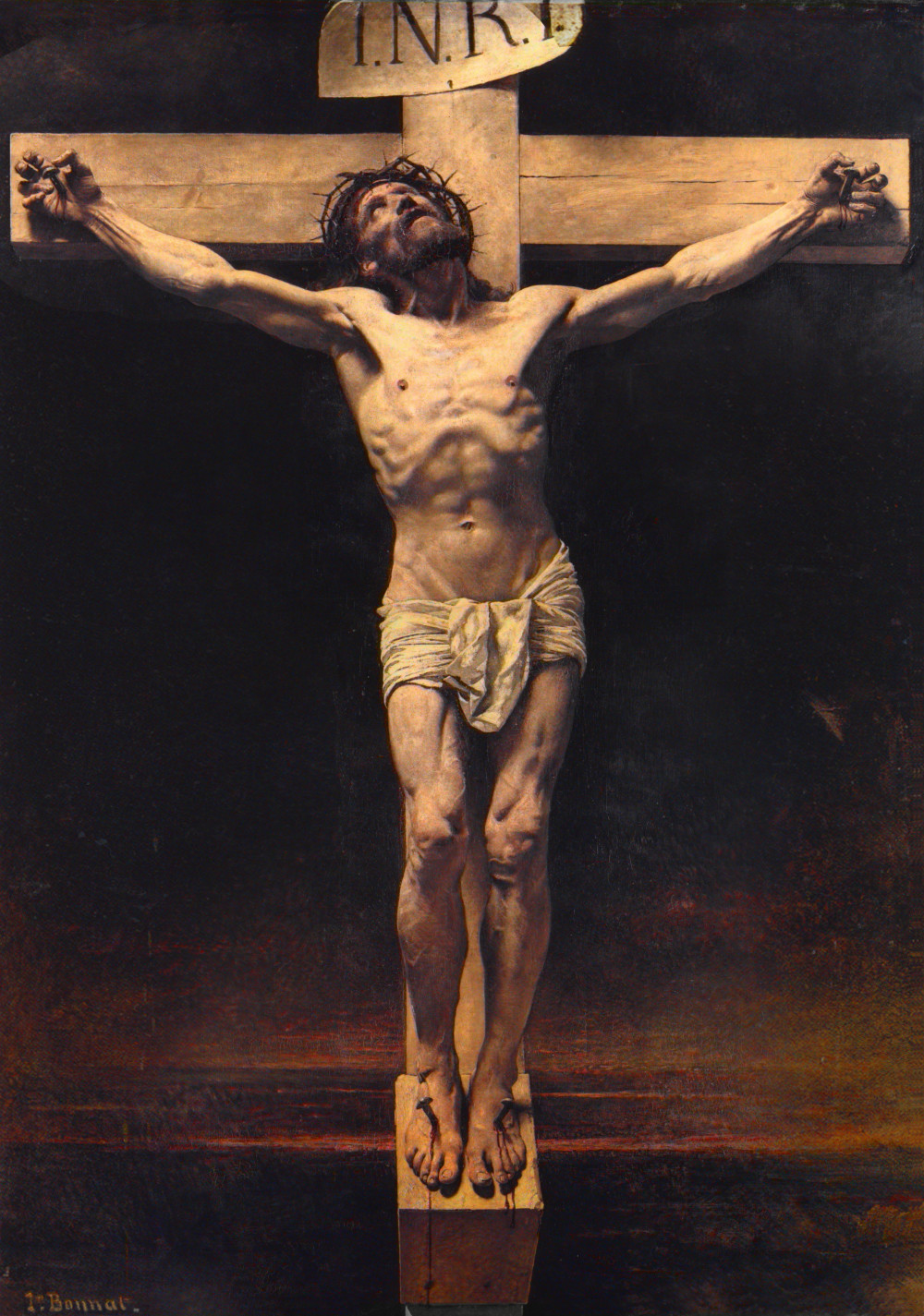
Cardinal Newman, now Saint John Henry Newman, was a towering figure of nineteenth-century Catholicism who is almost universally admired. I say “almost” because not everyone likes him. I knew a priest once, Arthur Caulkins, who has become disenchanted with Newman. As an undergraduate Arthur had been enamoured of Newman, and this interest continued when he[…]Continue reading→
Pope Benedict’s Last Holy Thursday Homily
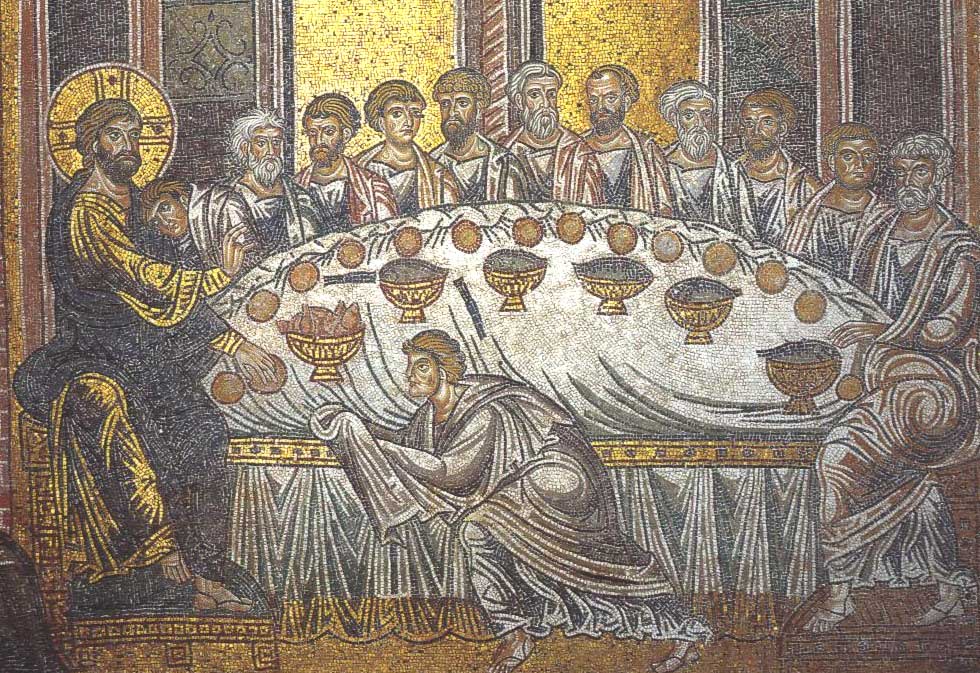
MASS OF THE LORD’S SUPPER HOMILY OF HIS HOLINESS BENEDICT XVI Basilica of St John Lateran Holy Thursday, 5 April 2012 Photo Gallery (Video) Dear Brothers and Sisters! Holy Thursday is not only the day of the institution of the Most Holy Eucharist, whose splendour bathes all else and in some ways draws it to[…]Continue reading→