
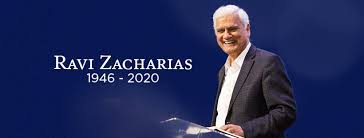
No Stone Left Unturned: Thoughts on Ravi Zacharias’s Mission
On May 19, Ravi Zacharias died at his home in Atlanta from a rare cancer known as sarcoma which was found as a malignant tumor on his sacrum. At his memorial, American Vice President, Mike Pence and baseballer, Tim Tebow both spoke of him with unqualified praise. In his speech, Pence repeated a statement issued by President Trump: “making the intellectual case for Christianity, Ravi Zacharias was instrumental in helping millions of people around the world come to know the love and mercy of Jesus Christ.”
A Remarkable Journey and Legacy
Zacharias was born in 1946 in Chennai, India but raised in New Delhi. In the 1960s he emigrated with his family to Canada. He was a dual citizen of Canada and the USA. His family were descendants of the highest caste of Hindu priests; however, they were converted to Christianity by missionaries. Despite this, throughout his youth, he was not deeply religious. When he was 17 years old, he attempted to take his life through ingesting poison. At the time, Zacharias suffered from some bouts of depression and existential angst. As a child he had aspirations of becoming a professional cricket or tennis player, but unfortunately, he lacked the talent to reach such levels. He was also a poor student, and this was met with corporal punishment from his father. Nevertheless, before his suicide attempt, he had accepted Christ into his life but had become disfavoured by his father for doing so. These, among other circumstances, led to Zacharias’s attempt to take his own life. On his death bed, he was visited by Fred David an American preacher who worked for Youth For Christ International. David read for Zacharias John 14:6, “Jesus answered, ‘I am the way and the truth and the life. No one comes to the Father except through me’”, and John 14:19, ‘Because I live, you also shall live.’ The latter defined and influenced the rest of his life.
Shortly thereafter, David invited Zacharias into a preaching competition, reluctantly, Zacharias obliged. He was declared a co-winner, and this became the seeds of a remarkable journey for Zacharias. In 2013, David passed away and had the following words to say to Zacharias: ‘I sit down sometimes and watch you on YouTube, and the tears run down my face and I think to myself the main reason God brought me into this world was to bring that Bible to you.’ Since that fateful encounter, Zacharias, in 1984 founded his own ministry: Ravi Zacharias International Ministries (RZIM) which comprises a global team with offices around the world including itinerant speakers some of whom are professional philosophers. Zacharias had become one of the most talented, evocative and effective Christian speakers and apologists of the past 50 years; he had authored over 30 books; he preached and became quite comfortable at major secular university campuses throughout the world; he spoke to political and religious leaders around the world; he studied under the tutelage of intellectual giants of the Christian faith such as Norman Geisler and John Warwick Montgomery; and had debated alongside arguably the greatest Christian debater of our time, William Lane Craig. Interestingly, in 1973, both studied together at Trinity Evangelical School.
Zacharias’s ministry, without a doubt, has impacted millions throughout the world. Even in 2019, he was one of the most requested guests for both The Ben Shapiro Show and The Rubin Report. As a Catholic, and never having had the privilege of meeting Zacharias, I am nevertheless thankful for his ministry. Zacharias’s words have brought much light upon dark periods of my life.
Although he was not a professional philosopher or theologian, Zacharias did not give simplistic answers to difficult questions regarding the Christian faith, including the existence of God, the problem of evil and suffering, the trustworthiness of the bible, the afterlife, homosexuality, religious pluralism, the exclusivity of salvation through Christ, totalitarian regimes and the suppression of faith, poverty, suicide and host of other existential issues. He was a world-class Christian apologist who had many talents including a facility with words and a tremendous ability to captivate audiences, alongside a bleeding heart to defend the Christian faith; one that was sufficiently compelling for the conversion of many students and outsiders of the faith. Zacharias saw the importance in ministering to the individual, not just responding to questions and presenting arguments. The questioner was more important than the question to him. As so often is the case, the rejection of God and obstacles to the Christian faith stem from personal experiences rather than merely intellectual roadblocks. The intellectual questions often function as a mask for hiding something much more hidden, as is the case with personal suffering and disappointment.
Discrepancies in Apologetic Approaches between Protestants and Catholics for Evangelization
Zacharias’s approach to evangelization was unique at the time in that it brought back apologetics to its fore. Standard evangelization, at the time, proved to be insufficient without a rational justification for the Christian faith. The times were changing, and people were asking difficult questions that required intellectual responses. Apologetics is nothing new and has been used since the time of St. Paul, not only to edify the faith of believers, but for also the conversion of outsiders (Jews and pagans of his time). There is a negative, or defensive, element of apologetics which defends the faith from criticisms, as well as a positive aspect which argues for the truth of Christian doctrines. This has been a formidable tool for defending the faith but had been largely ignored and downplayed by clergy throughout Christendom. Unfortunately, there has remained an intellectual void among laypersons within Christendom whether Protestant, Catholic or Eastern Orthodox. Christians, in general, simply do not understand nor are they equipped to defend their faith to individuals of other faiths or secular beliefs. Zacharias’s ministry among many others, whether Catholic, Protestant or Orthodox have helped reverse the tide, but there remains a lot of work to be done.
Catholicism has a rich intellectual tradition which dates to the early Church fathers of the first and second centuries such as Clement of Rome, Mathetes, Polycarp, Ignatius, Barnabas, Papias, Justin Martyr, and Irenaeus. All of these figures were winsome in their preaching while also rigorous in their persuasion through apologetics. Unfortunately, this was largely forgotten through the early period of the twentieth century and its ramifications are manifested in the ignorance of the average Christian, despite the resurgence of apologetics in Protestant and Catholic circles.
Protestants’ use of apologetics is found in the defense of particular doctrines and claims made of the Christian faith. Whereas, traditionally, Catholic apologetics has been embedded within fundamental theology and has always been a deep aspect of the faith. In contrast, Protestant thinkers such as Martin Luther disparaged philosophy and bifurcated faith and reason, however inconsistently. Other examples include the work of Soren Kierkegaard who espoused fideism – the view that maintains that faith is independent of reason. It wasn’t until the works of Joseph Butler and William Paley, that apologetics was made great use of in Protestant thought.
In recent years, Catholic philosophers such as Peter Kreeft and theologians like Scott Hahn saw much value in the Catholic tradition. They had carefully investigated the truth of Catholicism in contrast with their previously held Potestant beliefs, and eventually converted to Catholicism. Unlike Protestantism, Catholicism extends beyond Christian revelation. The movements throughout both the apostolic and subapostolic periods from the end of the first century to the beginning of the second century, demonstrate that the true fruits of Christianity extend beyond individual belief and practice but to the inseparable historicity of the Church from a tangible social organization. This is why Catholic apologetics continues its apologetic even further, to defend Christ’s true Church as identified with the Roman Catholic Church.
Interestingly, in recent years, Evangelical mega-churches have been embracing some Catholic traditions. New Life Church which comprises 10, 000 members now recites the Nicene Creed (recognized as a statement of faith), follows and teaches about the liturgical calendar, offers Communion on Sunday mornings, and most remarkably provides shelter for homeless unwed mothers in what is known as Mary’s house. There has been a significant sway among mega churches towards traditional-liturgical style services including Willow Creek which has 24,000 congregants. So, although there are many fruits to Zacharias’s apologetic and ministry, at the level of a “mere” Christianity, there are also desirable elements that many evangelicals long for from the traditional Catholic practice and thought.
Cancel Culture and Warranted Accusations?
Within the last years of his life, several criticisms were leveled against Zacharias by both Christians and non-Christians. I have not delved deeply to investigate whether these allegations are warranted or not, but I did come across a well reasoned defense of Zacharias that is worth reading if one is interested in a balanced response. There were several minor allegations as to false claims about his credentials, to more major ones with accusations of infidelity. The accusation of “sexting” seemed to be exaggerated since the evidence seemed to indicate that the alleged victim was setting Zacharias up for a lawsuit since she had done this before. Christianity Today published an article with Zacharias’s response to various allegations.
Ironically, in the godless culture we live in today, there are unreflective puritans who wish to execute moral authority over all others while not administering the same level of scrutiny on their own actions. It is a classic case of hypocrisy. They seek to disparage the legacies and contributions to society that many have made, including civil rights activist Martin Luther King Jr., as well as one of the most eminent evolutionary biologists of our time, Francisco Ayala and philosopher John Searle, among many others. These individuals may very well be guilty of some wrongful acts, but is it warranted to disparage their contributions to humanity? I believe the contributions stand on their own: truth is truth. Nevertheless, these champions of social “justice” and this cancel culture, should take heed of Jesus’s words:
Do not judge, or you too will be judged. For in the same way you judge others, you will be judged, and with the measure you use. It will be measured to you. Why do you look at the speck of sawdust in your brother’s eye and pay no attention to the plank in your own eye? How can you say to your brother, ‘Let me take the speck out of your eye,’ when all the time there is a plank in your own eye? You hypocrite, first take the plank out of your own eye, and then you will see clearly to remove the speck from your brother’s eye (Matthew 7:1-5).
Even worse, we now see the erasing of history by those of Black Lives Matter, not the sentiment but the Global Network Foundation through the toppling of statues like that of Ulysses Grant, a republican president who fought against the party of Jim Crow and the KKK, the Democrats. You wonder if this is sheer ignorance or something more sinister looming in the background, as Orwell eerily predicted in his book, 1984:
Every record has been destroyed or falsified, every book rewritten, every picture has been repainted, every statue and street building has been renamed, every date has been altered. And the process is continuing day by day and minute by minute. History has stopped.
It is only a matter of time this ideology will devour itself. Be that as it may, let not some poor decisions or minor missteps tarnish a tremendous legacy. Zacharias helped ignite a revolution in the evangelization of non-believers and those of other faiths through his unique combination of apologetics and emotively charged talks which captivated audiences around the world. His ministry outlives him with many capable and brilliant speakers and thinkers. His impact was far reaching, from an attempted suicide at 17, to a deathbed at 74, he was able to penetrate into the hearts of countless converts throughout the world: the message of eternal salvation through Christ. I, although a Catholic, am grateful for his life and ministry which helped me return to my once-lost faith.

Remembering Father Alphonse de Valk
(Today marks the sixth anniversary of the death of Father Alphonse de Valk, C.S.B., a faithful, courageous and indefatigable Basilian priest, pro-life-and-family apostle, and the founder of Catholic Insight magazine. Here is what we wrote those on his entering into eternity five years ago, as we continue to remember him in our prayers and thoughts)[…]Continue reading→

Divine Mercy Sunday – An Echo of Every Mass
Reach out your hand and put it in my side. Do not doubt but believe’… ‘My Lord and my God!’ (Jn. 20:18)). Today is Divine Mercy Sunday, and as we celebrate the end of the Easter Octave, we contemplate the wounded side of our Saviour, the Church’s source of life. On Good Friday in the[…]Continue reading→

Saint Stanislaus of Szczepanów
We celebrate Saint Stanislaus today (+ April 11, 1079), in light of this Easter Octave, a bishop and martyr who accepted the episcopacy only at the direct order of Pope Alexander II. He proved a wise and courageous leader of his flock, put to death by his own king, Boleslaus, for rebuking the monarch’s ‘immoral[…]Continue reading→

First Holy Communion: Sermon from May 16, 1943
Here is a sermon from the good old days by +Rev. Msgr. Vincent Nicholas Foy (August 14, 1915 – March 13, 2017), from 1943. Readers may recall that Pope Saint Pius X, by the decree Quam Singulari in 1910, lowered the customary age of reception of Holy Communion – after the rigours of the plague[…]Continue reading→
In the Glorious Light of Easter, Alleluia!
Set your minds on things that are above, not on things that are on earth, for you have died, and your life is hidden with Christ in God. When Christ who is your life is revealed, then you also will be revealed with him in glory (Col. 3:3-4). The Resurrection of Our Lord and Saviour[…]Continue reading→
An Ancient Homily for Holy Saturday
The time between Good Friday and Easter Sunday is one of waiting, in silence, as the world wonders – anticipates – what will happen, after the death of Christ. We re-live this time each year in the anamnesis of our liturgy, and in turn look forward to the glorious re-creation of all things at the[…]Continue reading→
Europe’s Long Descent
(As we meditate on this day on Christ’s burial, and His descent into hell, it is fitting to ponder here with contributor Peter Marcus how the world seems to be heading there as well. The difference is that, although God cannot ‘redeem’ hell, nor those therein, He can and did redeem the world. There is[…]Continue reading→
Pope Saint John Paul II’s First Good Friday Homily
ADDRESS OF HIS HOLINESS JOHN PAUL II AT THE CONCLUSION OF THE STATIONS OF THE CROSS AT THE COLOSSEUM Good Friday, 13 April 1979 When we make the Way of the Cross from one station to the next, in spirit we are always at the spot wherethis journey had its “historical” place: where it[…]Continue reading→
A Meditation for Good Friday: How To Undo the Effects of Sin?
Cardinal Newman, now Saint John Henry Newman, was a towering figure of nineteenth-century Catholicism who is almost universally admired. I say “almost” because not everyone likes him. I knew a priest once, Arthur Caulkins, who has become disenchanted with Newman. As an undergraduate Arthur had been enamoured of Newman, and this interest continued when he[…]Continue reading→
Pope Benedict’s Last Holy Thursday Homily
MASS OF THE LORD’S SUPPER HOMILY OF HIS HOLINESS BENEDICT XVI Basilica of St John Lateran Holy Thursday, 5 April 2012 Photo Gallery (Video) Dear Brothers and Sisters! Holy Thursday is not only the day of the institution of the Most Holy Eucharist, whose splendour bathes all else and in some ways draws it to[…]Continue reading→