

The Controversy of Communion in the Hand
The ‘Communion in the hand’ controversial swirling around the instantiated Covid protocols is causing crises of conscience for many Catholics. After all, reception in the hand itself began as a rebellion – first in Holland (yes, I know – why there, when they used to be so devout?) then spreading around the world – against the long-standing custom of the Church – and by long-standing, we’re talking millennia – that the laity receive the Eucharist on the tongue, for various pious and practical reasons: To signify being fed by the Good Shepherd in the person of the priest, and that we don’t feed ourselves with what Christ wills to feed us; to safeguard the dignity of the Body of Christ, handled by hands consecrated for that purpose; to ensure it was not carried off for vain or nefarious purposes.
Pope Saint Paul VI issued an indult soon after the Council that Communion could be received on the hand, so, pace the thoughts of some, such a practice is not an intrinsic evil (after all, one could pick up the Eucharist cast upon the ground, say, and consume the species, as saints have done, in emergency situations).
One can hold, and many do, that the current situation is not such an emergency, and such is the argument of Dr. Andrew Caruk. It it thus that we might understand what he claims to be an ‘evil’ – but I would caution we must wary of bandying about that term. Yes, it is objectively less perfect, less devout and more open to abuse, scandal and diminution of belief to receive in the hand, not least while standing and lining up like we’re at a grocery store – oh, where are all the altar rails! – but we must at least accept what the Church has permitted in her praxis, which may be altered according to circumstances.
What is true is that the Church at the highest authority has granted the faithful the right to receive the Eucharist on the tongue, while kneeling, the constant practice of the Church, and a practice which should not be lightly altered, even temporarily.
As I wrote recently, each Catholic must decide in his own informed conscience, how to deal with this, at least in those dioceses where Communion on the tongue is proscribed, and on the hand prescribed. There is no easy answer, for we are under the bishops’ authority one way or the other, whether that be amenable to us or not. But we also have the right to speak our mind, and here is Dr. Caruk speaking his: (Editor)
The Supreme Authority of the Universal Church in Rome has stated unequivocally on four separate occasions: in 1969, 1985, 2004 and 2009 through the Congregation for Divine Worship, making it crystal clear, that receiving Communion on the tongue is the norm for the entire Catholic Church, and cannot be denied to the faithful, if they choose to receive it as such. This is in contrast to what His Excellency Bishop Crosby has ordered in his June 10, 2020 letter to the faithful in the Diocese of Hamilton, where he stated: “Communion can be received only in the hand…”
In 1969, The Sacred Congregation for Divine Worship, issued the Instruction Memoriale Domini (AAS61 (1969):541-547), saying: “…Thus the custom was established of the minister placing a particle of consecrated bread on the tongue of the communicant. This method of distributing Holy Communion must be retained…Because it expresses the faithful’s reverence for the Eucharist.”
Later when the question of Communion on the tongue being denied again came up, a letter from The Holy See to the American Bishops on April 3, 1985 was written by The Congregation for Divine Worship, by Archbishop Augustin Mayer, to The National Conference of Catholic Bishops. In the letter under Point 7, it states: “The faithful are not to be obligated to adopt the practice of Communion in the hand. Each one is free to communicate in one way or the other.”
Fast forward to 2004, when The Congregation for Divine Worship in its new Instruction named Redemptionis Sacramentum, stated: “Although each of the faithful always has the right to receive Holy Communion on the tongue, at his choice, if any communicant should wish to receive the Sacrament in the hand… the sacred host is to be administered to him or her. If there is risk of profanation, then Holy Communion should not be given in the hand to the faithful.” (R.S. 92- March 25, 2004).
Again in 2009, when the H1N1 “Swine Flu” epidemic was occurring, some bishops in Catholic Dioceses tried to ban Communion on the tongue for hygienic reasons, prompting someone to write to the CDW for clarification. The response was predictable. The Congregation for Divine Worship referred in its July 24, 2009 letter to an earlier ruling of the 2004 Redemptionis Sacramentum Instruction, by stipulating again, that: “…each of the faithful always has the right to receive Holy Communion on the tongue.” (R.S. n.92), and further stating that “nor is it licit to deny Holy Communion to any of Christ’s faithful who are not impeded by law from receiving the Holy Eucharist (cf. n 91). The Congregation thanks you for bringing this important matter to its attention. Be assured that the appropriate contacts will be made.”
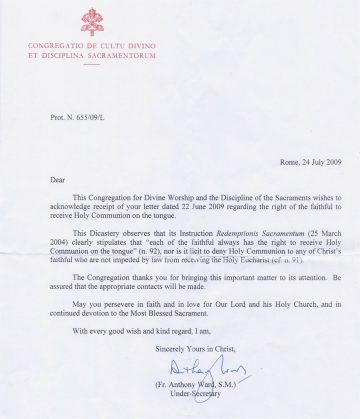
Therefore, based on the above letter, the CDW regards clergy who illegally bar Catholics from receiving Holy Communion on the tongue as violating the law. No bishop on earth has the authority to countermand a law or specific directive of the Vatican, that is intended to the Universal Church.
Declarations by clergy that they are giving Communion on the hand to protect us from contagious diseases are scientifically wrong. As a scientist who has studied extensively microbiology in university, no scientific proof exists that shows that there are less germs passed on to others from the hands, than from the mouth -and most likely it is the other way around, since our hands come in contact with much more unusual and dirtier items than our mouths.
In conclusion, since the Supreme Authority of the Universal Church in Rome has told us repeatedly that Catholics cannot be forbidden to receive Communion on the tongue, even in a situation involving a contagious illness, their ruling outranks anybody and everybody else in the hierarchal structure of the Church. If nevertheless we are made to feel guilty for not wanting to possibly spread the contagion, we should think of what St Thomas Aquinas said about the end never being justified by the means, namely: “An evil action cannot be justified by reference to a good intention” (cf. St. Thomas Aquinas, Dec. praec.6). The end does not justify the means. (CCC 1759).
Let us all pray that this worldwide crisis affecting our economies, our health, individual freedoms to choose our healthcare and how to worship, especially on reception of the Eucharist (grounded in Catholic theology), will be respected by our governments and our bishops and priests – with God’s help.

Saint Kateri , Canada’s Protectress
This was the title given to Saint Kateri Tekakwitha, by Pope Benedict XVI, when he canonized her on October 28th, 2012, along with six others, in Saint Peter’ Square (she had been beatified by Pope John Paul II back in 1980). With Saint Joseph as our protector, along with the Canadian martyrs, we seem to[…]Continue reading→

Remembering Father Alphonse de Valk
(Today marks the sixth anniversary of the death of Father Alphonse de Valk, C.S.B., a faithful, courageous and indefatigable Basilian priest, pro-life-and-family apostle, and the founder of Catholic Insight magazine. Here is what we wrote those on his entering into eternity five years ago, as we continue to remember him in our prayers and thoughts)[…]Continue reading→

My Name is Bernadette
April 16th is a propitious day, for besides the anniversary of Father de Valk’s death, who founded Catholic Insight in its print form decades ago, and the commemoration of the ‘two Benedicts’, mentioned in accompanying posts, today we also recall Saint Bernadette Soubirous, the young visionary to whom the Virgin Mary appeared numerous times at[…]Continue reading→

Canonizing Sister Faustina and Divine Mercy
HOMILY OF THE HOLY FATHER MASS IN ST PETER’S SQUARE FOR THE CANONIZATION OF SR MARY FAUSTINA KOWALSKA Sunday, 30 April 2000 1. “Confitemini Domino quoniam bonus, quoniam in saeculum misericordia eius”; “Give thanks to the Lord for he is good; his steadfast love endures for ever” (Ps 118: 1). So the Church sings on the Octave of[…]Continue reading→

Divine Mercy Sunday – An Echo of Every Mass
Reach out your hand and put it in my side. Do not doubt but believe’… ‘My Lord and my God!’ (Jn. 20:18)). Today is Divine Mercy Sunday, and as we celebrate the end of the Easter Octave, we contemplate the wounded side of our Saviour, the Church’s source of life. On Good Friday in the[…]Continue reading→

Saint Stanislaus of Szczepanów
We celebrate Saint Stanislaus today (+ April 11, 1079), in light of this Easter Octave, a bishop and martyr who accepted the episcopacy only at the direct order of Pope Alexander II. He proved a wise and courageous leader of his flock, put to death by his own king, Boleslaus, for rebuking the monarch’s ‘immoral[…]Continue reading→
First Holy Communion: Sermon from May 16, 1943
Here is a sermon from the good old days by +Rev. Msgr. Vincent Nicholas Foy (August 14, 1915 – March 13, 2017), from 1943. Readers may recall that Pope Saint Pius X, by the decree Quam Singulari in 1910, lowered the customary age of reception of Holy Communion – after the rigours of the plague[…]Continue reading→
In the Glorious Light of Easter, Alleluia!
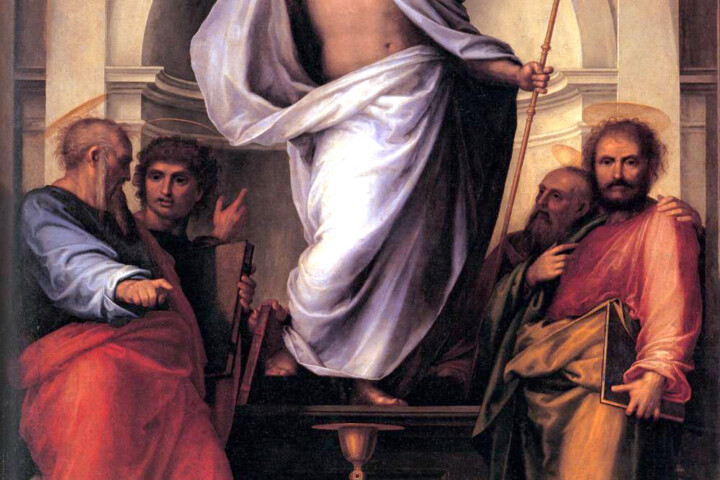
Set your minds on things that are above, not on things that are on earth, for you have died, and your life is hidden with Christ in God. When Christ who is your life is revealed, then you also will be revealed with him in glory (Col. 3:3-4). The Resurrection of Our Lord and Saviour[…]Continue reading→
An Ancient Homily for Holy Saturday
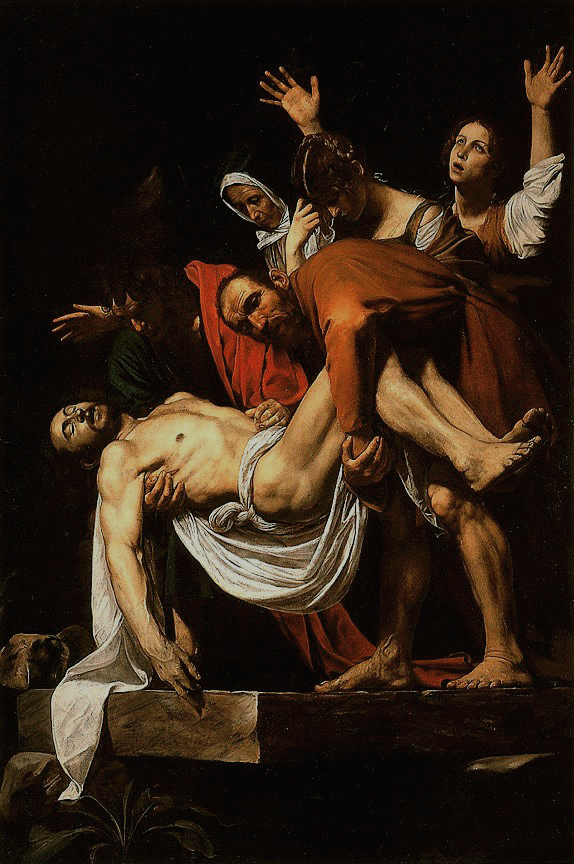
The time between Good Friday and Easter Sunday is one of waiting, in silence, as the world wonders – anticipates – what will happen, after the death of Christ. We re-live this time each year in the anamnesis of our liturgy, and in turn look forward to the glorious re-creation of all things at the[…]Continue reading→
Europe’s Long Descent
(As we meditate on this day on Christ’s burial, and His descent into hell, it is fitting to ponder here with contributor Peter Marcus how the world seems to be heading there as well. The difference is that, although God cannot ‘redeem’ hell, nor those therein, He can and did redeem the world. There is[…]Continue reading→