
The Similes of the Spirit
Suppose a blind man asked you, “What is a crimson like?” You might answer, “It’s like a blare of trumpets.” And the simile is reversible, for you could tell a deaf man that a blare of trumpets is like a crimson banner. It’s worth our while to consider this characteristic of metaphors and similes because we use it when we speak of God: “Father and Son,” for instance, can be read both ways. That is to say, we can learn something about God from knowing what a human father and son are, but we also learn something about them from what Jesus—the Son of God—exhibits in his relationship to his Father. On Pentecost Sunday we are invited to consider the metaphors Scripture uses to describe the Holy Spirit. To begin with, “spirit” is itself is one, for in the biblical languages—Hebrew (=ruah) and Greek (=pneuma)—and also in Latin (=spiritus), it can mean air, wind, breath and soul. There are traces of these meanings in English, as in a pneumatic, i.e., air-driven, drill or in pneumonia, a condition that makes breathing difficult. And we call hard liquor “spirits” because by evaporation it disappears quickly into the air. There is a consequent ambiguity in any biblical text concerning “spirit” that makes it difficult if not impossible to translate. Consider John 3.8 in in which pneuma in the original is translated sometimes as “Spirit” and other times as “wind”:
- The Spirit breatheth where he will (Douay-Rheims)
- God’s Spirit blows wherever it wishes (Common English Bible)
- The wind bloweth where it listeth (King James)
- The wind blows where it likes, you can hear the sound of it but you have no idea where it comes from and where it goes. Nor can you tell how a man is born by the wind of the Spirit (Phillips New Testament)
A similar play on words can be found in John’s Gospel: “Jesus breathed on them and said, ‘Receive the Holy Spirit,’”[1] and its parallel in Genesis: “God breathed into Adam’s nostrils, and he became a living being.”[2]
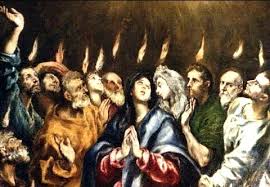
The images of fire and air are found into the first reading for the feast of Pentecost: the mighty wind and the tongues of fire that came down on the Apostles in the upper room. Fire was also used of the Holy Spirit in John the Baptist’s description of Jesus, “who will baptize you with the Holy Spirit and with fire.”[3] Surely that statement allows us to enter more profoundly into Our Lord’s statement, “I have come to cast fire on the earth!”[4] The use of water as a symbol of the Spirit is also frequent: “Unless a man be born of water and the Spirit, he cannot enter the Kingdom of God.”[5] And more explicitly, “He who believes in me, . . . out of his heart shall flow rivers of living water.” Saint John affirms that “[Jesus] said this about the Spirit.”[6] Thus the Holy Spirit is like water, and water like the Holy Spirit.
Everything I have written hitherto will be familiar to the general run of Catholic, and you many be wondering why I repeat what everyone already knows. I do so because air, fire and water have another significance: they are three of the elements that the ancients regarded as the stuff of the physical world. Everything that exists was a more-or-less complicated combination of these elements and a fourth, viz., earth. And remarkably, earth can also be employed by itself as a metaphor for man: “And the Lord God formed man of the slime of the earth.”[7]
Shakespeare uses the same symbolism: “Poor soul, the centre of my sinful earth.”[8] Gerard Manley Hopkins pushes the metaphor further in a vivid image of the interior world of human consciousness: “O the mind, the mind has mountains, cliffs of fall/frightful, sheer, no-man fathomed.”[9] If we compare the symbols found in the Bible for the Spirit—air, fire and water—with their physical counterparts—actual air or wind, fire and water—we may draw a useful lesson for the spiritual life. The earth will be fruitful if it has air, fire (in the heat of the sun), and water in sufficient quantity. And so man—“earth” in our present scheme—will be fruitful in virtue if the various gifts of the Holy Spirit our down upon him. A poetic, even exuberant expression of this idea is found in Oration I by Saint Gregory of Nyssa:
On this day, as the prophet says, God makes a new heaven and a new earth.[10] “What is this new heaven?” you ask. It is the firmament of our faith in Christ. “And what is this new earth?” A good heart, a heart like the earth, which drinks up the [water] that falls on it [as rain] and yields a rich harvest. In this new creation, purity of life is the [fire of the] sun, the virtues are the stars, transparent goodness is the air, and “the depths of the riches of wisdom and knowledge” [form] the sea. Sound doctrine . . . is the grass . . . that feeds God’s flock, which is the people who he shepherds; the keeping of the commandments is the fruit borne by the trees.[11]a
[1] Jn 19.23.
[2] Gen 2.7.
[3] Matt 3.11.
[4] Lk 12.49.
[5] Jn 3.5.
[6] Jn 7.38-39.
[7] Gen 2.7; cf. Job 10.9.
[8] Sonnet 146.
[9] Gerard Manley Hopkins, “No Worst, There is None,” Gerard Manley Hopkins: Poems and Prose (London: Penguin, 1953), p. 61.
[10] Is 65.17, cited in Revelation 21.1
[11] This paragraph is taken from the Office of Readings for Monday of the fifth week of Easter

Saint Kateri , Canada’s Protectress
This was the title given to Saint Kateri Tekakwitha, by Pope Benedict XVI, when he canonized her on October 28th, 2012, along with six others, in Saint Peter’ Square (she had been beatified by Pope John Paul II back in 1980). With Saint Joseph as our protector, along with the Canadian martyrs, we seem to[…]Continue reading→

Remembering Father Alphonse de Valk
(Today marks the sixth anniversary of the death of Father Alphonse de Valk, C.S.B., a faithful, courageous and indefatigable Basilian priest, pro-life-and-family apostle, and the founder of Catholic Insight magazine. Here is what we wrote those on his entering into eternity five years ago, as we continue to remember him in our prayers and thoughts)[…]Continue reading→

My Name is Bernadette
April 16th is a propitious day, for besides the anniversary of Father de Valk’s death, who founded Catholic Insight in its print form decades ago, and the commemoration of the ‘two Benedicts’, mentioned in accompanying posts, today we also recall Saint Bernadette Soubirous, the young visionary to whom the Virgin Mary appeared numerous times at[…]Continue reading→

Canonizing Sister Faustina and Divine Mercy
HOMILY OF THE HOLY FATHER MASS IN ST PETER’S SQUARE FOR THE CANONIZATION OF SR MARY FAUSTINA KOWALSKA Sunday, 30 April 2000 1. “Confitemini Domino quoniam bonus, quoniam in saeculum misericordia eius”; “Give thanks to the Lord for he is good; his steadfast love endures for ever” (Ps 118: 1). So the Church sings on the Octave of[…]Continue reading→

Divine Mercy Sunday – An Echo of Every Mass
Reach out your hand and put it in my side. Do not doubt but believe’… ‘My Lord and my God!’ (Jn. 20:18)). Today is Divine Mercy Sunday, and as we celebrate the end of the Easter Octave, we contemplate the wounded side of our Saviour, the Church’s source of life. On Good Friday in the[…]Continue reading→

Saint Stanislaus of Szczepanów
We celebrate Saint Stanislaus today (+ April 11, 1079), in light of this Easter Octave, a bishop and martyr who accepted the episcopacy only at the direct order of Pope Alexander II. He proved a wise and courageous leader of his flock, put to death by his own king, Boleslaus, for rebuking the monarch’s ‘immoral[…]Continue reading→

First Holy Communion: Sermon from May 16, 1943
Here is a sermon from the good old days by +Rev. Msgr. Vincent Nicholas Foy (August 14, 1915 – March 13, 2017), from 1943. Readers may recall that Pope Saint Pius X, by the decree Quam Singulari in 1910, lowered the customary age of reception of Holy Communion – after the rigours of the plague[…]Continue reading→

In the Glorious Light of Easter, Alleluia!
Set your minds on things that are above, not on things that are on earth, for you have died, and your life is hidden with Christ in God. When Christ who is your life is revealed, then you also will be revealed with him in glory (Col. 3:3-4). The Resurrection of Our Lord and Saviour[…]Continue reading→

An Ancient Homily for Holy Saturday
The time between Good Friday and Easter Sunday is one of waiting, in silence, as the world wonders – anticipates – what will happen, after the death of Christ. We re-live this time each year in the anamnesis of our liturgy, and in turn look forward to the glorious re-creation of all things at the[…]Continue reading→

Europe’s Long Descent
(As we meditate on this day on Christ’s burial, and His descent into hell, it is fitting to ponder here with contributor Peter Marcus how the world seems to be heading there as well. The difference is that, although God cannot ‘redeem’ hell, nor those therein, He can and did redeem the world. There is[…]Continue reading→