
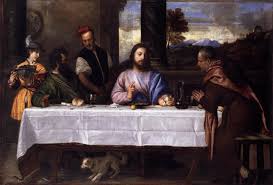
Two Different Views of the Story of Emmaus
(A re-posting of this gem from Dale Ahlquist, which fits the spirit of our times)
Okay, the big news at our house is that we finally remodeled the only room in the house that we had not remodeled since we moved in 18 years ago. It was the guest bathroom. For those who like the Baroque style, the old bathroom may still have held some charm. Old is not bad. Old can be good. The 1650s were not bad. But this was the 1970s interpretation of the 1650s, wherein we understand the distinction between “antique” and “dated.”
Everything had to go. Even the yellow toilet. All the art in the bathroom had ornate gilt frames to match the mirror. One of the pictures that was evicted held a certain sentimental value to me. I won it in a scripture memory contest at my old Baptist Sunday School. It was The Road to Emmaus, depicting the scene from Luke 24, where Jesus, after his Resurrection, joins two of his disciples, who do not recognize him, and walks with them to the town of Emmaus.
![Robert Zünd [Public domain], via Wikimedia Commons.](https://2026.catholicinsight.com/wp-content/uploads/Zünd_Gang_nach_Emmaus_1877-360x258.jpg)
Contrast this painting with a painting from almost three centuries earlier, The Supper at Emmaus. Though less familiar, that is, less reproduced, it is more famous. And everyone who knows the painting knows who painted it: Caravaggio.
![Caravaggio [Public domain], via Wikimedia Commons.](https://2026.catholicinsight.com/wp-content/uploads/Caravaggio_-_Cena_in_Emmaus-360x300.jpg)
As someone who grew up loving the Bible, I was particularly drawn to this story because it was about Jesus explaining the Bible. The disciples were distressed at the death of Jesus, and amazed at the reports of his resurrection, but then Jesus surprised them by saying, “O foolish men, and slow of heart to believe all that the prophets have spoken! Was it not necessary that the Christ should suffer these things and enter into his glory?” It was the next verse that especially grabbed me: “And beginning with Moses and all the prophets, he interpreted to them in all the scriptures the things concerning himself.”
I tried to imagine the things Jesus said as he went through the whole Old Testament and explained all the messianic references, all the prophecies of his suffering, death, and resurrection. It would have been the Scripture in all its fullness. And Robert Zund’s painting, though idyllic, still captures the rapt attention of the two disciples listening to the Teacher.
Caravaggio’s painting captures what happened next. When the three travelers reached Emmaus, the two disciples urged the stranger to stay and eat with them. When Jesus sat down at the table with them, “he took the bread, blessed and broke it, and gave it them.” Then, just as they suddenly recognized him, he vanished out of their sight.
Naturally they were astonished. They rushed back to Jerusalem and told the Apostles that the Lord had indeed risen. They had seen him.
Caravaggio’s incomparable painting captures that precise instant of the disciples recognizing Jesus just before he vanishes, that sudden astonishment. They have had a supernatural experience. Christ himself is present.
Robert Zund’s painting depicts the experience of a Protestant worship service: a sermon, a teaching from Scripture. It has a certain careful comfort to it. Caravaggio depicts the experience of the Mass. He captures the sacrament, the miracle of the Eucharist.
It was not Christ’s teaching about himself as the fulfillment of Scripture that astonished the disciples, even though they admitted that their hearts burned within them while he spoke. It was his presence. But they did not recognize his presence in the Scripture teaching. They recognized it “in the breaking of the bread.”
Dale Ahlquist is the president and co-founder of the American Chesterton Society (www.chesterton.org). He is the creator and host of the Eternal Word Television Network series, “G.K. Chesterton: The Apostle of Common Sense,” and the author of G.K. Chesterton: Apostle of Common Sense, The Complete Thinker, and All Roads: Roamin’ Catholic Apologetics. Dale is also the publisher of Gilbert magazine and associate editor of the Collected Works of G.K. Chesterton (Ignatius Press). He lives near Minneapolis, Minnesota with his wife and six children.

Saint Kateri , Canada’s Protectress
This was the title given to Saint Kateri Tekakwitha, by Pope Benedict XVI, when he canonized her on October 28th, 2012, along with six others, in Saint Peter’ Square (she had been beatified by Pope John Paul II back in 1980). With Saint Joseph as our protector, along with the Canadian martyrs, we seem to[…]Continue reading→

Remembering Father Alphonse de Valk
(Today marks the sixth anniversary of the death of Father Alphonse de Valk, C.S.B., a faithful, courageous and indefatigable Basilian priest, pro-life-and-family apostle, and the founder of Catholic Insight magazine. Here is what we wrote those on his entering into eternity five years ago, as we continue to remember him in our prayers and thoughts)[…]Continue reading→

My Name is Bernadette
April 16th is a propitious day, for besides the anniversary of Father de Valk’s death, who founded Catholic Insight in its print form decades ago, and the commemoration of the ‘two Benedicts’, mentioned in accompanying posts, today we also recall Saint Bernadette Soubirous, the young visionary to whom the Virgin Mary appeared numerous times at[…]Continue reading→

Canonizing Sister Faustina and Divine Mercy
HOMILY OF THE HOLY FATHER MASS IN ST PETER’S SQUARE FOR THE CANONIZATION OF SR MARY FAUSTINA KOWALSKA Sunday, 30 April 2000 1. “Confitemini Domino quoniam bonus, quoniam in saeculum misericordia eius”; “Give thanks to the Lord for he is good; his steadfast love endures for ever” (Ps 118: 1). So the Church sings on the Octave of[…]Continue reading→

Divine Mercy Sunday – An Echo of Every Mass
Reach out your hand and put it in my side. Do not doubt but believe’… ‘My Lord and my God!’ (Jn. 20:18)). Today is Divine Mercy Sunday, and as we celebrate the end of the Easter Octave, we contemplate the wounded side of our Saviour, the Church’s source of life. On Good Friday in the[…]Continue reading→
First Holy Communion: Sermon from May 16, 1943
Here is a sermon from the good old days by +Rev. Msgr. Vincent Nicholas Foy (August 14, 1915 – March 13, 2017), from 1943. Readers may recall that Pope Saint Pius X, by the decree Quam Singulari in 1910, lowered the customary age of reception of Holy Communion – after the rigours of the plague[…]Continue reading→
In the Glorious Light of Easter, Alleluia!
Set your minds on things that are above, not on things that are on earth, for you have died, and your life is hidden with Christ in God. When Christ who is your life is revealed, then you also will be revealed with him in glory (Col. 3:3-4). The Resurrection of Our Lord and Saviour[…]Continue reading→
An Ancient Homily for Holy Saturday
The time between Good Friday and Easter Sunday is one of waiting, in silence, as the world wonders – anticipates – what will happen, after the death of Christ. We re-live this time each year in the anamnesis of our liturgy, and in turn look forward to the glorious re-creation of all things at the[…]Continue reading→
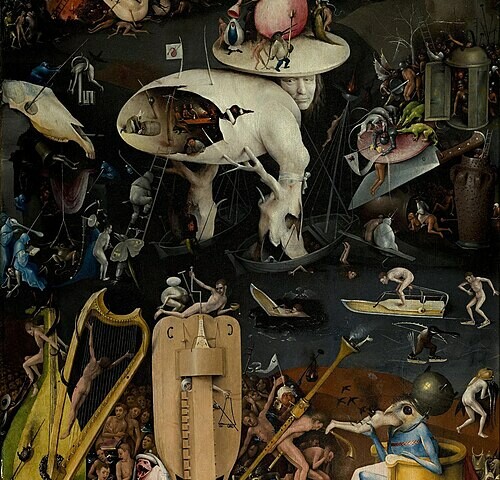
Europe’s Long Descent
(As we meditate on this day on Christ’s burial, and His descent into hell, it is fitting to ponder here with contributor Peter Marcus how the world seems to be heading there as well. The difference is that, although God cannot ‘redeem’ hell, nor those therein, He can and did redeem the world. There is[…]Continue reading→
Pope Saint John Paul II’s First Good Friday Homily
ADDRESS OF HIS HOLINESS JOHN PAUL II AT THE CONCLUSION OF THE STATIONS OF THE CROSS AT THE COLOSSEUM Good Friday, 13 April 1979 When we make the Way of the Cross from one station to the next, in spirit we are always at the spot wherethis journey had its “historical” place: where it[…]Continue reading→