
An Easter Hymn: Ad cenam Agni providi
Ad cenam Agni providi, stolis salutis candidi,
post transitum maris Rubri, Christo canamus principi.
Cuius corpus sanctissimum, in ara crucis torridum,
sed et cruorem roseum, gustando Dei vivimus.
Protecti paschae vespero, a devastante angelo,
de Pharaonis aspero, sumus erepti imperio.
Iam pascha nostrum Christus est, agnus occisus innocens;
sinceritatis azyma, qui carnem suam obtulit.
O vera, digna hostia, per quam franguntur tartara,
captiva plebs redimitur, redduntur vitae praemia!
Consurgit Christus tumulo, victor redit de barathro,
tyrannum trudens vinculo, et paradisum reserans.
Esto perenne mentibus, paschale, Iesu, gaudium
et nos renatos gratiae, tuis triumphis aggrega.
Iesu, tibi sit gloria, qui morte victa praenites,
cum Patre et almo Spiritu, in sempiterna saecula.
Amen.
After the transit of the Red Sea, let us sing to Christ, our leader,
as, in the white robes of salvation, we look forward to the supper of the Lamb,
whose holiest body was parched, on the altar of the cross;
but we live by tasting, the roseate blood of God.
On that paschal evening, we were protected from the devastating angel
and snatched from the harsh rule of Pharaoh.
Our pasch is now Christ, the innocent lamb who was slain,
who offered his flesh as the unleavened bread of sincerity.
O truly worthy victim, by whom hell is shattered,
a captive people is redeemed, and the rewards of life are restored!
Christ rose from the grave, the victor has come back from the abyss,
putting down the tyrant with a chain and reopening paradise.
O Jesus, be for our minds an everlasting paschal joy,
and join us to your triumph,we who have been reborn to grace.
O Jesus, glory be to you, who, death having been conquered,
are resplendent with the Father and the nourishing Spirit forever.
Amen.
(Sixth century hymn)
In speaking of things liturgical, an alternate chronology is employed, for anything less than a thousand years old is considered a novelty, such as the new-fangled feast of Corpus Christ, a mere 750 years old. With a sigh of relief, then, we note that the Easter hymn Ad cenam Agni dates back to the five hundreds, a respectable millennium and a half from the present.
We Catholics are accused of being ignorant of Scripture. Maybe so, but even the most obtuse of us will catch the biblical inspiration of every verse of this ancient hymn. The opening lines resonate across the sacred text, with a reference to our admission to “the supper of the Lamb.” We know who that Lamb is from John the Baptist’s exclamation as Jesus approached him at the Jordon: “Behold, the Lamb of God!” It is the Lamb who was slain and yet lives that we find celebrated in the Book of Revelation, the paschal Lamb whose blood on the door posts of the Israelites in Egypt was a type, or symbol, of the blood of Jesus. As the Jews of old were spared a visit from the angel of death—“protected from the devastating angel”[1]—so Christians whose lips are stained with the blood of the Lamb of God are assured eternal life—“ we live by tasting the roseate blood of God.”[2]
Similarly is the messianic banquet another scriptural theme. Christ at the Last Supper announced it to his followers: “Amen, I say to you that I shall not drink again of the fruit of the vine until that day when I drink it anew in the Kingdom of God.”[3] We learn more about it from the Book of Revelation: “Bless are those who are invited to the marriage supper of the Lamb.”[4] And Isaiah prophesied it: “On the mountain, the Lord of hosts will make for all peoples a feast of fat things, a feast of wine on the lees well refined.”[5]
The verse also refers to “the white robes of salvation.”[6] These robes are white because they have been washed in the blood of the Lamb.[7] In the sixth century, when this hymn was first in use, the newly baptized entered the church building wearing white robes, to participate, for the first time, in the full Mass. (Before baptism, catechumens would have been dismissed after the sermon.) Can you in imagination enter that church with the newly baptized? They had just completed the forty days of Lent, with severe fasting and—surprising to us—without bathing, at that time a standard ascetical practice. Saint Jerome, for instance, in celebrating the virtues of his patroness, Saint Paula, noted that she never bathed. “Cleanliness is next to ungodliness” was the slogan then. The candidates for baptism would have visited the public baths on Holy Thursday in preparation for their baptism on Holy Saturday night. That completed, they donned glistening white robes and moved from the shadowy baptistry into a church ablaze with candles and resounding with the chant of the congregation, as loud, Jerome says, as thunder. It was a spine-tingling event, all the more so because the newly baptised received the body and blood of Christ for the first time. It must have been an intriguing as well as an overwhelming experience since they came with no knowledge of the Mass of the Faithful or of the Real Presence. Only in the weeks following Easter did they receive the mystagogic catechesis during which the full meaning of the Eucharist was expounded.
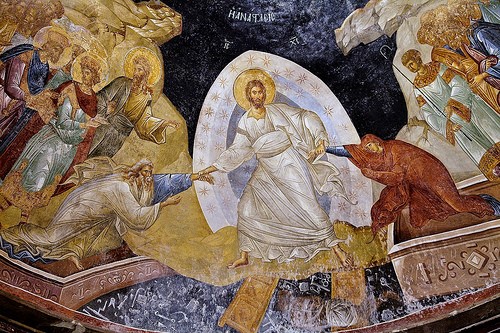
Verses five and six describe the visit of Jesus to the realm of the dead—“the harrowing of Hell”—where the just men and women of the Old Testament were waiting for Jesus to break the power of Satan and lead them into heaven: “Christ, the new Adam, entered the kingdom of death to release all the just since the beginning of the world.”[8] This incident has been popular in the art of the Eastern Church. One of its most powerful presentation, dating from the fourteenth century, can be found in the Chora Church, now the Kariye Museum, in Istanbul (see featured image).
Christ is portrayed as rising . . . no, as springing from the dead. He is in the stance of an athlete, vigorous and dynamic. As he rises, he is pulling out of their tombs and old man and an old woman, Adam and Eve, symbolic of the universal effect of his death and resurrection: all mankind has been saved. At his feet we see the gates of hell smashed apart, with keys, bolts, hinges and bars thrown into the air, and Satan himself utterly defeated, lying bound at the bottom of the mural. If a picture is worth a thousand words, this mural speaks volumes.
Ad cenam Agni, like the other hymns we have been examining, is a tissue of biblical allusions. They remind us that the words of Scripture and the events they record are always contemporary to the believer who hears them proclaimed at Mass and reflects on them privately. We shall do so more effectively if we make use of the commentary provided by our rich Tradition in theology, devotion and art.
[1] Verse three.
[2] Verse two.
[3] Mk 14.25.
[4] Rev 19.9.
[5] Is 25.6. The “mountain” is Mount Zion, which is celebrated in the Book of Revelation as the new Jerusalem, i.e., the Church.
[6] The word “candidate,” as in politics, has its origin in the Latin word for white: candidus. The English derivate came to assume its political meaning because in ancient Rome a candidate for public office identified himself by wearing a white toga.
[7] Rev. 7.14.
[8] Holy Saturday, Morning Prayer. The creed states “He was crucified, died and was buried: he descended into Hell: on the third day he rose again from the dead.” The doctrine is affirmed, somewhat tentatively, by 1 Pet 3.18-20, Matt 27. 52f and Lk 23.43.

Remembering Father Alphonse de Valk
(Today marks the sixth anniversary of the death of Father Alphonse de Valk, C.S.B., a faithful, courageous and indefatigable Basilian priest, pro-life-and-family apostle, and the founder of Catholic Insight magazine. Here is what we wrote those on his entering into eternity five years ago, as we continue to remember him in our prayers and thoughts)[…]Continue reading→

Divine Mercy Sunday – An Echo of Every Mass
Reach out your hand and put it in my side. Do not doubt but believe’… ‘My Lord and my God!’ (Jn. 20:18)). Today is Divine Mercy Sunday, and as we celebrate the end of the Easter Octave, we contemplate the wounded side of our Saviour, the Church’s source of life. On Good Friday in the[…]Continue reading→

Saint Stanislaus of Szczepanów
We celebrate Saint Stanislaus today (+ April 11, 1079), in light of this Easter Octave, a bishop and martyr who accepted the episcopacy only at the direct order of Pope Alexander II. He proved a wise and courageous leader of his flock, put to death by his own king, Boleslaus, for rebuking the monarch’s ‘immoral[…]Continue reading→

First Holy Communion: Sermon from May 16, 1943
Here is a sermon from the good old days by +Rev. Msgr. Vincent Nicholas Foy (August 14, 1915 – March 13, 2017), from 1943. Readers may recall that Pope Saint Pius X, by the decree Quam Singulari in 1910, lowered the customary age of reception of Holy Communion – after the rigours of the plague[…]Continue reading→

In the Glorious Light of Easter, Alleluia!
Set your minds on things that are above, not on things that are on earth, for you have died, and your life is hidden with Christ in God. When Christ who is your life is revealed, then you also will be revealed with him in glory (Col. 3:3-4). The Resurrection of Our Lord and Saviour[…]Continue reading→

An Ancient Homily for Holy Saturday
The time between Good Friday and Easter Sunday is one of waiting, in silence, as the world wonders – anticipates – what will happen, after the death of Christ. We re-live this time each year in the anamnesis of our liturgy, and in turn look forward to the glorious re-creation of all things at the[…]Continue reading→

Europe’s Long Descent
(As we meditate on this day on Christ’s burial, and His descent into hell, it is fitting to ponder here with contributor Peter Marcus how the world seems to be heading there as well. The difference is that, although God cannot ‘redeem’ hell, nor those therein, He can and did redeem the world. There is[…]Continue reading→
Pope Saint John Paul II’s First Good Friday Homily
ADDRESS OF HIS HOLINESS JOHN PAUL II AT THE CONCLUSION OF THE STATIONS OF THE CROSS AT THE COLOSSEUM Good Friday, 13 April 1979 When we make the Way of the Cross from one station to the next, in spirit we are always at the spot wherethis journey had its “historical” place: where it[…]Continue reading→
A Meditation for Good Friday: How To Undo the Effects of Sin?
Cardinal Newman, now Saint John Henry Newman, was a towering figure of nineteenth-century Catholicism who is almost universally admired. I say “almost” because not everyone likes him. I knew a priest once, Arthur Caulkins, who has become disenchanted with Newman. As an undergraduate Arthur had been enamoured of Newman, and this interest continued when he[…]Continue reading→
Pope Benedict’s Last Holy Thursday Homily
MASS OF THE LORD’S SUPPER HOMILY OF HIS HOLINESS BENEDICT XVI Basilica of St John Lateran Holy Thursday, 5 April 2012 Photo Gallery (Video) Dear Brothers and Sisters! Holy Thursday is not only the day of the institution of the Most Holy Eucharist, whose splendour bathes all else and in some ways draws it to[…]Continue reading→