
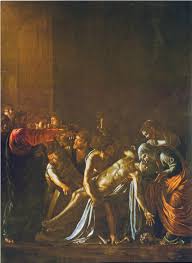
The Raising of Lazarus
How old was Lazarus? Robert Browning, in a poem written in 1855—An Epistle Containing the Strange Medical Experience of Karshish, the Arab Physician—suggests that he would have been about ten years old. We learn from the poem that Karshish is touring the Near East in A.D. 70 as a student of medicine, sending back in a series of letters to his master, Abib, what he has been able to discover, including, e.g., “Three samples of true snakestone—rarer still,/One of the other sort, the melon-shaped.” In the course of his travels he visits Bethany, where he encounters Lazarus, then a man of fifty.[1] That would make him ten years old in A.D. 30, which is the date Jesus brought him back to life. Indirect evidence for this view can be found in the Gospel of Luke, which states that “a woman named Martha received Jesus into her house.”[2] It seems, then, to have been a household managed by women, with little Lazarus dependent on his older sisters.
In the first century Arab medicine, however primitive by modern standards, was much admired and resorted to. Karshish represents the sceptical, scientific mind, interested and intrigued by the story of a man raised from the dead. In the poem, as in the Gospel, Lazarus himself never speaks, although during the interview he is surrounded by town folk eager to answer Karshish’s queries:
Some elders of his tribe, I should premise,
Led in their friend, obedient as a sheep,
To bear my inquisition. While they spoke,
Now sharply, now with sorrow,—told the case,—
He listened not except I spoke to him,
Karshish begins by accounting for the event in strictly rationalistic terms:
’Tis but a case of mania—subinduced
By epilepsy, at the turning-point
Of trance prolonged unduly some three days.
In other words, Lazarus, having come to after having been in a coma, was under the delusion that he had died and been miraculously restored to life by Jesus, “a Nazarene physician of his tribe.” Soon, however, Karshish is struck by an extraordinary sensitivity he observes in Lazarus:
Heaven opened to a soul while yet on earth,
Earth forced on a soul’s use while seeing heaven:
The man is witless of the size, the sum,
The value in proportion of all things,
Or whether it be little or be much. . . .
Wonder and doubt come wrongly into play,
Preposterously, at cross purposes.
As Browning describes him, Lazarus may be indifferent to what impresses most people, but he is not apathetic:
Contrariwise, he loves both old and young,
Able and weak, affects the very brutes
And birds—how say I? flowers of the field—
As a wise workman recognizes tools
In a master’s workshop, loving what they make.
The reason for this seeming indifference or distraction on the part of Lazarus is the fact that he lives continually in the presence of Jesus:
And oft the man’s soul springs into his face
As if he saw again and heard again
His sage that bade him “Rise” and he did rise.
The effect is to make him completely, almost stoically, resigned to God’s will. “
Indeed the especial marking of the man
Is prone submission to the heavenly will—
Seeing it, what it is, and why it is.
The climax of the poem comes in the last few lines when the still-sceptical Karshish confesses to his fascination with Lazarus’s conviction that in Jesus God had made himself available to mankind in human form:
The very God! think, Abib; dost thou think?
So, the All-Great, were the All-Loving too—
So, through the thunder comes a human voice
Saying, “O heart I made, a heart beats here!
Face, my hands fashioned, see it in myself!
Thou hast no power nor mayst conceive of mine,
But love I gave thee, with myself to love,
And thou must love me who have died for thee!”
The madman saith He said so: it is strange.
The poem is a meditation on life and death, in the form of the behaviour of a man who lives in the light of eternity:
He holds on firmly to some thread of life— . . .
The spiritual life around the earthly life:
The law of that is known to him as this,
His heart and brain move there, his feet stay here.
When I preached this as a sermon a few years ago in the chapel of a small Catholic college, I left the congregation with an assignment, viz., to depict, if not in a poem then in prose, how they would have imagined the risen Lazarus: a mystic? an activist? a bishop? married or celibate? Such an exercise would reveal what we think of the effect of Jesus Christ in our lives, for in baptism each of us has ben resurrected from the death of sin into new life: “I am the resurrection and the life; he who believes in me will never die.”[3] This promise is as valid for us as it was for Lazarus. And so, what do you make of the mysterious figure of Lazarus?a
[1] “The man—it is one Lazarus a Jew,/Sanguine, proportioned, fifty years of age . . .”
[2] Lk 10.38.
[3] Jn 11.25.

Remembering Father Alphonse de Valk
(Today marks the sixth anniversary of the death of Father Alphonse de Valk, C.S.B., a faithful, courageous and indefatigable Basilian priest, pro-life-and-family apostle, and the founder of Catholic Insight magazine. Here is what we wrote those on his entering into eternity five years ago, as we continue to remember him in our prayers and thoughts)[…]Continue reading→

Divine Mercy Sunday – An Echo of Every Mass
Reach out your hand and put it in my side. Do not doubt but believe’… ‘My Lord and my God!’ (Jn. 20:18)). Today is Divine Mercy Sunday, and as we celebrate the end of the Easter Octave, we contemplate the wounded side of our Saviour, the Church’s source of life. On Good Friday in the[…]Continue reading→

Saint Stanislaus of Szczepanów
We celebrate Saint Stanislaus today (+ April 11, 1079), in light of this Easter Octave, a bishop and martyr who accepted the episcopacy only at the direct order of Pope Alexander II. He proved a wise and courageous leader of his flock, put to death by his own king, Boleslaus, for rebuking the monarch’s ‘immoral[…]Continue reading→
First Holy Communion: Sermon from May 16, 1943
Here is a sermon from the good old days by +Rev. Msgr. Vincent Nicholas Foy (August 14, 1915 – March 13, 2017), from 1943. Readers may recall that Pope Saint Pius X, by the decree Quam Singulari in 1910, lowered the customary age of reception of Holy Communion – after the rigours of the plague[…]Continue reading→
In the Glorious Light of Easter, Alleluia!
Set your minds on things that are above, not on things that are on earth, for you have died, and your life is hidden with Christ in God. When Christ who is your life is revealed, then you also will be revealed with him in glory (Col. 3:3-4). The Resurrection of Our Lord and Saviour[…]Continue reading→
An Ancient Homily for Holy Saturday
The time between Good Friday and Easter Sunday is one of waiting, in silence, as the world wonders – anticipates – what will happen, after the death of Christ. We re-live this time each year in the anamnesis of our liturgy, and in turn look forward to the glorious re-creation of all things at the[…]Continue reading→
Europe’s Long Descent
(As we meditate on this day on Christ’s burial, and His descent into hell, it is fitting to ponder here with contributor Peter Marcus how the world seems to be heading there as well. The difference is that, although God cannot ‘redeem’ hell, nor those therein, He can and did redeem the world. There is[…]Continue reading→
Pope Saint John Paul II’s First Good Friday Homily
ADDRESS OF HIS HOLINESS JOHN PAUL II AT THE CONCLUSION OF THE STATIONS OF THE CROSS AT THE COLOSSEUM Good Friday, 13 April 1979 When we make the Way of the Cross from one station to the next, in spirit we are always at the spot wherethis journey had its “historical” place: where it[…]Continue reading→
A Meditation for Good Friday: How To Undo the Effects of Sin?
Cardinal Newman, now Saint John Henry Newman, was a towering figure of nineteenth-century Catholicism who is almost universally admired. I say “almost” because not everyone likes him. I knew a priest once, Arthur Caulkins, who has become disenchanted with Newman. As an undergraduate Arthur had been enamoured of Newman, and this interest continued when he[…]Continue reading→
Pope Benedict’s Last Holy Thursday Homily
MASS OF THE LORD’S SUPPER HOMILY OF HIS HOLINESS BENEDICT XVI Basilica of St John Lateran Holy Thursday, 5 April 2012 Photo Gallery (Video) Dear Brothers and Sisters! Holy Thursday is not only the day of the institution of the Most Holy Eucharist, whose splendour bathes all else and in some ways draws it to[…]Continue reading→