
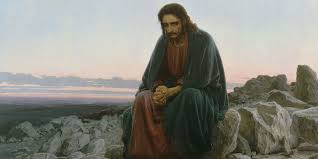
The Three Temptations of the First Lenten Sunday
When the devil had finished every test, he departed from him until an opportune time (Lk. 4:13). ⧾
On Ash Wednesday we began our observance of the holy season of Lent. By the solemn forty days of Lent the Church unites herself each year to the mystery of Jesus in the desert (The Catechism of the Catholic Church, 510).
As this mystery is described and revealed by St. Luke, the temptations endured by Our Lord are three in number and they reveal to us something of how the devil can also tempt us. St. Ambrose explains that there are three special weapons which we are taught the devil is wont to arm himself with, that he may wound the soul of man. One is of appetite, another of boasting, the third, ambition (St. Thomas Aquinas, Catena Aurea, St. Luke, Vol. III, p. 145).
St. Ambrose further explains that St. Luke would not have said that all temptation was ended, had there not been in the three temptations which have been described the materials for every crime; for the causes of temptations are the cause of desire, namely, delight of the flesh, the pomp of vain-glory [and] the greediness of power (Ibid., p. 151). What St. Ambrose calls greediness for power is what St. Augustine describes in his monumental work, The City of God, as the lust of domination (libido dominandi); the lust for power, advantage and glory. Our Lord clearly taught us that this is the way of the world and not the way of the Christian: ‘You know that the rulers of the Gentiles lord it over them, and their great men exercise authority over them. It shall not be so among you; but whoever will be great among you must be your servant, and whoever would be first among you must be your slave; even as the Son of man came not to be served but to serve, and to give his life as a ransom for many’ (Mt. 20: 25-28).
The whole of Divine Revelation is seen in the humility of the Creator in becoming incarnate and the humility of the creature in welcoming Him. Appropriating this humility is the work of a lifetime and it is the path that is especially set before us during the holy season of Lent. In a certain sense Lent allows us to unite ourselves in a particular manner to the mystery of Our Lord’s humility.
St. Augustine acknowledged that great is the effort needed to convince the proud of the power and excellence of humility, an excellence which makes it soar above all the summits of this world, which sway in their temporal instability (The City of God, Bk. 1, Preface). It is an effort that engages each one of us in our own interior struggle to conform ourselves to the gentle and humble Heart of Our Saviour. Humility is a foundational virtue; the one upon which we must establish our life. On Ash Wednesday, when we were marked with blessed ashes, we made a public expression of sorrow for sin, of our resolve to undertake Lenten discipline and we were visibly marked with a visible sign of the power and excellence of humility. The traditional forms of penance undertaken during this holy season, namely, prayer, fasting and almsgiving allow us to enter into the mystery of our Lord’s obedience and humility. By self-denial, discipline and other forms of penance we humble our sinful pride (Preface III of Lent, The Roman Missal) and with minds made pure we are better able to understand the meaning of our Lord’s Passion. Our external forms of penance express an internal attitude of submission to the will of God, of trust in His Providence, of compassion for others, especially the poor; the materially poor and the spiritually poor. The devotions which are also traditionally associated with this holy season such as the Stations of Cross likewise help us to conform ourselves to the mystery of Our Lord’s humble obedience.
In our own particular manner and in the concrete circumstance of our life, each one of us is engaged in a disciplined effort to conform ourselves to the pattern of Our Lord’s life and especially His Sacred Passion. St. Thomas Aquinas teaches us in very simple terms that the passion of Christ completely suffices to fashion our lives. Whoever wishes to live perfectly should do nothing but disdain what Christ disdained on the cross and desire what He desired, for the cross exemplifies every virtue (Collatio 6 super Credo in Deum). This is why Our Lord left us the Mass as the Memorial of His Sacred Passion. In the Mass we participate in Our Lord’s Sacred Passion for the world’s salvation and we are one with Him in His self-offering to the Father. When this mystery truly becomes the defining mystery of our own individual existence then the lust for power, advantage and glory have no appeal for us and we desire only the greater glory of God and the salvation of souls, for what does it profit a man if he gains the whole world and loses or forfeits himself (Lk. 9:25)?
Our Lenten obedience and our union with the mystery of Jesus in the desert lead to the Sacrifice of Jesus on the Cross. The saving knowledge or science of the Cross is at the heart of authentic Christian discipleship and so above all we pray for the grace to come to a deeper awareness of the power of the Cross and of our own participation in this Mystery. The Cross is the fulfilment of all the prophecies and Jesus Crucified is both the power and the wisdom of God. Therefore, we should glory in the Cross of Our Lord Jesus Christ, in whom is our salvation, life and resurrection, through whom we are saved and delivered (Gal. 6:14). +

Saint Kateri , Canada’s Protectress
This was the title given to Saint Kateri Tekakwitha, by Pope Benedict XVI, when he canonized her on October 28th, 2012, along with six others, in Saint Peter’ Square (she had been beatified by Pope John Paul II back in 1980). With Saint Joseph as our protector, along with the Canadian martyrs, we seem to[…]Continue reading→

Remembering Father Alphonse de Valk
(Today marks the sixth anniversary of the death of Father Alphonse de Valk, C.S.B., a faithful, courageous and indefatigable Basilian priest, pro-life-and-family apostle, and the founder of Catholic Insight magazine. Here is what we wrote those on his entering into eternity five years ago, as we continue to remember him in our prayers and thoughts)[…]Continue reading→

My Name is Bernadette
April 16th is a propitious day, for besides the anniversary of Father de Valk’s death, who founded Catholic Insight in its print form decades ago, and the commemoration of the ‘two Benedicts’, mentioned in accompanying posts, today we also recall Saint Bernadette Soubirous, the young visionary to whom the Virgin Mary appeared numerous times at[…]Continue reading→

Canonizing Sister Faustina and Divine Mercy
HOMILY OF THE HOLY FATHER MASS IN ST PETER’S SQUARE FOR THE CANONIZATION OF SR MARY FAUSTINA KOWALSKA Sunday, 30 April 2000 1. “Confitemini Domino quoniam bonus, quoniam in saeculum misericordia eius”; “Give thanks to the Lord for he is good; his steadfast love endures for ever” (Ps 118: 1). So the Church sings on the Octave of[…]Continue reading→

Divine Mercy Sunday – An Echo of Every Mass
Reach out your hand and put it in my side. Do not doubt but believe’… ‘My Lord and my God!’ (Jn. 20:18)). Today is Divine Mercy Sunday, and as we celebrate the end of the Easter Octave, we contemplate the wounded side of our Saviour, the Church’s source of life. On Good Friday in the[…]Continue reading→

First Holy Communion: Sermon from May 16, 1943
Here is a sermon from the good old days by +Rev. Msgr. Vincent Nicholas Foy (August 14, 1915 – March 13, 2017), from 1943. Readers may recall that Pope Saint Pius X, by the decree Quam Singulari in 1910, lowered the customary age of reception of Holy Communion – after the rigours of the plague[…]Continue reading→

In the Glorious Light of Easter, Alleluia!
Set your minds on things that are above, not on things that are on earth, for you have died, and your life is hidden with Christ in God. When Christ who is your life is revealed, then you also will be revealed with him in glory (Col. 3:3-4). The Resurrection of Our Lord and Saviour[…]Continue reading→

An Ancient Homily for Holy Saturday
The time between Good Friday and Easter Sunday is one of waiting, in silence, as the world wonders – anticipates – what will happen, after the death of Christ. We re-live this time each year in the anamnesis of our liturgy, and in turn look forward to the glorious re-creation of all things at the[…]Continue reading→

Europe’s Long Descent
(As we meditate on this day on Christ’s burial, and His descent into hell, it is fitting to ponder here with contributor Peter Marcus how the world seems to be heading there as well. The difference is that, although God cannot ‘redeem’ hell, nor those therein, He can and did redeem the world. There is[…]Continue reading→
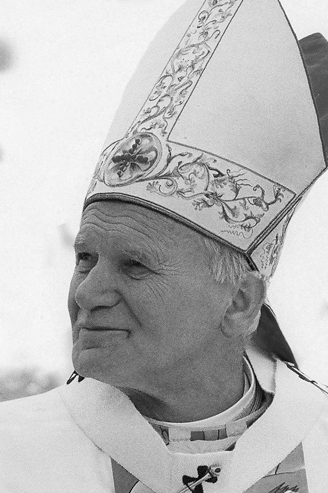
Pope Saint John Paul II’s First Good Friday Homily
ADDRESS OF HIS HOLINESS JOHN PAUL II AT THE CONCLUSION OF THE STATIONS OF THE CROSS AT THE COLOSSEUM Good Friday, 13 April 1979 When we make the Way of the Cross from one station to the next, in spirit we are always at the spot wherethis journey had its “historical” place: where it[…]Continue reading→