
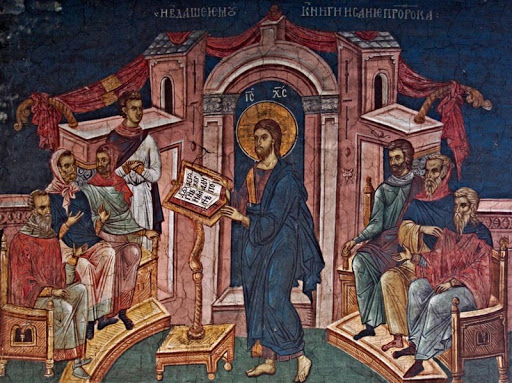
Seventh Sunday Quodlibetal
We moderns have been indoctrinated to regard the Middle Ages as a time of superstition and cruelty, but in fact they were quite wonderful. Simply consider those splendid mediaeval cathedrals, the rich poetry of Dante, the unflagging appeal of Saint Francis of Assisi. There’s another accomplishment of those times that we still honour today: they invented the university. A favourite event back then was a public debate between professors, known in Latin as a quodlibet, which could be translated as “anything goes.” For instance, the question at issue might be, “Does God exist?” It’s not that anyone doubted the fact; it was, rather, a good opportunity for theologians to sharpen their wits by examining the various bases for atheism and belief. Another popular topic was the apparent contradiction between various texts of the Bible. Suppose we transport ourselves in imagination back seven hundred years and join in such a debate based on what you have just heard read in today’s Gospel.
I say to you, “Do not resist one who is evil. But if any one strikes you on the right cheek, turn to him the other also.”[1]
You have heard that it was said, “You shall love your neighbour and hate your enemy.” But I say to you, “Love your enemies.”[2]
For if you love those who love you, what reward have you?[3]
You, therefore, must be perfect, as your heavenly Father is perfect.[4]
One of the officers . . . struck Jesus. . . . Jesus answered him, “If I . . . have spoken rightly, why do you strike me?”[5]
Woe to you, scribes and Pharisees, hypocrites! for you are like whitewashed tombs, which . . . are full of dead men’s bones and all uncleanness.[6]
Paul, an apostle of Christ Jesus . . . to Timothy, my beloved child: Grace, mercy, and peace . . .[7]
For I do not do the good I want, but the evil I do not want is what I do.[8]
One side of the debate might claim that, because the Bible contradicts itself, you can pick and choose and so justify any opinion by a judicious selection of texts. It seems to me that this approach is not uncommon even today among people who like to argue about religion. The other side, defending the integrity of the Bible, might begin by examining Jesus’s way of speaking. For it cannot be denied that he uses hyperbole, i.e., exaggeration, to make His point vividly. Many examples, aside from those I have mentioned from today’s reading, come to mind, as when He said that the Pharisees would blow a trumpet every time they gave alms or that it would be easier for a camel to pass through the eye of a needle than for a rich man to enter the kingdom of heaven. There are also passages that tell us to tear out an eye, to chop off a hand, to sell all our possessions and give the money to the poor, and still others that threaten hell for anyone who calls his brother a fool, . . . even if he is one.
Are we to dismiss these statements as merely absurd? Surely not. But what, then, are we to make of them? I think I know; more than that, I even think these extravagant sayings, once they be examined, turn out to be obvious and necessary elements of Christian living. More than that, they are important for any way of life that can be called humane, that is to say, authentically human. With this in mind, let us re-examine a couple of those challenging commands we have just heard from the lips of Jesus himself.
- I say to you, “Do not resist one who is evil. But if any one strikes you on the right cheek, turn to him the other also.”
- You have heard that it was said, “You shall love your neighbour and hate your enemy.” But I say to you, “Love your enemies.”
- For if you love those who love you, what reward have you?
- You, therefore, must be perfect, as your heavenly Father is perfect.
What do they have in common? The answer is simple: forgetfulness of self and a concern for another. The first forbids us to seek revenge—“an eye for an eye and a tooth for a tooth”—for to answer violence with violence is to initiate a cycle of reprisals and counter-reprisals that will end only with the destruction of both parties in the feud. The others I have listed provide the basis for successful and harmonious resolution of conflict, in a generous commitment to the well-being of the other, even when it requires some sacrifice on my part. It happens all the time, especially in the attitude of parents towards their children. I know a couple, for instance, who would plan each summer holiday carefully: last year to Tuscany, the year before that to Provence, this year to Croatia. But now schemes of pleasure are joyfully cancelled because they are expecting a baby. That’s an instance of what it means to give away your cloak as well as your coat. The self-sacrificing love of parents is the criterion for men and women in the professions, in public service, in industry and entertainment. Our school teachers, as we have been frequently reminded, care nothing about themselves; their entire professional activity is directed to the benefit of their students. Like them, our politicians claim willingly to have sacrificed careers and personal advantage in order to safeguard the common good. Industry, too, if we can believe the advertisements, is dedicated to producing necessities for the householder, from plumbing and light bulbs to groceries and clothing, at the lowest possible coast, with no thought of undue profit. And entertainment, in the sports arena or on the internet is, or should be, focused on providing entertaining and ennobling relaxation for viewers. And one could continue with medicine, technology, big business. . . .
I don’t of course, claim that these noble sentiments are fully realized; only that they are honoured in the image that the various sectors of our society project of themselves. And each, in its ideal form, is really what Jesus meant by telling me to give the shirt off my back. Similarly, the seemingly impossible command to “love my enemy” amounts to nothing more than wanting what is best for him. And what is that? It’s certainly not a facile ignoring of a wrong done. No; it is willing him to respond to the Gospel’s call to repentance, to become a better person, to turn to Christ Jesus in order to begin anew the thrilling and rewarding way of life we know as Christianity. Let me close with a note of warning, in that not infrequently I can be my own worst enemy. To love that “enemy” in Gospel language, is to feel regret for the conflicts I have occasioned, to acknowledge my own sins and to experience re-conversion each day. “Charity begins at home” thus takes on a new and profound meaning as I realize that that ability to forgive—to love, really—begins with my acknowledgement of forgiveness, of love received from God because of the infinite merits of Jesus Christ.
[1] Matt 5.39.
[2] Matt 5.43.
[3] Matt 5.46.
[4] Matt 5.48.
[5] Jn 1.22-23.
[6] Matt 23.27.
[7] 2 Tim 1.1-2.
[8] Rom 7.19.

Remembering Father Alphonse de Valk
(Today marks the sixth anniversary of the death of Father Alphonse de Valk, C.S.B., a faithful, courageous and indefatigable Basilian priest, pro-life-and-family apostle, and the founder of Catholic Insight magazine. Here is what we wrote those on his entering into eternity five years ago, as we continue to remember him in our prayers and thoughts)[…]Continue reading→

Divine Mercy Sunday – An Echo of Every Mass
Reach out your hand and put it in my side. Do not doubt but believe’… ‘My Lord and my God!’ (Jn. 20:18)). Today is Divine Mercy Sunday, and as we celebrate the end of the Easter Octave, we contemplate the wounded side of our Saviour, the Church’s source of life. On Good Friday in the[…]Continue reading→

Saint Stanislaus of Szczepanów
We celebrate Saint Stanislaus today (+ April 11, 1079), in light of this Easter Octave, a bishop and martyr who accepted the episcopacy only at the direct order of Pope Alexander II. He proved a wise and courageous leader of his flock, put to death by his own king, Boleslaus, for rebuking the monarch’s ‘immoral[…]Continue reading→

First Holy Communion: Sermon from May 16, 1943
Here is a sermon from the good old days by +Rev. Msgr. Vincent Nicholas Foy (August 14, 1915 – March 13, 2017), from 1943. Readers may recall that Pope Saint Pius X, by the decree Quam Singulari in 1910, lowered the customary age of reception of Holy Communion – after the rigours of the plague[…]Continue reading→
In the Glorious Light of Easter, Alleluia!
Set your minds on things that are above, not on things that are on earth, for you have died, and your life is hidden with Christ in God. When Christ who is your life is revealed, then you also will be revealed with him in glory (Col. 3:3-4). The Resurrection of Our Lord and Saviour[…]Continue reading→
An Ancient Homily for Holy Saturday
The time between Good Friday and Easter Sunday is one of waiting, in silence, as the world wonders – anticipates – what will happen, after the death of Christ. We re-live this time each year in the anamnesis of our liturgy, and in turn look forward to the glorious re-creation of all things at the[…]Continue reading→
Europe’s Long Descent
(As we meditate on this day on Christ’s burial, and His descent into hell, it is fitting to ponder here with contributor Peter Marcus how the world seems to be heading there as well. The difference is that, although God cannot ‘redeem’ hell, nor those therein, He can and did redeem the world. There is[…]Continue reading→
Pope Saint John Paul II’s First Good Friday Homily
ADDRESS OF HIS HOLINESS JOHN PAUL II AT THE CONCLUSION OF THE STATIONS OF THE CROSS AT THE COLOSSEUM Good Friday, 13 April 1979 When we make the Way of the Cross from one station to the next, in spirit we are always at the spot wherethis journey had its “historical” place: where it[…]Continue reading→
A Meditation for Good Friday: How To Undo the Effects of Sin?
Cardinal Newman, now Saint John Henry Newman, was a towering figure of nineteenth-century Catholicism who is almost universally admired. I say “almost” because not everyone likes him. I knew a priest once, Arthur Caulkins, who has become disenchanted with Newman. As an undergraduate Arthur had been enamoured of Newman, and this interest continued when he[…]Continue reading→
Pope Benedict’s Last Holy Thursday Homily
MASS OF THE LORD’S SUPPER HOMILY OF HIS HOLINESS BENEDICT XVI Basilica of St John Lateran Holy Thursday, 5 April 2012 Photo Gallery (Video) Dear Brothers and Sisters! Holy Thursday is not only the day of the institution of the Most Holy Eucharist, whose splendour bathes all else and in some ways draws it to[…]Continue reading→