
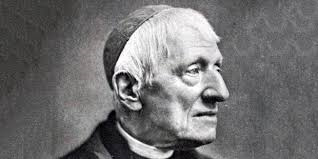
Saint Newman, Slavery and Freedom
A WEEK from today, on 13 October, a man dear to the hearts of everyone here will be canonized: John Henry Newman. I wonder, sometimes, if those who profess to admire him have actually read him, and in particular, if they are familiar with the sermons he preached as the Anglican vicar of the University church of Saint Mary the Virgin in Oxford. These sermons, immensely popular in the 1830s, are demanding, even relentless in their depiction of Christian commitment and its implications for the daily conduct of people who profess to follow Jesus. One of them, “The Strictness of the Law of Christ,” comes to mind as a commentary on today’s Gospel, about our being unprofitable servants—or rather “slaves,” for that is what the word means—who have done nothing more than we are obliged to do.
It is not, of course, the brutality of the American south or of the slave trade generally that Newman is invoking as a model of the Christian life, but all the same a slavery it is, as Our Lord noted in today’s Gospel. Saint Paul, too, continually uses the imagery of slavery to describe his own vocation and that of all Christians. How often, e.g., his letters open with the expression, “Paul, servant— that is, a slave—of Jesus Christ,” a slave who is not under “the law of nature,” but who is bound by the “law of faith,” or again by “the law of the Spirit of life.” For Newman, then, surely correctly, the state of man is necessarily one of slavery. In his own words:
We may choose our master, but God or mammon we must serve. We cannot possibly be in a neutral or intermediate state. Such a state does not exist. If we will not be Christ’s servants, we are forthwith Satan’s; and Christ set us free from Satan only by making us His servants.
But how, one must ask, is this talk of slavery and absolute obedience justified when the Gospels, and Saint Paul too, repeatedly refer to the freedom that Jesus brings to his disciples?
The truth will make you free.
. . . the glorious liberty of the sons of God.
For freedom Christ has set us free; stand fast, therefore, and do not submit again to the yoke of slavery.
To reconcile the Gospel’s demand that we are slaves with its promise that we are free, we may begin by examining elements of necessity in any exercise our freedom to choose, for choose we must at every moment, in even as simple a thing as whether to drink our coffee black or with cream. Once it has been drunk, our decision is unalterable: one cannot undrink a cup of coffee.
When you choose anything, you reject everything else. . . . Every act is an irrevocable selection and exclusion. Just as when you marry one woman you give up all the others, so when you take one course of action you give up all the other courses.
The important thing to note is that our having made a choice does not remove our freedom. For we affirm our freedom when we accept our decision, as when a man stays with his wife not because he is forced to do so but because he has chosen her. Similarly, to embrace the Gospel is to be bound by its demands and so to exclude behaviour incompatible with it. We are not free later to compromise our commitment. A parallel can be drawn with our assent to unavoidable physical facts. I unreservedly accept the limitations on my actions imposed by the law of gravity; I would be foolish indeed if I would demonstrate my deliverance from it by jumping off the roof of a ten-storey building. Thus, we freely obey the laws of nature—in physics, biology, etc.—recognizing that such conformity is not a constraint but merely the condition of our leading a normal life. In somewhat the same way, the moral law as enunciated by Jesus is to be fully and joyfully embraced in perfect freedom. In other words, the freedom of the sons of God that Paul talks about is indicative of our acceptance of the inspiration we receive from the Holy Spirit who, Jesus tells us, dwells in us to direct our thoughts and acts in accordance with the law of Christ.
We require our children to be honest, not as a restraint but as a means of attaining responsible maturity. We too, at first may find that the demands of the Christian life inhibiting, but they are so only to the spiritually immature. Once we are fed with the meat of Christian doctrine, and are no longer infants who can take only milk (to use Saint Paul’s image ), the refined and purified instincts of our hearts move freely along the path of Christian virtue. I suppose no one would deny that in some areas, at least, we remain childish. And in those matters, the external law serves as a valuable guide, preserving our integrity until we are fully in accord with what is right and true. And so, we have a choice. We may continue to be a slave to sin and in so acting enclose ourselves in a prison into which light barely penetrates, or we can embrace the service of Christ that is true freedom, in which bad habits—vices—are eliminated and with them the compulsive behaviour that is truly slavery in its most objectionable and degrading mode. Let Newman have the final word:
We are still slaves, but to a new master, and that master is Christ. . . . He has given us that only liberty which is really such, bond-service to Himself; lest if left to ourselves, we should fall back again . . . to the cruel bondage from which he redeemed us.

Saint Kateri , Canada’s Protectress
This was the title given to Saint Kateri Tekakwitha, by Pope Benedict XVI, when he canonized her on October 28th, 2012, along with six others, in Saint Peter’ Square (she had been beatified by Pope John Paul II back in 1980). With Saint Joseph as our protector, along with the Canadian martyrs, we seem to[…]Continue reading→

Remembering Father Alphonse de Valk
(Today marks the sixth anniversary of the death of Father Alphonse de Valk, C.S.B., a faithful, courageous and indefatigable Basilian priest, pro-life-and-family apostle, and the founder of Catholic Insight magazine. Here is what we wrote those on his entering into eternity five years ago, as we continue to remember him in our prayers and thoughts)[…]Continue reading→

My Name is Bernadette
April 16th is a propitious day, for besides the anniversary of Father de Valk’s death, who founded Catholic Insight in its print form decades ago, and the commemoration of the ‘two Benedicts’, mentioned in accompanying posts, today we also recall Saint Bernadette Soubirous, the young visionary to whom the Virgin Mary appeared numerous times at[…]Continue reading→

Canonizing Sister Faustina and Divine Mercy
HOMILY OF THE HOLY FATHER MASS IN ST PETER’S SQUARE FOR THE CANONIZATION OF SR MARY FAUSTINA KOWALSKA Sunday, 30 April 2000 1. “Confitemini Domino quoniam bonus, quoniam in saeculum misericordia eius”; “Give thanks to the Lord for he is good; his steadfast love endures for ever” (Ps 118: 1). So the Church sings on the Octave of[…]Continue reading→

Divine Mercy Sunday – An Echo of Every Mass
Reach out your hand and put it in my side. Do not doubt but believe’… ‘My Lord and my God!’ (Jn. 20:18)). Today is Divine Mercy Sunday, and as we celebrate the end of the Easter Octave, we contemplate the wounded side of our Saviour, the Church’s source of life. On Good Friday in the[…]Continue reading→

First Holy Communion: Sermon from May 16, 1943
Here is a sermon from the good old days by +Rev. Msgr. Vincent Nicholas Foy (August 14, 1915 – March 13, 2017), from 1943. Readers may recall that Pope Saint Pius X, by the decree Quam Singulari in 1910, lowered the customary age of reception of Holy Communion – after the rigours of the plague[…]Continue reading→

In the Glorious Light of Easter, Alleluia!
Set your minds on things that are above, not on things that are on earth, for you have died, and your life is hidden with Christ in God. When Christ who is your life is revealed, then you also will be revealed with him in glory (Col. 3:3-4). The Resurrection of Our Lord and Saviour[…]Continue reading→

An Ancient Homily for Holy Saturday
The time between Good Friday and Easter Sunday is one of waiting, in silence, as the world wonders – anticipates – what will happen, after the death of Christ. We re-live this time each year in the anamnesis of our liturgy, and in turn look forward to the glorious re-creation of all things at the[…]Continue reading→

Europe’s Long Descent
(As we meditate on this day on Christ’s burial, and His descent into hell, it is fitting to ponder here with contributor Peter Marcus how the world seems to be heading there as well. The difference is that, although God cannot ‘redeem’ hell, nor those therein, He can and did redeem the world. There is[…]Continue reading→
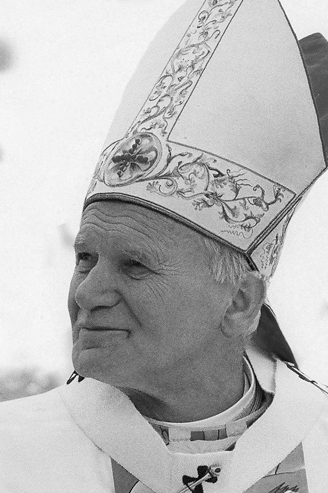
Pope Saint John Paul II’s First Good Friday Homily
ADDRESS OF HIS HOLINESS JOHN PAUL II AT THE CONCLUSION OF THE STATIONS OF THE CROSS AT THE COLOSSEUM Good Friday, 13 April 1979 When we make the Way of the Cross from one station to the next, in spirit we are always at the spot wherethis journey had its “historical” place: where it[…]Continue reading→