
Uganda’s Witness
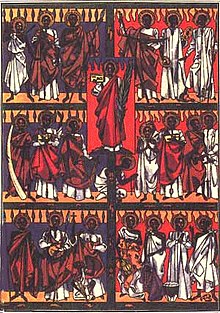
The memorial of Charles Llwanga and his companion martyrs, put to death in Uganda between 1885 and 1887, has complex undertones: the conquest of Africa in the midst of the ‘scramble’ by various European powers; the struggle for converts amongst Catholicism, Anglicanism and Islam; and the interior intrigues for power within the tribal hegemony of Uganda itself.
Tradition has it that the principal cause of the martyrdoms, the victims horrifically burnt alive, was that these Christians, Catholics and Anglicans, refused to submit to the homosexual lust of the king, Mwanga II. There are any number of revisionist theories, which a brief perusal of the perpetually-edited Wikipedia will attest, but contemporary evidence seems clear that these young men – pages and ministers at the king’s court – chose death rather than defilement, and that there was not much politically astute about the Mwanga’s quite literal blood lust. But where sin abounds, grace – not least in this case, heroism and courage – abound all the more.
There were 22 whom the Catholic Church beatified in 1920 (the same year that the North American, or Canadian if you will, Jesuit martyrs, were declared martyrs). Pope Saint Paul VI then canonized them in 1964 in the midst of the Second Vatican Council, praising also the 23 Anglican martyrs. His homily for the occasion signifies much, and may well be considered politically ‘incorrect’ in today’s zeitgeist of multiculturalism. But the Holy Father was well aware that there was Christian civilization, and there was pagan barbarism, and that the latter had to be replaced with the former, keeping, of course, whatever is true and good in the native genius. Tragically, many in Uganda did not learn the message of the martyrs, and in the following century, their noble people had to endure the savage rule of Idi Amin, who seized power in a military coup seven years after the canonization of the martyrs, and who soon revealed himself as an even-more corrupt Mwanga redivivus, massacring an untold number of his own people in a reign of terror that nearly defies description. We must learn from history, which includes the witness of others, or we may well be doomed to repeat it, as we are finding out on various fronts of this fallen world.
I will leave you with Paul VI’s own words, which give us hope that all is indeed not lost, and much gained:
These African martyrs herald the dawn of a new age. If only the mind of man might be directed not towards persecutions and religious conflicts but towards a rebirth of Christianity and civilisation!
Africa has been washed by the blood of these latest martyrs, the first of this new age (and, God willing, let them be the last, although such a holocaust is precious indeed). Africa is reborn free and independent.
The infamous crime by which these young men were put to death was so unspeakable and so expressive of the times. It shows us clearly that a new people needs a moral foundation, needs new spiritual customs firmly planted, to be handed down to posterity. Symbolically, this crime also reveals that a simple and rough way of life – enriched by many fine human qualities yet enslaved by its own weakness and corruption – must give way to a more civilised life wherein the higher expressions of the mind and better social conditions prevail.
The blood of Christians really is the seed of the Church, as Tertullian quipped in the third century, perhaps more true now than then. And the rebirth of the Church in the third millennium, if current demography is any indication, will be out of Africa, one of the few places on Earth still having enough children to perpetuate humanity. We have much to learn, or re-learn, and may the people of this burgeoning continent perfect their own genius by the supernatural grace the Faith offers.

Saint Kateri , Canada’s Protectress
This was the title given to Saint Kateri Tekakwitha, by Pope Benedict XVI, when he canonized her on October 28th, 2012, along with six others, in Saint Peter’ Square (she had been beatified by Pope John Paul II back in 1980). With Saint Joseph as our protector, along with the Canadian martyrs, we seem to[…]Continue reading→
A Closed, Unsustainable, Descending Loop
As a follow-up to my thoughts on Payette’s payout, here be a stark image of where are here in Canada. As the graph shows in, well, graphic terms, since 2025, the public sector has contributed to 95.5% of economic growth. The private sector – which funds the public sector, or is supposed to – has[…]Continue reading→

Remembering Father Alphonse de Valk
(Today marks the sixth anniversary of the death of Father Alphonse de Valk, C.S.B., a faithful, courageous and indefatigable Basilian priest, pro-life-and-family apostle, and the founder of Catholic Insight magazine. Here is what we wrote those on his entering into eternity five years ago, as we continue to remember him in our prayers and thoughts)[…]Continue reading→

My Name is Bernadette
April 16th is a propitious day, for besides the anniversary of Father de Valk’s death, who founded Catholic Insight in its print form decades ago, and the commemoration of the ‘two Benedicts’, mentioned in accompanying posts, today we also recall Saint Bernadette Soubirous, the young visionary to whom the Virgin Mary appeared numerous times at[…]Continue reading→
Presidential Pardon of Weronika Krawczyk
As a good news, follow-up to our story from Poland, of the persecution of Weronika Krawczyk for her pro-life views, we heard that she has been granted a presidential pardon. One might still wonder why one needs a presidential pardon for simply holding the long-held belief that the child within the womb is a child,[…]Continue reading→
Canonizing Sister Faustina and Divine Mercy
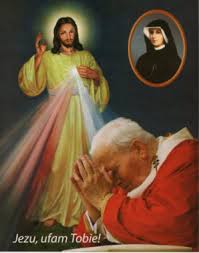
HOMILY OF THE HOLY FATHER MASS IN ST PETER’S SQUARE FOR THE CANONIZATION OF SR MARY FAUSTINA KOWALSKA Sunday, 30 April 2000 1. “Confitemini Domino quoniam bonus, quoniam in saeculum misericordia eius”; “Give thanks to the Lord for he is good; his steadfast love endures for ever” (Ps 118: 1). So the Church sings on the Octave of[…]Continue reading→

Divine Mercy Sunday – An Echo of Every Mass
Reach out your hand and put it in my side. Do not doubt but believe’… ‘My Lord and my God!’ (Jn. 20:18)). Today is Divine Mercy Sunday, and as we celebrate the end of the Easter Octave, we contemplate the wounded side of our Saviour, the Church’s source of life. On Good Friday in the[…]Continue reading→
Pope Leo and a Rosary for Peace
Pope Leo XIV has asked Catholics across the world to join him in a Rosary for peace today, at 18:00 Rome time (6 pm), which would be noon from where I write (EST). If you are able, whether at that time or another, and in whatever way you pray, to join in intercession with the[…]Continue reading→
Payette’s Payout
I was glancing through some headlines, and noticed a mention of Julie Payette – engineer and astronaut and sometime the Queen’s representative in Canada – which brought back vague memories. She was appointed Governor-General by Justin Trudeau in 2017. Ms. Payette resigned in 2021, amidst claims that she created a ‘toxic work environment’, with allegations[…]Continue reading→

Saint Stanislaus of Szczepanów
We celebrate Saint Stanislaus today (+ April 11, 1079), in light of this Easter Octave, a bishop and martyr who accepted the episcopacy only at the direct order of Pope Alexander II. He proved a wise and courageous leader of his flock, put to death by his own king, Boleslaus, for rebuking the monarch’s ‘immoral[…]Continue reading→