
They Have no Wine: Our Lady’s Role in Salvation
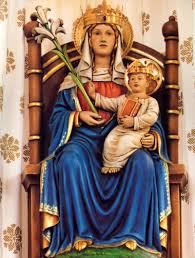
I enjoy the way that John begins the story of the wedding feast at Cana because he presents Mary with a mysterious authority that’s subtle and humble but clearly essential to the narrative. He does this first by introducing Mary before Jesus: “[T]he mother of Jesus was there; Jesus also was invited to the marriage, with his disciples” (Jn 2:1-2). Jesus has just begun his public ministry and he has a few disciples, but Mary, without being a public figure, is presented as the primary guest. This primacy is emphasized in the interactions that follow. Mary informs Jesus that, “They have no wine.” Jesus responds, “O woman, what is it to you and to me? My hour has not yet come” (Jn 2:4). It’s a puzzling response, and I will return to it later, but for now I want to focus on what happens next. Mary says to the servants, “Do whatever he tells you” (Jn 2:5). These are the last words that Mary speaks in the Gospel, and they are powerful. Who is this “woman”, and why is her authority a prerequisite for the servants to obey Jesus?
The wedding feast at Cana isn’t, of course, just a nice story about Jesus saving a party. God planned the event and John is recounting it so that we may learn more about how God works. The first thing that we should recognize is that Mary’s role is real. God has placed her in the story of salvation for a reason. She is the means by which he chose to enter the world, and she remains, even after Jesus is an adult, an intermediary between him and those in need.
At a deeper level, Mary is the New Israel, the new bride of God, and she is interceding on behalf of old Israel – the other people at the party. Old Israel is out of wine. That’s what Isaiah is speaking about in the first reading: “For as a young man marries a virgin, so shall your builder marry you, and as the bridegroom rejoices over the bride, so shall your God rejoice over you” (Is 62:5). Because of old Israel’s infidelity, God allowed her to be taken into exile, but he promised that he would vindicate her. Mary is already vindicated, she is the Immaculate Conception, and she is interceding on behalf of those who are still in exile. This reality is alluded to when Jesus says to her, “O woman, what is it to you and to me?” Mary has already received the new wine through a special privilege of grace; however, in order that others will be drawn to the new marriage, Jesus performs his first “sign”, changing water into wine, which points ahead to the new marriage that will take place between God and his people.
This “new marriage” is what Jesus is referring to when he says, “My hour has not yet come” (Jn 2:4). In the Gospel of John, whenever Jesus says, “my hour”, he is referring to his crucifixion. Therefore, his response to his mother indicates that he already intends to give them new wine. His Precious Blood, poured out on the cross to save us from sin, is the new wine. And, of course, as Jesus says later in John’s Gospel, “Truly, truly, I say to you, unless you eat the flesh of the Son of Man and drink his blood, you have no life in you” (Jn 6:53). This is the reality presented in the Eucharist. The Mass is the re-presentation of Christ’s sacrifice on the cross, which is also the celebration of his marriage to the Church at which he gives us the new wine.
At Mass, under the appearance of bread and wine, we receive the Body and Blood of Jesus. During the wedding feast at Cana Jesus changed water into wine. Both the appearances and the substance were changed. If he had merely added colour and flavour to the water, the steward could not have said, “Every man serves the good wine first; and when men have drunk freely, then the poor wine; but you have kept the good wine until now” (Jn 2:10). Changing appearances is one thing, and changing the substance is another. In the Eucharist God leaves the appearances of bread and wine, but he changes the substance (i.e., transubstantiation). Even though we do not see the change in substance, we know by faith that it has taken place. The wedding feast at Cana is a sign pointing us to this deeper reality.

Saint Kateri , Canada’s Protectress
This was the title given to Saint Kateri Tekakwitha, by Pope Benedict XVI, when he canonized her on October 28th, 2012, along with six others, in Saint Peter’ Square (she had been beatified by Pope John Paul II back in 1980). With Saint Joseph as our protector, along with the Canadian martyrs, we seem to[…]Continue reading→

Remembering Father Alphonse de Valk
(Today marks the sixth anniversary of the death of Father Alphonse de Valk, C.S.B., a faithful, courageous and indefatigable Basilian priest, pro-life-and-family apostle, and the founder of Catholic Insight magazine. Here is what we wrote those on his entering into eternity five years ago, as we continue to remember him in our prayers and thoughts)[…]Continue reading→

My Name is Bernadette
April 16th is a propitious day, for besides the anniversary of Father de Valk’s death, who founded Catholic Insight in its print form decades ago, and the commemoration of the ‘two Benedicts’, mentioned in accompanying posts, today we also recall Saint Bernadette Soubirous, the young visionary to whom the Virgin Mary appeared numerous times at[…]Continue reading→

Canonizing Sister Faustina and Divine Mercy
HOMILY OF THE HOLY FATHER MASS IN ST PETER’S SQUARE FOR THE CANONIZATION OF SR MARY FAUSTINA KOWALSKA Sunday, 30 April 2000 1. “Confitemini Domino quoniam bonus, quoniam in saeculum misericordia eius”; “Give thanks to the Lord for he is good; his steadfast love endures for ever” (Ps 118: 1). So the Church sings on the Octave of[…]Continue reading→

Divine Mercy Sunday – An Echo of Every Mass
Reach out your hand and put it in my side. Do not doubt but believe’… ‘My Lord and my God!’ (Jn. 20:18)). Today is Divine Mercy Sunday, and as we celebrate the end of the Easter Octave, we contemplate the wounded side of our Saviour, the Church’s source of life. On Good Friday in the[…]Continue reading→

Saint Stanislaus of Szczepanów
We celebrate Saint Stanislaus today (+ April 11, 1079), in light of this Easter Octave, a bishop and martyr who accepted the episcopacy only at the direct order of Pope Alexander II. He proved a wise and courageous leader of his flock, put to death by his own king, Boleslaus, for rebuking the monarch’s ‘immoral[…]Continue reading→

First Holy Communion: Sermon from May 16, 1943
Here is a sermon from the good old days by +Rev. Msgr. Vincent Nicholas Foy (August 14, 1915 – March 13, 2017), from 1943. Readers may recall that Pope Saint Pius X, by the decree Quam Singulari in 1910, lowered the customary age of reception of Holy Communion – after the rigours of the plague[…]Continue reading→

In the Glorious Light of Easter, Alleluia!
Set your minds on things that are above, not on things that are on earth, for you have died, and your life is hidden with Christ in God. When Christ who is your life is revealed, then you also will be revealed with him in glory (Col. 3:3-4). The Resurrection of Our Lord and Saviour[…]Continue reading→

An Ancient Homily for Holy Saturday
The time between Good Friday and Easter Sunday is one of waiting, in silence, as the world wonders – anticipates – what will happen, after the death of Christ. We re-live this time each year in the anamnesis of our liturgy, and in turn look forward to the glorious re-creation of all things at the[…]Continue reading→

Europe’s Long Descent
(As we meditate on this day on Christ’s burial, and His descent into hell, it is fitting to ponder here with contributor Peter Marcus how the world seems to be heading there as well. The difference is that, although God cannot ‘redeem’ hell, nor those therein, He can and did redeem the world. There is[…]Continue reading→