
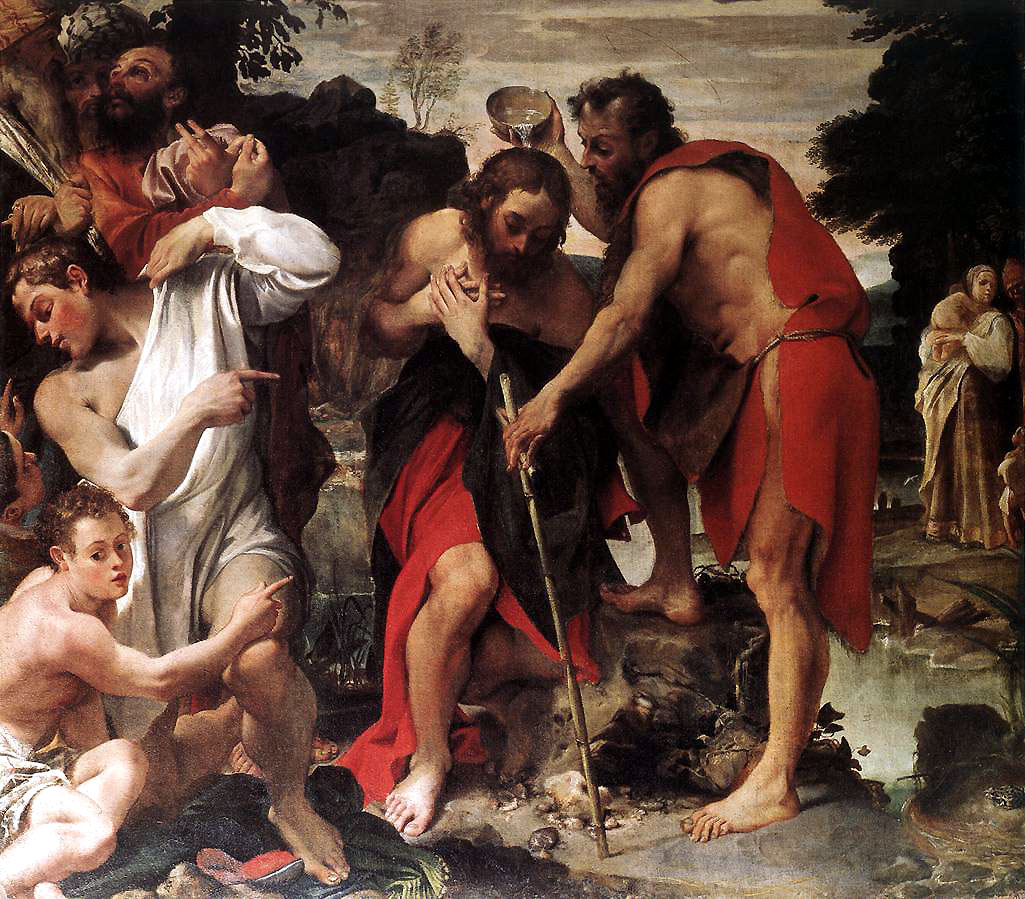
The Entrance of Baptism
A BIBLICAL TEXT can become so familiar that we simply bypass statements that would ordinarily puzzle us. I’m thinking of an aspect of the Gospel of today’s feast, viz., John’s baptizing at the River Jordan. Although I have read this passage countless times, today something about it suddenly struck me as strange, as requiring comment. And what is this mysterious feature of the text? It is this: why did John baptize at all, that is, why did he immerse the repentant sinners in the Jordan. Surely it would have been sufficient for them simply to admit their sinfulness and ask for forgiveness, as the publican did in the temple: “Lord, be merciful to me, a sinner.” And Jesus said that, by this simple confession of guilt, he was justified in the sight of God whereas the preening Pharisee at the front row was not.
We can approach the question by examining a principle of Old Testament Judaism, by which water represented a cleansing from sin as in Psalm 50/51:
Have mercy on me, O God, . . . Wash me thoroughly from my iniquity, and cleanse me from my sin.
More interesting, and suggestive, is the use of water to overcome what was known as “ritual impurity,” a concept that most of us find mysterious, even offensive; I’m not certain that I understand it fully myself. In the first place, it has nothing to do with morality. The term was used to describe the condition of a man—or woman—who was barred from public worship for performing what you would call a virtuous act. The noble Tobit, for instance, who buried the dead, was rendered ritually impure by doing so. So were soldiers who were battling to defend the nation; as was a woman who had had a child, all of which are good, very good things. An examination of the causes of ritual impurity, including, for example, serious illness, reveals that they have something in common, viz., they characterize someone who has had immediate contact with the beginning or the end of life or, in other words, someone who has encountered God, in that it is from him that all life has its origin and its ultimate purpose. The conviction was that any such person was in an extraordinary condition and, as a consequence, required a ceremonial re-entry into the ordinary public life of the community; washing was often part of the procedure. Thus someone who was ritually impure had one thing in common someone who had sinned: each of them, for very different reasons, had to be reintroduced into the community. But, as John the Baptist says in today’s Gospel, all of these washings were preliminary, provisional, pointing to a new kind of baptism—“a baptism with the Holy Spirit and fire”—that the Messiah would inaugurate. Like all fulfilments of the old law, this baptism incorporates all that had gone before, even as it adds something new and wonderful to them. It is, of course, Christian baptism that, like all those washings of Old Testament times, brings, first, forgiveness of sins—that corresponds to John’s baptism of repentance—and secondly gives the candidate access to full participation in the sacramental life of the Christian community—and this aspect of baptism is reminiscent of the notion of ritual purity.
Perhaps there is provided an insight to that episode at the Last Supper, when Jesus washed the feet of his disciples. It is usually interpreted as a mark of humility in that Jesus performed a task normally allotted to slaves, but in the light of all the washings we have been considering, it may also be seen as a preparation for entry into the great religious event which was soon to be anticipated in the new Passover Meal at which Christ instituted the Eucharist. In this way the foot-washing fits in with the baptismal symbolism: as our baptism is the means by which we enter into full participation in the unbloody sacrifice of the Mass, so the washing at the Last Supper prepared the Apostles for their experience at first hand of the sacrificial death of Jesus on the cross. What a lot John the Baptist has to tell us about our Christian vocation, and not least of all when he summarized his mission for his disciples: “He must increase, but I must decrease.

Saint Kateri , Canada’s Protectress
This was the title given to Saint Kateri Tekakwitha, by Pope Benedict XVI, when he canonized her on October 28th, 2012, along with six others, in Saint Peter’ Square (she had been beatified by Pope John Paul II back in 1980). With Saint Joseph as our protector, along with the Canadian martyrs, we seem to[…]Continue reading→

Remembering Father Alphonse de Valk
(Today marks the sixth anniversary of the death of Father Alphonse de Valk, C.S.B., a faithful, courageous and indefatigable Basilian priest, pro-life-and-family apostle, and the founder of Catholic Insight magazine. Here is what we wrote those on his entering into eternity five years ago, as we continue to remember him in our prayers and thoughts)[…]Continue reading→

My Name is Bernadette
April 16th is a propitious day, for besides the anniversary of Father de Valk’s death, who founded Catholic Insight in its print form decades ago, and the commemoration of the ‘two Benedicts’, mentioned in accompanying posts, today we also recall Saint Bernadette Soubirous, the young visionary to whom the Virgin Mary appeared numerous times at[…]Continue reading→

Canonizing Sister Faustina and Divine Mercy
HOMILY OF THE HOLY FATHER MASS IN ST PETER’S SQUARE FOR THE CANONIZATION OF SR MARY FAUSTINA KOWALSKA Sunday, 30 April 2000 1. “Confitemini Domino quoniam bonus, quoniam in saeculum misericordia eius”; “Give thanks to the Lord for he is good; his steadfast love endures for ever” (Ps 118: 1). So the Church sings on the Octave of[…]Continue reading→

Divine Mercy Sunday – An Echo of Every Mass
Reach out your hand and put it in my side. Do not doubt but believe’… ‘My Lord and my God!’ (Jn. 20:18)). Today is Divine Mercy Sunday, and as we celebrate the end of the Easter Octave, we contemplate the wounded side of our Saviour, the Church’s source of life. On Good Friday in the[…]Continue reading→

Saint Stanislaus of Szczepanów
We celebrate Saint Stanislaus today (+ April 11, 1079), in light of this Easter Octave, a bishop and martyr who accepted the episcopacy only at the direct order of Pope Alexander II. He proved a wise and courageous leader of his flock, put to death by his own king, Boleslaus, for rebuking the monarch’s ‘immoral[…]Continue reading→

First Holy Communion: Sermon from May 16, 1943
Here is a sermon from the good old days by +Rev. Msgr. Vincent Nicholas Foy (August 14, 1915 – March 13, 2017), from 1943. Readers may recall that Pope Saint Pius X, by the decree Quam Singulari in 1910, lowered the customary age of reception of Holy Communion – after the rigours of the plague[…]Continue reading→
In the Glorious Light of Easter, Alleluia!
Set your minds on things that are above, not on things that are on earth, for you have died, and your life is hidden with Christ in God. When Christ who is your life is revealed, then you also will be revealed with him in glory (Col. 3:3-4). The Resurrection of Our Lord and Saviour[…]Continue reading→
An Ancient Homily for Holy Saturday
The time between Good Friday and Easter Sunday is one of waiting, in silence, as the world wonders – anticipates – what will happen, after the death of Christ. We re-live this time each year in the anamnesis of our liturgy, and in turn look forward to the glorious re-creation of all things at the[…]Continue reading→
Europe’s Long Descent
(As we meditate on this day on Christ’s burial, and His descent into hell, it is fitting to ponder here with contributor Peter Marcus how the world seems to be heading there as well. The difference is that, although God cannot ‘redeem’ hell, nor those therein, He can and did redeem the world. There is[…]Continue reading→