

Faith as Common Sense
(A sermon of Father Daniel Callam for this Fourteenth Sunday in Ordinary Time)
A theme common to Ezekiel and Saint Mark, the readings we have just heard, is the necessity of faith—and, be it said, the difficulty of achieving it. The history of the Jews is a catalogue of the sin of idolatry, i.e., of surrendering their allegiance to the one true God for pagan idols. And it was a lack of faith at Nazareth that prevented Jesus from “doing deeds of power” there. And what about us? How strong is our faith? Well, you’re here, which indicates that it’s active. But no one will deny that there are difficulties in believing when any sort of religious commitment is continually challenged by the intellectual and cultural establishments of our society. Paradoxically, my own faith has been strengthened when I examine the current arguments brought against it. For not only do I find being a Catholic personally rewarding; it is also much superior to any alternative I have encountered in my long life.
Consider this statement from Richard Dawkins, an eloquent and persuasive exponent of atheism. What does he conclude? This: that we inhabit a universe in which there is “no design, no purpose, no evil, no good.”[1] His arguments may seem irrefutable to a simple-minded fellow like me, but I find his conclusion nonsensical. Furthermore, if we ask about evolution, i.e., how inert matter, a few atoms jostling around in primaeval mud, could possibly have the potential to develop over time into a Beethoven or an Einstein, we are told that “air and water are . . . conscious,”[2], that is, there is some sort of awareness in a stone or a star that directs its progress up the evolutionary scale. But if matter is conscious, if an atom somehow senses or thinks, we are really into pantheism, according to which the entire universe is a single gigantic organism, and human beings, like that stone, are manifestations of a single, universal intelligence. No thanks! If we have to choose between a divinized cosmos and the God of Abraham, Isaac and Jacob, I’ll take the latter every time, the creator who stands apart from his work and whose providential care delivers us from the crushing burden of mere chance or blind necessity.
Another character you will all have met is the relativist, who maintains that morality changes over time and even from person to person: “What is right to me is wrong to you, and vice versa”.
Of course, no one really believes this. To demonstrate his fallacy, ask him if slavery should have been morally acceptable two hundred years ago, or denying women the right to vote or burning witches at the stake. The fact is that, whatever he may say, everyone has definite convictions about right and wrong.
Consider also the #Metoo movement. No one defends past abuse on the grounds that morality was different then. And our Prime Minister does not think that abortion was legitimately punished as a crime in the past. Rather he views the decisions of the Supreme Court as righting a long-standing wrong, which he honours by requiring all his MPs to be pro-abortion. Similarly, formal apologies to homosexuals or victims of the residential schools are based on human rights that are regarded as valid always and everywhere.
Hence, the question is not whether there are definite moral principles, but rather which ones you will adopt As I say, I find no system as attractive and satisfying as that proposed by the Church. You may even have a chance of explaining it should your interlocutor turn on you, saying, “If you’re so smart, how do you determine what is right or wrong?” Referring to the ten commandments may not be an adequate response, but Saint Augustine has a noble and a powerful understanding of the Christian approach to life that is relevant to our present discussion. He bases his account of the human condition on the fact that we are moved to act by what we desire, that is to say, by love. An analysis of love, shows that it always attracted to something that is or, at least, seems to be good for us. The more excellent the good, the more strongly will we move towards it. It follows that I shall know how to behave in a given situation when my understanding has been directed to the object of my love. As God is the greatest good, eternal and all-satisfying, the rightly disposed person will be irresistibly drawn to him, and other, lesser goods will be honoured as coming from him and, properly used, as leading back to him. Such are the insights that underlie what is undoubtedly the most famous statement in the voluminous writings of Saint Augustine, “You have made us for yourself, O Lord, and out hearts are restless until they rest in you.”[3] Jesus himself provides the best account of this love “As the Father has loved me, so I have loved you. Abide in my love.”[4] He then proceeds to instruct us how to act: “If you keep my commandments, you will abide in my love, just as I have kept my Father’s commandments and abide in his love.”[5] “For God so loved the world that he gave his only Son, that whoever believes in him should not perish, but have eternal life.”[6]
[1] Daniel Callam, A Catholic Goes to the Movies (Ottawa: Justin Press, 2017), p. 52.
[2] Ibid., p. 53.
[3] Confessions, I.1.
[4] Jn 15.9.
[5] Jn 15.10.
[6] Jn 3.16.

Saint Kateri , Canada’s Protectress
This was the title given to Saint Kateri Tekakwitha, by Pope Benedict XVI, when he canonized her on October 28th, 2012, along with six others, in Saint Peter’ Square (she had been beatified by Pope John Paul II back in 1980). With Saint Joseph as our protector, along with the Canadian martyrs, we seem to[…]Continue reading→

Remembering Father Alphonse de Valk
(Today marks the sixth anniversary of the death of Father Alphonse de Valk, C.S.B., a faithful, courageous and indefatigable Basilian priest, pro-life-and-family apostle, and the founder of Catholic Insight magazine. Here is what we wrote those on his entering into eternity five years ago, as we continue to remember him in our prayers and thoughts)[…]Continue reading→

My Name is Bernadette
April 16th is a propitious day, for besides the anniversary of Father de Valk’s death, who founded Catholic Insight in its print form decades ago, and the commemoration of the ‘two Benedicts’, mentioned in accompanying posts, today we also recall Saint Bernadette Soubirous, the young visionary to whom the Virgin Mary appeared numerous times at[…]Continue reading→

Canonizing Sister Faustina and Divine Mercy
HOMILY OF THE HOLY FATHER MASS IN ST PETER’S SQUARE FOR THE CANONIZATION OF SR MARY FAUSTINA KOWALSKA Sunday, 30 April 2000 1. “Confitemini Domino quoniam bonus, quoniam in saeculum misericordia eius”; “Give thanks to the Lord for he is good; his steadfast love endures for ever” (Ps 118: 1). So the Church sings on the Octave of[…]Continue reading→

Divine Mercy Sunday – An Echo of Every Mass
Reach out your hand and put it in my side. Do not doubt but believe’… ‘My Lord and my God!’ (Jn. 20:18)). Today is Divine Mercy Sunday, and as we celebrate the end of the Easter Octave, we contemplate the wounded side of our Saviour, the Church’s source of life. On Good Friday in the[…]Continue reading→

First Holy Communion: Sermon from May 16, 1943
Here is a sermon from the good old days by +Rev. Msgr. Vincent Nicholas Foy (August 14, 1915 – March 13, 2017), from 1943. Readers may recall that Pope Saint Pius X, by the decree Quam Singulari in 1910, lowered the customary age of reception of Holy Communion – after the rigours of the plague[…]Continue reading→

In the Glorious Light of Easter, Alleluia!
Set your minds on things that are above, not on things that are on earth, for you have died, and your life is hidden with Christ in God. When Christ who is your life is revealed, then you also will be revealed with him in glory (Col. 3:3-4). The Resurrection of Our Lord and Saviour[…]Continue reading→

An Ancient Homily for Holy Saturday
The time between Good Friday and Easter Sunday is one of waiting, in silence, as the world wonders – anticipates – what will happen, after the death of Christ. We re-live this time each year in the anamnesis of our liturgy, and in turn look forward to the glorious re-creation of all things at the[…]Continue reading→

Europe’s Long Descent
(As we meditate on this day on Christ’s burial, and His descent into hell, it is fitting to ponder here with contributor Peter Marcus how the world seems to be heading there as well. The difference is that, although God cannot ‘redeem’ hell, nor those therein, He can and did redeem the world. There is[…]Continue reading→
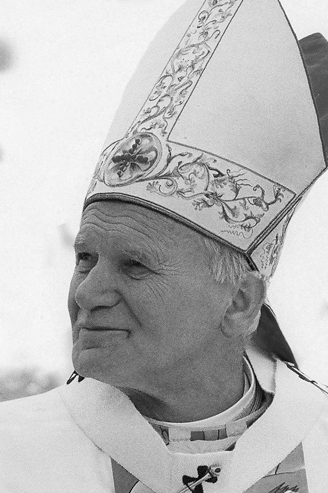
Pope Saint John Paul II’s First Good Friday Homily
ADDRESS OF HIS HOLINESS JOHN PAUL II AT THE CONCLUSION OF THE STATIONS OF THE CROSS AT THE COLOSSEUM Good Friday, 13 April 1979 When we make the Way of the Cross from one station to the next, in spirit we are always at the spot wherethis journey had its “historical” place: where it[…]Continue reading→