
A Pastoral Reflection on Amoris Laetitia
Amoris Laetitia can be interpreted as saying that couples in irregular relationship can be admitted to the sacraments of reconciliation and the Eucharist when they have a sincere desire to change their marital situation but cannot without causing harm, particularly to their children. That interpretation has been challenged, as we know. But some situations need special attention. Let me give an example:
Nearly two decades ago I became deacon in charge of a Catholic mission in the distant North of our country. At the time I arrived there, a lay women already had responsibility in the absence of the missionary priest who would come on a monthly basis. It did not take long for me to discover that this women was living common law with a divorced non-Catholic. She was a devout and generous woman which led me to believe that at the beginning of her relationship with the father of her children, her faith left much to be desired, but that in time it grew and she developed a relationship with Christ. At the time I met her she had had been allowed to receive the sacraments. Continence was out of the question, as her partner would never have accepted that. She could leave him, but then, what would happen to her children? Nevertheless, I could not give her Communion and told her so, explaining that it would create scandal and that it would be against the guidelines of the Church. Although she was very saddened and cried, she courageously accepted my decision.
I also told her that she could invite Christ to come in her heart. That is also the solution offered by Cardinal Ouellet during the Amoris Laetitia debate on the topic. Can Christ be received outside the sacrament of his Body and Blood? Did He not say: “Truly, truly, I say to you, unless you eat the flesh of the Son of man and drink his blood, you have no life in you; he who eats my flesh and drinks my blood has eternal life, and I will raise him up at the last day.” (John 6:53) Does that mean that all non-Catholics and Catholics who are not allowed to receive Communion cannot have Life in them? That does not accord with the Church’s teaching and here is my thinking regarding this question:
Christ is One, fully human and fully divine. He is fully in the consecrated wine and fully in the consecrate bread. When receiving either one or the other of these elements, one receives the whole of Christ. But Christ is also the Word made flesh: St John writes ”In the beginning was the Word…” ”The Word became flesh and dwelt among us.” And he quotes Jesus as saying: ”…whoever hears my word and believes in the one who sent me has eternal life and will not come to condemnation, but has passed from death to life.” Also, ”… whoever keeps my word will never see death.” There are many such affirmations from the Gospels.
I conclude that whoever receives the Word of God in his heart and adheres to it in faith receives Christ integrally, as Christ is One. By receiving Him in this way one receives also his Body and His blood, although not sacramentally and consequently, not as perfectly..
Jean-Nil Chabot, Deacon
Jean-Nil Chabot, Ph.D. (Philosophy), a Permanent Deacon in the Pembroke Diocese at Saint Hedwig’s Parish, has taught at Our Lady Seat of Wisdom College, but has been retired for a few years. He wrote his doctoral thesis on the preamble to the Canadian Charter of Rights and Freedoms, which is the introductory sentence to the Constitution of Canada‘s Charter of Rights and Constitution Act of 1982. In full, the preamble reads, “whereas Canada is founded upon principles that recognize the supremacy of God and the rule of law.”

Saint Kateri , Canada’s Protectress
This was the title given to Saint Kateri Tekakwitha, by Pope Benedict XVI, when he canonized her on October 28th, 2012, along with six others, in Saint Peter’ Square (she had been beatified by Pope John Paul II back in 1980). With Saint Joseph as our protector, along with the Canadian martyrs, we seem to[…]Continue reading→

Remembering Father Alphonse de Valk
(Today marks the sixth anniversary of the death of Father Alphonse de Valk, C.S.B., a faithful, courageous and indefatigable Basilian priest, pro-life-and-family apostle, and the founder of Catholic Insight magazine. Here is what we wrote those on his entering into eternity five years ago, as we continue to remember him in our prayers and thoughts)[…]Continue reading→

My Name is Bernadette
April 16th is a propitious day, for besides the anniversary of Father de Valk’s death, who founded Catholic Insight in its print form decades ago, and the commemoration of the ‘two Benedicts’, mentioned in accompanying posts, today we also recall Saint Bernadette Soubirous, the young visionary to whom the Virgin Mary appeared numerous times at[…]Continue reading→

Canonizing Sister Faustina and Divine Mercy
HOMILY OF THE HOLY FATHER MASS IN ST PETER’S SQUARE FOR THE CANONIZATION OF SR MARY FAUSTINA KOWALSKA Sunday, 30 April 2000 1. “Confitemini Domino quoniam bonus, quoniam in saeculum misericordia eius”; “Give thanks to the Lord for he is good; his steadfast love endures for ever” (Ps 118: 1). So the Church sings on the Octave of[…]Continue reading→

Divine Mercy Sunday – An Echo of Every Mass
Reach out your hand and put it in my side. Do not doubt but believe’… ‘My Lord and my God!’ (Jn. 20:18)). Today is Divine Mercy Sunday, and as we celebrate the end of the Easter Octave, we contemplate the wounded side of our Saviour, the Church’s source of life. On Good Friday in the[…]Continue reading→

Saint Stanislaus of Szczepanów
We celebrate Saint Stanislaus today (+ April 11, 1079), in light of this Easter Octave, a bishop and martyr who accepted the episcopacy only at the direct order of Pope Alexander II. He proved a wise and courageous leader of his flock, put to death by his own king, Boleslaus, for rebuking the monarch’s ‘immoral[…]Continue reading→
First Holy Communion: Sermon from May 16, 1943
Here is a sermon from the good old days by +Rev. Msgr. Vincent Nicholas Foy (August 14, 1915 – March 13, 2017), from 1943. Readers may recall that Pope Saint Pius X, by the decree Quam Singulari in 1910, lowered the customary age of reception of Holy Communion – after the rigours of the plague[…]Continue reading→
In the Glorious Light of Easter, Alleluia!
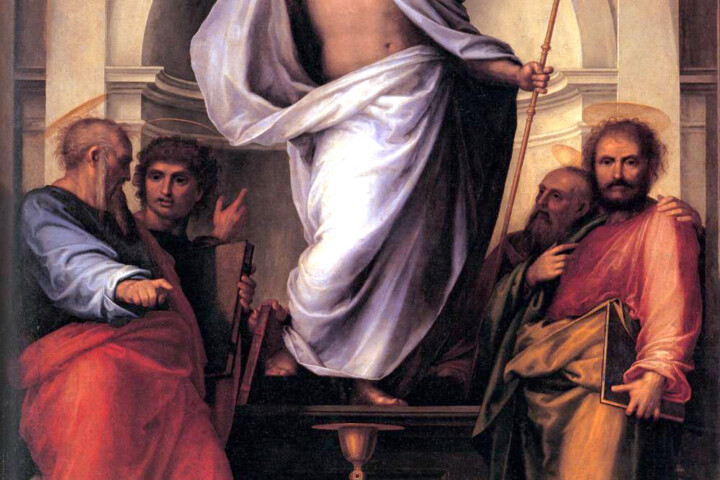
Set your minds on things that are above, not on things that are on earth, for you have died, and your life is hidden with Christ in God. When Christ who is your life is revealed, then you also will be revealed with him in glory (Col. 3:3-4). The Resurrection of Our Lord and Saviour[…]Continue reading→
An Ancient Homily for Holy Saturday
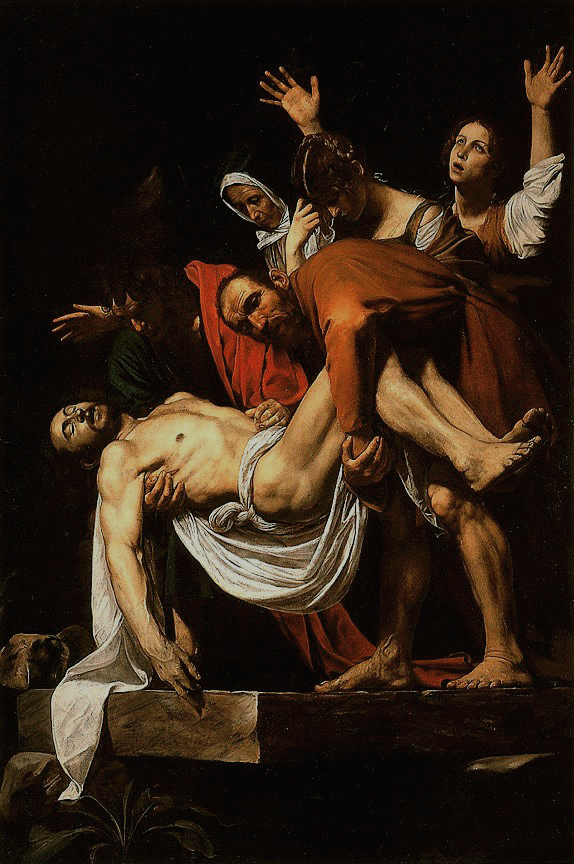
The time between Good Friday and Easter Sunday is one of waiting, in silence, as the world wonders – anticipates – what will happen, after the death of Christ. We re-live this time each year in the anamnesis of our liturgy, and in turn look forward to the glorious re-creation of all things at the[…]Continue reading→
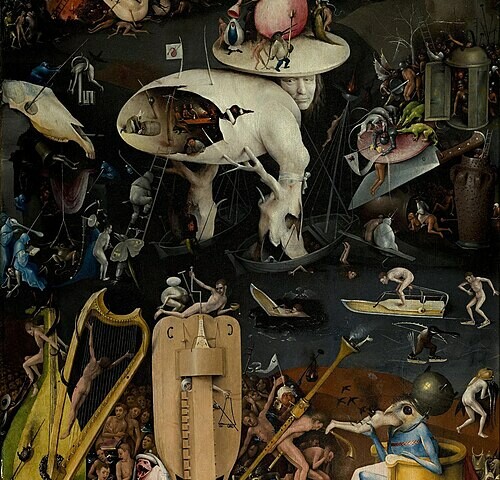
Europe’s Long Descent
(As we meditate on this day on Christ’s burial, and His descent into hell, it is fitting to ponder here with contributor Peter Marcus how the world seems to be heading there as well. The difference is that, although God cannot ‘redeem’ hell, nor those therein, He can and did redeem the world. There is[…]Continue reading→