
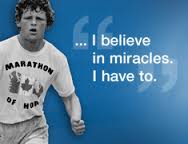
Finding Unity Despite Disunity: God, Love and the Enduring Message of Terry Fox
Much of the Western world is split by issues pertaining to politics, economics, race, gender, sexual orientation and religion. No doubt, these issues need to be adequately assessed and dealt within a morally prudent and logical manner. This is especially true in light of the upcoming presidential election between Donald Trump and Hilary Clinton. The decision is not a simple one, especially given their past and flip flop type attitudes. One cannot but help question their true motivations and whether they have the best interest of the people. Indeed, it is a sad period for American voters. This is not to say, that here in Canada, we do not have our fair share of political, economic and social problems, it is undeniable that we do. And of course, this is not endemic solely to North America but spread out across the world with varying degrees of severity.
The popular debates surrounding these broad issues concern human wellbeing, both individually and collectively but demonstrate a deep neglect of the intrinsic worth of the human person. There is au fond, a profound flawed misunderstanding and/or dismissal of metaphysics and meta-ethics. Unfortunately, particular ideologies, have been elevated over the human person. Truth has been compromised. This has manifested itself in the debates revolving around abortion, assisted suicide and transgender washrooms. As polarizing and misguided, these debates truly are, we sometimes need to take a pause from the cacophony of confused and competing voices. Regardless of ideological clashes, I would like to focus on a timeless issue. For a brief moment, let us focus our attention towards a cause that will help create unity instead of disunity, even if just for a brief moment.
Whether one believes in the Judeo-Christian doctrine of the image-likeness of God (Genesis 1:27) or not it provides one with an equalizer or guarantor in terms of why each human person has intrinsic value. Although Jewish, Christian and Sufi Islamic philosophers and theologians have debated the meaning of being created in the image of God, it is as an aspect to the human person which signifies a profound intrinsic worth distinguishing human persons from the rest of the animal kingdom. I would argue that our capacity for self-consciousness (i.e., our ability to be aware of ourselves – the ability to recognize we are persons, the “I” moment) and what such a capacity entails, including the ability to deliberate, imagine, love, empathize, create and imagine are what encompass being created in the image of God. This doctrine is inclusive to all of humanity. All human persons share in this image whether one is a believer in the doctrine (Jew, Christian, Sufi-Muslim) or a non-believer (Hindu, Buddhist, Atheist, Agnostic etc.).
It is worth pointing out that the origin and experience of self-consciousness is part of the subjective phenomenological human experience. This is not to negate that animals have a certain level of self-awareness but the extent that it exists in humans seems to be something rather radical in comparison to the rest of the animal kingdom. Panpsychists who see consciousness as being ubiquitous throughout nature and particularly the animal kingdom will certainly disagree with such a statement. It is worth pointing out that a number of Christian intellectuals such as Catholic paleontologist, Daryl Domning, Catholic philosopher Peter van Inwagen and theologians such as Anglican bishop and eminent New Testament scholar N.T. Wright, through the implication of their embracing of Christian physicalism (which denies the existence of an immaterial self/soul), postulate that through further evolutionary development leading to high levels of complexity is what led to the origin of self-consciousness, i.e., the ability to introspect deeply on one’s own self. However, in Saint Pope John Paul II’s address The Pontifical Academy of Sciences: On Evolution in 1996, he sates
It is by virtue of his eternal soul that the whole person, including his body, possesses such great dignity. Pius XII underlined the essential point: if the origin of the human body comes through living matter which existed previously, the spiritual soul is created directly by God (“animas enim a Deo immediate creari catholica fides non retimere iubet”). (Humani Generis)
As a result, the theories of evolution which, because of the philosophies which inspire them, regard the spirit either as emerging from the forces of living matter, or as a simple epiphenomenon of that matter, are incompatible with the truth about man. They are therefore unable to serve as the basis for the dignity of the human person.
John Paul II, rightfully emphasizes the great discontinuity between humanity’s soul and consciousness with the rest of the animal kingdom. This was a point of contention between the co-discoverers of evolution by natural selection: Alfred Wallace (1832-1913) and Charles Darwin (1809-1882). The origin of self-consciousness is a radical event in the history of the universe, as G.K. Chesterton (1874-1936), observes:
The matter here is one of history and not of philosophy so that it need only be noted that no philosopher denies that a mystery still attaches to the two great transitions: the origin of the universe itself and the origin of the principle of life itself. Most philosophers have the enlightenment to add that a third mystery attaches to the origin of man himself. In other words, a third bridge was built across a third abyss of the unthinkable when there came into the world what we call reason and what we call will. Man is not merely an evolution but rather a revolution. That he has a backbone or other parts upon a similar pattern to birds and fishes is an obvious fact, whatever be the meaning of the fact. But if we attempt to regard him, as it were, as a quadruped standing on his hind legs, we shall find what follows far more fantastic and subversive than if he were standing on his head.
It is our conscious experience of reality which entails self-consciousness, this provides us with the capacity towards love which is what binds humans together. Inevitably, so does suffering, which occurs upon reflection of physical and/or emotional pain. Our ability to empathize and identify with those who suffer, unifies us with others through our ability to love.
The Catholic philosopher and theologian, Bernard Lonergan would refer to love for God and love for others, as a mode of self-transcendence which would be the fulfillment of our self-consciousness. Or as Lonergan would put it “being in love with God is the basic fulfillment of our conscious intentionality.”
The greatest example of love throughout the history of humanity is embodied in the person of Jesus. Jesus asks us to love in a radical manner, i.e., to love those who are our enemies and who persecute us: “But I tell you, love your enemies and pray for those who persecute you, that you may be children of your Father in heaven. He causes his sun to rise on the evil and the good, and sends rain on the righteous and the unrighteous” (Matthew 5:44-45). Jesus also asks us to love completely selflessly and in a radical form of perfect altruism which will help us break free from the shackles of our selfishness and sinful desires, in the form of sacrificing one’s self for our neighbour but to ultimately also save ourselves from our sinful and selfish nature: “My command is this: Love each other as I have loved you. Greater love has no one than this: to lay down one’s life for one’s friends” (John 15:12-13). It is in this sense that we can freely partake in God’s love to others through being created in His image.
Catholic paleontologist Daryl Domning and the late theologian Monika Hellwig entertain an intriguing (but ultimately unorthodox, ed.) idea of perfect altruism in their book, Original Selfishness: Original Sin And Evil in the Light of Evolution. This is something only exemplified through Christ in the created order. It helps break us free from our evolutionary roots of selfishness which before the advent of moral consciousness was manifested in pre-humans through a propensity and innate predisposition to do everything in our capacity (or any particular organism) to survive. All organisms are selfish in a non-pejorative sense merely because of this propensity to survive. This inherent selfishness, Domning calls “original selfishness”, as a substitute to what is typically referred to as “original sin”. All organisms share this original selfishness from the origin of life to all present organisms including humans. The difference with humans is that we have a moral consciousness to choose evil through free will whereby guilt can result.
Moral evil although largely passed on from cultural transmission from sinful societies, is not the root. Domning and Hellwig reason this is not the result of a pre-historical Fall, so, eventually moral evil evolves out of physical evil. Yet, again, it is worth clarifying that this stands in contrast to Catholic doctrine, as enunciated in Pius XII’s 1950 encyclical Humani Generis:
When, however, there is question of another conjectural opinion, namely polygenism, the children of the Church by no means enjoy such liberty. For the faithful cannot embrace that opinion which maintains either that after Adam there existed on this earth true men who did not take their origin through natural generation from him as from the first parent of all or that Adam represents a certain number of first parents. Now it is in no way apparent how such an opinion can be reconciled with that which the sources of revealed truth and the documents of the Teaching Authority of the Church propose with regard to original sin, which proceeds from a sin actually committed by an individual Adam and which through generation is passed on to all and is in everyone as his own. (#37).
This involves the debate between polygenism and monogenism. Domning and Hellwig opt for polygenism. Over the years, there have been several attempts, although highly speculative, to try and reconcile a monogenist theological account of human origins with that of a polygenist. The success or failure of such notions would be beyond the scope of this essay. Nonetheless, what is certain between Domning and Hellwig’s view and Church Doctrine, is that perfect unselfishness cannot come from natural processes; we need supernatural grace transcending our original selfishness through Christ’s salvation. Thus, Domning and Hellwig see our emulation of Jesus’ perfect altruism as portrayed through his words and his ultimate act of love through his sacrifice on the Cross is how we may overcome “selfishness” and our mere ability to perform reciprocal altruism as is found through much of the animal kingdom. Similarly, in reference to Christian authenticity, Lonergan expresses how this is truly manifested:
Christian authenticity – which is a love of others that does not shrink from self-sacrifice and suffering – is the sovereign means for overcoming evil. Christians bring about the kingdom of God in the world not only by doing good but also by overcoming evil with good (Rom. 12, 21).
God’s perfect image through Christ, is the highest example, who embodies the perfect moral consciousness which is geared towards love for one another. This is demonstrated through God’s true love and purpose for His creation. Jesus through the ultimate act of love and humility (His sacrificing atonement) is the one who demonstrates the true image stamp of God.
Following such an understanding of moral self-consciousness and authentic Christian living, through God’s image, is the inspirational story of the great Canadian hero Terry Fox. The story is well known. Fox at the age of 18 was diagnosed with bone cancer and had to have his right leg amputated above the knee. Despite this huge setback in his life he was determined to fight cancer through running from coast to coast in Canada. When many people would choose to turn inwards and become bitter and succumb to their impending death, Fox chose life and decided to rage against that good night, as he states:
I don’t feel that this is unfair. That’s the thing about cancer. I’m not the only one, it happens all the time to people. I’m not special. This just intensifies what I did. It gives it more meaning. It’ll inspire more people. I just wish people would realize that anything’s possible if you try; dreams are made possible if you try.
This run, in 1979, came to be known as the Marathon of Hope. Unfortunately, he had to stop running outside of Thunder Bay, Ontario since the cancer had spread to his lungs and had made it extremely difficult for him to breathe. Only months after people from all over the world were able to realize Fox’s dream of raising one dollar per Canadian citizen for cancer research – $23.4 million was raised. Indeed, miracles of hope can occur. Who would’ve thought in a span of a few months such a feat was possible, fittingly Fox had stated: “I’m not a dreamer, and I’m not saying this will initiate any kind of definitive answer or cure to cancer, but I believe in miracles. I have to.”
This was 36 years ago. Since, that moment, not just only Canadians but millions of people around the world have participated in The National School Run Day, The Terry Fox Run, and Terry Fox fundraising event. As of 2014, remarkably, 650 million dollars have been raised in Terry Fox’s name — an incredible milestone considering how it all began. Fox’s prophetic words have been realized: “Even if I don’t finish, we need others to continue. It’s got to keep going without me.”
Just the other day, a newsletter sent home to parents from my daughter’s Catholic elementary school, describing the Terry Fox Run/Walk On inspired me to create a webpage for my daughter where sponsors could donate money online. This was an opportunity for friends and family to unite for a common cause despite their internal disagreements and discord. It is a beautiful thing to see the sponsor’s names from people who have different ideologies and religious outlooks but share the common propensity towards love and fighting a secondary cause to much of our human suffering: cancer. As an aside, I am proud to say this year she was able to run 17 more laps than the previous year (21 in total). She also helped raise close to 500 which was one third of the school’s goal! A special thank you to all the generous donors (you know who you are).
As Fox recognized, cancer affects us all whether indirectly or directly, it also doesn’t discriminate with respect to our ideologies, age, race, gender, religion, etc., things that otherwise separate us. This realization of our common finitude and fragility, is an appeal to our moral consciousness, where we can come together and be unified. It is this propensity towards love, even if sometimes buried deep down inside, that unifies us to one another through our common suffering.
Although, Fox was only 22 years old when he died, he realized his higher purpose. Terry Fox was a self-professed Christian. Unfortunately, many people spend a lifetime without truly embodying such a propensity towards love and helping others, as he states: “It took cancer to realize that being self-centered is not the way to live. The answer is to try and help others.” It is through his very suffering that he is transformed and redeemed. A curse turns into a blessing. This seems to evince the notion that some evil is necessary for a greater good. In this light, evil has profound spiritual benefits towards human development. Augustine in his Enchiridion argues that evil is not a thing in and of itself but merely an absence of the good, so if we are able to increase the good despite the circumstance we find ourselves in, as Fox did, we are able diminish such an absence of good. We thus increase the light in this world to illuminate truth.
Fox promised himself that if he should live, he should prove to himself deserving of life. Indeed, he did and serves as extraordinary example for all of us to live by. We should all follow Fox’s example to love selflessly, mirroring Jesus’ radical altruism, albeit through a finite and imperfect way. Even if one does not believe in Christ, following such an example, will lead us from disunity to unity despite our many differences.
Keeping with this spirit of love, let us not forget the great many persons who have suffered from cancer and who continue to this very day; which could include close loved ones. Regardless of whether we are able to one day find a cure or not, let us always give our love to comfort them. In line with this, let us keep Christian apologist and Christian convert from Islam, Nabeel Qureshi (author of Seeking Allah, Finding Jesus), in our prayers, who has been recently stricken with stage IV stomach cancer. Let his work, faith and courage be an example to all of us.
Scott Ventureyra is a doctoral candidate in theology at Dominican University College in Ottawa, Canada. His research focuses on the Christian conception of God and creation in understanding the origin of consciousness. He has presented at a number of different conferences including the international conference on consciousness in Tucson, Arizona – The Science of Consciousness this past April. He has published in academic journals such as Science et Esprit, The American Journal of Biblical Theology, Studies in Religion and has some forthcoming articles to be published in the next issue of Maritain Studies. He has also written for magazines such as Crisis and Convivium and newspapers such as The National Post, City Light News, The Ottawa Citizen and The Times Colonist.

Saint Kateri , Canada’s Protectress
This was the title given to Saint Kateri Tekakwitha, by Pope Benedict XVI, when he canonized her on October 28th, 2012, along with six others, in Saint Peter’ Square (she had been beatified by Pope John Paul II back in 1980). With Saint Joseph as our protector, along with the Canadian martyrs, we seem to[…]Continue reading→

Remembering Father Alphonse de Valk
(Today marks the sixth anniversary of the death of Father Alphonse de Valk, C.S.B., a faithful, courageous and indefatigable Basilian priest, pro-life-and-family apostle, and the founder of Catholic Insight magazine. Here is what we wrote those on his entering into eternity five years ago, as we continue to remember him in our prayers and thoughts)[…]Continue reading→

My Name is Bernadette
April 16th is a propitious day, for besides the anniversary of Father de Valk’s death, who founded Catholic Insight in its print form decades ago, and the commemoration of the ‘two Benedicts’, mentioned in accompanying posts, today we also recall Saint Bernadette Soubirous, the young visionary to whom the Virgin Mary appeared numerous times at[…]Continue reading→

Canonizing Sister Faustina and Divine Mercy
HOMILY OF THE HOLY FATHER MASS IN ST PETER’S SQUARE FOR THE CANONIZATION OF SR MARY FAUSTINA KOWALSKA Sunday, 30 April 2000 1. “Confitemini Domino quoniam bonus, quoniam in saeculum misericordia eius”; “Give thanks to the Lord for he is good; his steadfast love endures for ever” (Ps 118: 1). So the Church sings on the Octave of[…]Continue reading→

Divine Mercy Sunday – An Echo of Every Mass
Reach out your hand and put it in my side. Do not doubt but believe’… ‘My Lord and my God!’ (Jn. 20:18)). Today is Divine Mercy Sunday, and as we celebrate the end of the Easter Octave, we contemplate the wounded side of our Saviour, the Church’s source of life. On Good Friday in the[…]Continue reading→

Saint Stanislaus of Szczepanów
We celebrate Saint Stanislaus today (+ April 11, 1079), in light of this Easter Octave, a bishop and martyr who accepted the episcopacy only at the direct order of Pope Alexander II. He proved a wise and courageous leader of his flock, put to death by his own king, Boleslaus, for rebuking the monarch’s ‘immoral[…]Continue reading→

First Holy Communion: Sermon from May 16, 1943
Here is a sermon from the good old days by +Rev. Msgr. Vincent Nicholas Foy (August 14, 1915 – March 13, 2017), from 1943. Readers may recall that Pope Saint Pius X, by the decree Quam Singulari in 1910, lowered the customary age of reception of Holy Communion – after the rigours of the plague[…]Continue reading→

In the Glorious Light of Easter, Alleluia!
Set your minds on things that are above, not on things that are on earth, for you have died, and your life is hidden with Christ in God. When Christ who is your life is revealed, then you also will be revealed with him in glory (Col. 3:3-4). The Resurrection of Our Lord and Saviour[…]Continue reading→

An Ancient Homily for Holy Saturday
The time between Good Friday and Easter Sunday is one of waiting, in silence, as the world wonders – anticipates – what will happen, after the death of Christ. We re-live this time each year in the anamnesis of our liturgy, and in turn look forward to the glorious re-creation of all things at the[…]Continue reading→

Europe’s Long Descent
(As we meditate on this day on Christ’s burial, and His descent into hell, it is fitting to ponder here with contributor Peter Marcus how the world seems to be heading there as well. The difference is that, although God cannot ‘redeem’ hell, nor those therein, He can and did redeem the world. There is[…]Continue reading→