
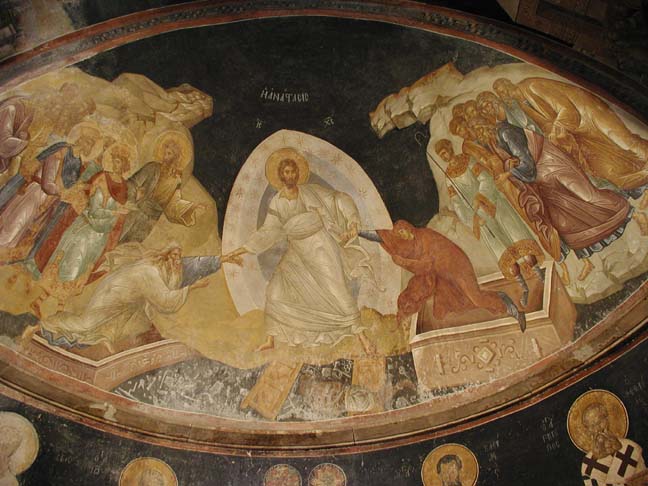
He Descended into Hell
(As we begin these latter days of Advent, awaiting the imminent arrival of our Saviour, it would do us well to ponder what indeed He is saving us from. Hence, this piece by Father Callam is quite a propos, that the Child in the manger is also the Redeemer of all men, the vanquisher of Satan, who was destined to carry in His own body and soul the sins of all time, and all of their heinous effects, in this world and the next. So hope, the virtue especially dear in this Advent season, springs eternal. Editor)
“He descended into Hell”
In the first place, we have a text from first Peter in the new English version of the Mass, a striking phrase occurs in the Apostles’ Creed, which in Canada is said almost every Sunday. Over the last few decades, we have been saying, “Jesus Christ . . . suffered under Pontius Pilate, was crucified, died and was buried. He descended to the dead. On the third day he rose again. . . .” Now we are instructed to say, “He descended into Hell,” which represents a return to the traditional wording.[1] Why “Hell” was changed into “the dead” at all is an interesting question. It seems to have been the product of a policy on the part of the translators of a preceding generation to shield the faithful from anything that would shock us or even make us think. The result was a tepidity in the texts that made them the liturgical equivalent of the muzak you hear on elevators or in a doctor’s office. Our forbears in the faith were, it seems, made of sterner stuff. In fact, there are good reasons for restoring the original vigorous wording.
For Christ also died for sins once for all, the righteous for the unrighteous, that he might bring us to God, being put to death in the flesh but made alive in the spirit; in which he went and preached to the spirits in prison, who formerly did not obey, when God’s patience waited in the days of Noah, during the building of the ark, in which a few, that is, eight persons, were saved through water. (1 Peter 3.18-20)
This strange text, whatever conclusions scholars may eventually come to about it, clearly indicates one thing, namely, that Christ’s triumph over sin and death was universally recognized, in every spiritual realm. In the traditional harrowing of Hell, especially popular in the art of the Middle Ages, Jesus is portrayed as exhibiting his power “in the spirit” by releasing the souls of the just who could not enter heaven until Christ had completely his great work of salvation. He once and for all overcame the power of Satan.
While in common speech, the word “Hell” is usually restricted to the abode of the damned, with Satan and the fallen angels, it is also used as a general term for the realm of the dead, like the “Hades” of Greek mythology. Nevertheless, something has been gained by restoring “Hell” to the creed in that it draws vivid attention to the universality of Christ’s redemptive work.” The art of the Greek Church illustrates in a striking manner that all men are given the invitation to eternal life through Jesus Christ. Consider the magnificent fresco in the Church of Chora (now the Kariye Museum) in Instanbul:
We see Christ portrayed as rising . . . no, springing up from the dead, as vigorous as an athlete completing the course. The aged couple he is pulling out of their coffins are Adam and Eve whose sin in the Garden of Eden resulted in all mankind’s being alienated from God in the first place. The universal restoration to God’s good favour is thus brilliantly depicted in the icon by having the progenitors of the human race sharing in the triumph of Jesus over sin and death: “Where sin increased, grace abounded all the more.”[2] The fact that not everyone is actually saved, despite the fact that “God desires all men to be saved,”[3] is owing to the exercise of free will. Only those who consciously turn against God are lost. The gates of Hell are locked on the inside.
Glimpsed at the bottom of the icon, at the feet of Jesus, is Satan, “the prince of this world,”[4] bound and helpless. He has lost his power, as we see from the gates of Hell smashed open with bolts and locks, keys and hinges, chains and fetters, careening around the prostrate figure. It follows that it is significant that Christ has visited Hell, rather that some shadowy, indeterminate region of the dead.
There is another element to be considered. The Swiss theologian Hans Urs von Balthasar (1905-88) commented on the descent into hell in light of the hellish conditions of the concentration camps of the twentieth century. Surely, someone might say, Christ’s agony, excruciating as it was, would not have been as great the suffering experienced in the Nazi camps or the Soviet gulag. Alexander Solzhenitsyn’s The Gulag Archipelago, or Martin Amis’s Koba the Dread,[5] presents a terrifying account of what it was like to fall victim to the brutal whims of Stalin. Equally appalling are the countless descriptions of the Poles and Jews who fell victim to the insane racism of Hitler.
von Balthasar, interpreted Christ’s cry from the cross, “My God, my God, why have you forsaken me?”[6] as implying that Jesus then experienced the absence of his Father, of God, which is the very definition of Hell. At this moment, von Balthasar would say, Jesus “descended into Hell” by experiencing the greatest torment of Hell: the absence of God. In Chesterton’s striking phrase, “[Christ] passed in some superhuman manner through our human horror of pessimism.”[7] And as the union of the man Jesus, the eternal Word made flesh, with the Father was of a surpassing intimacy, the anguish of separation would have been tremendously increased. His absolute innocence means that his “becoming sin”[8] for us would have had none of the mitigating effect that our imperfections bring to our evil actions. That is to say that even the victims of the gulag and the camps cannot say to Christ that he did not know the extremes of human suffering. He knew them all—physical, psychological, spiritual—and to such an extent that he visited the very confines of Hell where his fidelity and love for his Father, confirmed by the resurrection, demonstrate the presence of God’s love even among the damned souls of Hell. Only those who choose to separate themselves definitively from God are fettererd there.
[1] The original Latin reads descendit ad inferos.
[2] Rom 5.20.
[3] 1 Tim 2.4.
[4] John 12.31.
[5] “Koba” was Stalin’s nickname.
[6] Matt 27.46.
[7] G.K. Chesterton, Orthodoxy, Collected Works, vol. 1 (San Francisco: Ignatius Press,1986), p. 343. Chesterton continues: “When the world shook and the sun was wiped out of heaven, it was not at the crucifixion, but at the cry from the cross: the cry which confessed that God was forsaken of God. And now let the revolutionists choose a creed from all the creeds and a god from all the gods of the world, carefully weighing all the gods of inevitable recurrence and of unalterable power. They will not find another god who has himself been in revolt. Nay, (the matter grows too difficult for human speech,) but let the atheists themselves choose a god. They will find only one divinity who ever uttered their isolation; only one religion in which God seemed for an instant to be an atheist.”
[8] 2 Cor.5.21: “For our sake he made him [Christ] to be sin who knew no sin.”

Saint Kateri , Canada’s Protectress
This was the title given to Saint Kateri Tekakwitha, by Pope Benedict XVI, when he canonized her on October 28th, 2012, along with six others, in Saint Peter’ Square (she had been beatified by Pope John Paul II back in 1980). With Saint Joseph as our protector, along with the Canadian martyrs, we seem to[…]Continue reading→

Remembering Father Alphonse de Valk
(Today marks the sixth anniversary of the death of Father Alphonse de Valk, C.S.B., a faithful, courageous and indefatigable Basilian priest, pro-life-and-family apostle, and the founder of Catholic Insight magazine. Here is what we wrote those on his entering into eternity five years ago, as we continue to remember him in our prayers and thoughts)[…]Continue reading→

My Name is Bernadette
April 16th is a propitious day, for besides the anniversary of Father de Valk’s death, who founded Catholic Insight in its print form decades ago, and the commemoration of the ‘two Benedicts’, mentioned in accompanying posts, today we also recall Saint Bernadette Soubirous, the young visionary to whom the Virgin Mary appeared numerous times at[…]Continue reading→
Canonizing Sister Faustina and Divine Mercy
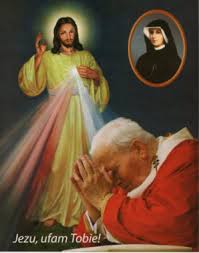
HOMILY OF THE HOLY FATHER MASS IN ST PETER’S SQUARE FOR THE CANONIZATION OF SR MARY FAUSTINA KOWALSKA Sunday, 30 April 2000 1. “Confitemini Domino quoniam bonus, quoniam in saeculum misericordia eius”; “Give thanks to the Lord for he is good; his steadfast love endures for ever” (Ps 118: 1). So the Church sings on the Octave of[…]Continue reading→
Divine Mercy Sunday – An Echo of Every Mass
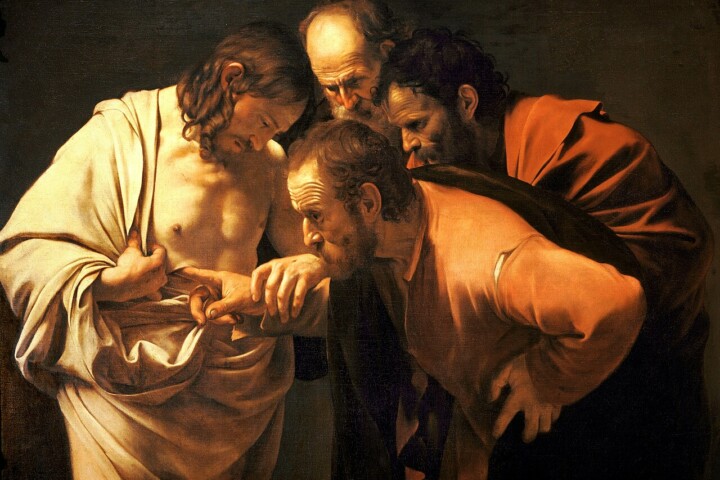
Reach out your hand and put it in my side. Do not doubt but believe’… ‘My Lord and my God!’ (Jn. 20:18)). Today is Divine Mercy Sunday, and as we celebrate the end of the Easter Octave, we contemplate the wounded side of our Saviour, the Church’s source of life. On Good Friday in the[…]Continue reading→

Saint Stanislaus of Szczepanów
We celebrate Saint Stanislaus today (+ April 11, 1079), in light of this Easter Octave, a bishop and martyr who accepted the episcopacy only at the direct order of Pope Alexander II. He proved a wise and courageous leader of his flock, put to death by his own king, Boleslaus, for rebuking the monarch’s ‘immoral[…]Continue reading→
First Holy Communion: Sermon from May 16, 1943
Here is a sermon from the good old days by +Rev. Msgr. Vincent Nicholas Foy (August 14, 1915 – March 13, 2017), from 1943. Readers may recall that Pope Saint Pius X, by the decree Quam Singulari in 1910, lowered the customary age of reception of Holy Communion – after the rigours of the plague[…]Continue reading→
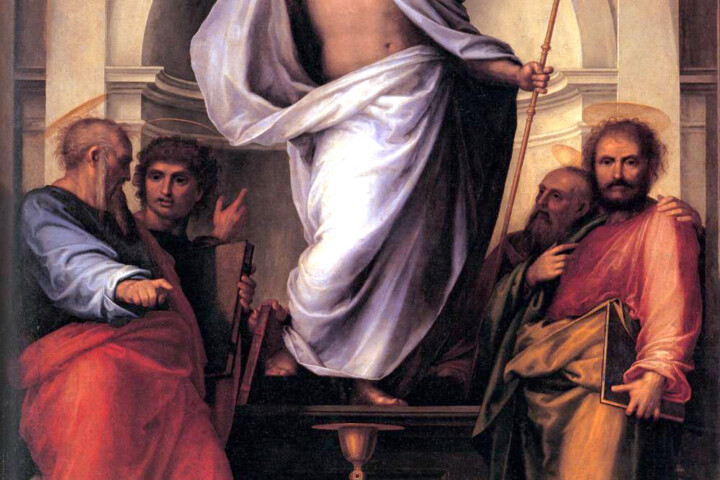
In the Glorious Light of Easter, Alleluia!
Set your minds on things that are above, not on things that are on earth, for you have died, and your life is hidden with Christ in God. When Christ who is your life is revealed, then you also will be revealed with him in glory (Col. 3:3-4). The Resurrection of Our Lord and Saviour[…]Continue reading→
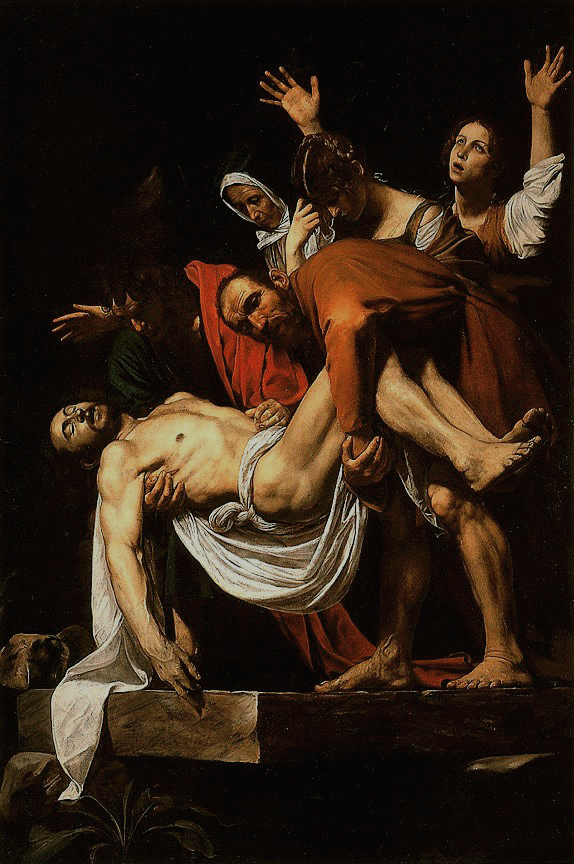
An Ancient Homily for Holy Saturday
The time between Good Friday and Easter Sunday is one of waiting, in silence, as the world wonders – anticipates – what will happen, after the death of Christ. We re-live this time each year in the anamnesis of our liturgy, and in turn look forward to the glorious re-creation of all things at the[…]Continue reading→
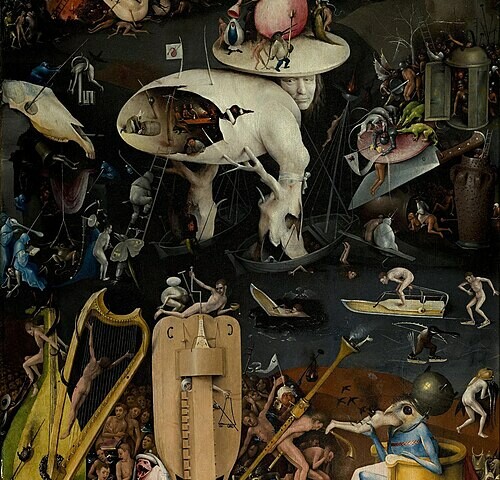
Europe’s Long Descent
(As we meditate on this day on Christ’s burial, and His descent into hell, it is fitting to ponder here with contributor Peter Marcus how the world seems to be heading there as well. The difference is that, although God cannot ‘redeem’ hell, nor those therein, He can and did redeem the world. There is[…]Continue reading→