
First Sunday of Advent: Sacred Liturgy
Yet, O Lord, you are our Father; we are the clay, and you are our potter; we are all the work of your hand (Is 64:8).
The first Sunday of Advent marks the beginning of a new liturgical year. In the cycle of the sacred liturgy, this is Year B, during which the Sunday Gospel readings will be taken from the Gospel of St. Mark. At the school of discipleship that is our life in Christ, we will recall the great deeds of salvation; events that belong to the past, to history. In the Christian understanding of time, however, what we may term Church time or sacred time, past, present, and future interpenetrate and touch upon eternity. This happens in the liturgy “for the liturgy is the means by which earthly time is inserted into the time of Jesus Christ and into the present” (Pope Benedict XVI, The Spirit of the Liturgy, p. 61). This is possible because when “the eternal Word assumed human existence at His Incarnation, He also assumed temporality. He drew time into the sphere of eternity. Christ is Himself the bridge between time and eternity” (ibid, p. 92).
At the beginning of this new liturgical year then, we are on the threshold of a cycle, an annual cycle centred on Christmas, Easter, and Pentecost. As we celebrate the Liturgy of Advent, the ancient expectancy of the Messiah is made present; and in recalling the long preparation for the Saviour’s first coming, we renew our ardent desire for His second coming (cf. Catechism of the Catholic Church, 524). Past, present, and future especially penetrate one another in the liturgy of Advent although this is true of the celebration of any of the Christian mysteries.
The words of John the Baptist recorded at the beginning of the Gospel of St. Mark invite us anew to enter into this unique cycle of time: “The time is fulfilled, and the kingdom of God is at hand; repent and believe the Gospel” (Mk 1:15). The liturgical year, however, is much more than the recounting of a sacred drama. Those who respond to this call to repentance and discipleship understand that “now is the acceptable time…now is the time of salvation” (2 Cor 6:2). As the mysteries of the life of Christ our Lord are recalled, time and eternity, Christ and the Church, the divine and the human, these are all interwoven in the course of the liturgical year, such that our bodies, that is, our bodily existence on earth, become a living sacrifice united to the Sacrifice of Jesus. This transformation expresses the purpose and goal of our worship: our transformation in Christ. In the sacred liturgy we encounter the living God and by means of His grace and our conformity to the mysteries of the life of Christ; our Father looks upon us and sees in us the image of His Son.
To the early Christians in the city of Rome, the Apostle Paul made this appeal: “Do not be conformed to this world (age), but be transformed by the renewal of your mind” (Rom 12:2). It is as if the Apostle were saying: Do not limit yourselves to this present time. Time is a cosmic reality encompassing all of creation as it moves towards its fulfillment and enters into the Sabbath rest of God when God will be all in all (cf. 1 Cor 15:28). In the sacred liturgy, we transcend the limits imposed on us by time and we already partake in the eternal realities that give our earthly existence supernatural meaning and scope. In the same epistle, St. Paul says, “We know that the whole creation has been groaning in travail together until now; and not only creation, but we ourselves, who have the first fruits of the Spirit, groan inwardly as we wait for adoption as sons, the redemption of our bodies. For in this hope we were saved” (Rom 8:22-24). The Advent liturgy especially recalls humanity’s yearning and hope for the salvation of God, and the fulfillment of this hope in Christ our Saviour.
The sacred liturgy of the Church is the liturgy of Christ the High Priest. It is therefore a cosmic liturgy. The liturgical commemorations of the life, death, and resurrection of our Saviour encompass the ultimate destiny of man and the world. This is what we begin anew today, and we do so with attention, reverence, dignity, and devotion. Especially in the cycle of the scriptural readings, faith perceives God’s promise of fulfillment. Our conscious, active participation in the sacred liturgy, by which we unite the sacrifice of our own lives to the one, eternal sacrifice of Christ our Lord, enables us to glimpse even if “in a mirror dimly” (1 Cor 13:12) and to experience the ultimate goal of all creation. For God “has made known to us in all wisdom and insight the mystery of His will, according to His purpose which He set forth in Christ as a plan for the fullness of time, to unite all things in Him, things in heaven and things on earth” (Eph 1:9-10).
This wisdom is ours through His Word which we attentively proclaim and receive with humility. This Word “is living and active” (Heb 4:12). This Word is Jesus Himself; and we encounter Him fully alive in the Word, in the Sacrament of the Eucharist and in the Body of the Church. Our personal encounter with Christ our Lord is in fact a convergence of our existence with His, here and now; and, as a result, we are drawn into the sphere of eternity. Let us then profit from the mysteries that we commemorate, so that as we walk amid passing things along the path of devout humility, our Lord Himself may “teach us by them to love the things of heaven and hold fast to what endures” (Prayer After Communion, First Sunday of Advent; The Roman Missal). We entrust our interior lives to the care and protection of our Lady and St. Joseph through whom “in the fullness of time, God sent forth His Son, born of a woman…so that we might receive adoption as sons” (Gal 4:4-5).

Saint Kateri , Canada’s Protectress
This was the title given to Saint Kateri Tekakwitha, by Pope Benedict XVI, when he canonized her on October 28th, 2012, along with six others, in Saint Peter’ Square (she had been beatified by Pope John Paul II back in 1980). With Saint Joseph as our protector, along with the Canadian martyrs, we seem to[…]Continue reading→

Remembering Father Alphonse de Valk
(Today marks the sixth anniversary of the death of Father Alphonse de Valk, C.S.B., a faithful, courageous and indefatigable Basilian priest, pro-life-and-family apostle, and the founder of Catholic Insight magazine. Here is what we wrote those on his entering into eternity five years ago, as we continue to remember him in our prayers and thoughts)[…]Continue reading→

My Name is Bernadette
April 16th is a propitious day, for besides the anniversary of Father de Valk’s death, who founded Catholic Insight in its print form decades ago, and the commemoration of the ‘two Benedicts’, mentioned in accompanying posts, today we also recall Saint Bernadette Soubirous, the young visionary to whom the Virgin Mary appeared numerous times at[…]Continue reading→

Canonizing Sister Faustina and Divine Mercy
HOMILY OF THE HOLY FATHER MASS IN ST PETER’S SQUARE FOR THE CANONIZATION OF SR MARY FAUSTINA KOWALSKA Sunday, 30 April 2000 1. “Confitemini Domino quoniam bonus, quoniam in saeculum misericordia eius”; “Give thanks to the Lord for he is good; his steadfast love endures for ever” (Ps 118: 1). So the Church sings on the Octave of[…]Continue reading→

Divine Mercy Sunday – An Echo of Every Mass
Reach out your hand and put it in my side. Do not doubt but believe’… ‘My Lord and my God!’ (Jn. 20:18)). Today is Divine Mercy Sunday, and as we celebrate the end of the Easter Octave, we contemplate the wounded side of our Saviour, the Church’s source of life. On Good Friday in the[…]Continue reading→

First Holy Communion: Sermon from May 16, 1943
Here is a sermon from the good old days by +Rev. Msgr. Vincent Nicholas Foy (August 14, 1915 – March 13, 2017), from 1943. Readers may recall that Pope Saint Pius X, by the decree Quam Singulari in 1910, lowered the customary age of reception of Holy Communion – after the rigours of the plague[…]Continue reading→

In the Glorious Light of Easter, Alleluia!
Set your minds on things that are above, not on things that are on earth, for you have died, and your life is hidden with Christ in God. When Christ who is your life is revealed, then you also will be revealed with him in glory (Col. 3:3-4). The Resurrection of Our Lord and Saviour[…]Continue reading→

An Ancient Homily for Holy Saturday
The time between Good Friday and Easter Sunday is one of waiting, in silence, as the world wonders – anticipates – what will happen, after the death of Christ. We re-live this time each year in the anamnesis of our liturgy, and in turn look forward to the glorious re-creation of all things at the[…]Continue reading→

Europe’s Long Descent
(As we meditate on this day on Christ’s burial, and His descent into hell, it is fitting to ponder here with contributor Peter Marcus how the world seems to be heading there as well. The difference is that, although God cannot ‘redeem’ hell, nor those therein, He can and did redeem the world. There is[…]Continue reading→
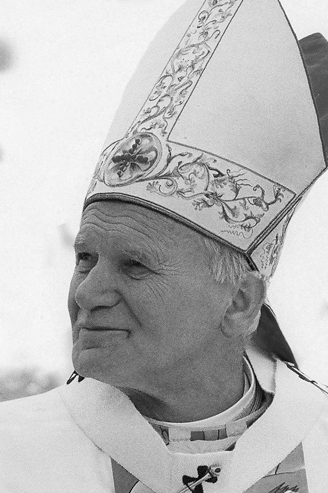
Pope Saint John Paul II’s First Good Friday Homily
ADDRESS OF HIS HOLINESS JOHN PAUL II AT THE CONCLUSION OF THE STATIONS OF THE CROSS AT THE COLOSSEUM Good Friday, 13 April 1979 When we make the Way of the Cross from one station to the next, in spirit we are always at the spot wherethis journey had its “historical” place: where it[…]Continue reading→