
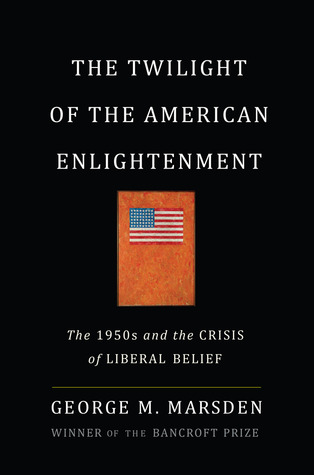
The Twilight of American Enlightenment
The average age of North Americans is forty-one; this means that most people have no personal recollection of the decade of the 1950s, the focus of George Marsden’s fascinating and accessible book.
Marsden, an historian at Notre Dame University, focuses on a time of promise and anxiety; a time of new technologies, a pervasive emphasis on the relatively new social science of psychology, and a reliance on expertise in fields of life formerly governed by common sense and experience.
The fifties was also the decade when television made its ominous appearance, spawning a mass culture that was (simultaneously) portrayed as liberating and threatening. It was also the last decade in which churches were influential in public life and relatively full; in 1960 seven out of ten Americans attended church on Sunday. Catholics still struggled for acceptance, and the public square was dominated by the assumptions of liberal Protestantism.
In the spring of 1960 Life magazine, with twenty-five million readers, published a five-part series on what was wrong with America. Contributors included Walter Lippmann, Billy Graham, the poet Archibald MacLeish, and two-time presidential nominee Adlai Stevenson. The series attempted to define a “national purpose” for a country that increasingly dominated the world stage but was riven by self-doubt.
Marsden goes on to examine the writings of such public intellectuals as Hannah Arendt, Erich Fromm, David Riesman, Vance Packard, B. F. Skinner, Dr. Benjamin Spock, Reinhold Niebuhr, and others. Many of these people are largely forgotten today, but their influence (and it was quite often malign) in some cases survives. Marsden traces how such intellectuals searched for a way to build a culture that would be based on principles like openness, equality, reason, and individual autonomy. What most of them did not reckon with was the degree to which there was no longer any comprehensive vision or, even more important, accepted source of authority.
Although Communism was called (by Arthur Koestler) “the god that failed” so, too, the secular American dream failed—or at least faded; an ever-expanding Gross National Product proved a less than exalted objective for a country. As Adlai Stevenson put it, “With the supermarket as our temple and the singing commercial as our litany, are we likely to fire the world with an irresistible vision of America’s exalted purposes and inspiring way of life?”
The increasing fragmentation of what passed for American “culture” accelerated through the 1960s and 70s (particularly after the Supreme Court decision in Roe v. Wade in 1973) and the preoccupation of intellectuals gradually turned to the culture wars and the rise of the religious right, all documented by Marsden.
Through six chapters, Marsden chronicles a time of intellectual and social foment; then, in the final chapter (called “Toward a more inclusive pluralism”) he examines the works of the Dutch theologian Abraham Kuyper and suggests that these provide a way forward. I did not find this last chapter at all persuasive; nevertheless, Marsden has written an elegant and compelling account of how the high hopes of 1950s liberalism flickered and died.
The Twilight of the American Enlightenment: The 1950s and the crisis of liberal belief
by George M. Marsden
Basic Books, 2014
ISBN: 978-0-465-03010-1

Saint Kateri , Canada’s Protectress
This was the title given to Saint Kateri Tekakwitha, by Pope Benedict XVI, when he canonized her on October 28th, 2012, along with six others, in Saint Peter’ Square (she had been beatified by Pope John Paul II back in 1980). With Saint Joseph as our protector, along with the Canadian martyrs, we seem to[…]Continue reading→
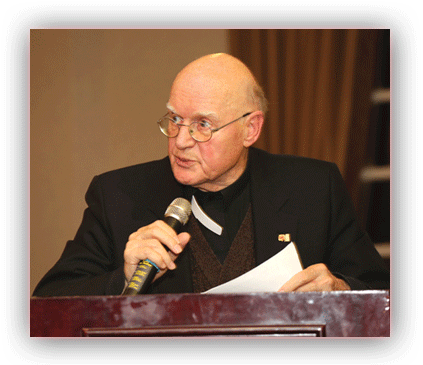
Remembering Father Alphonse de Valk
(Today marks the sixth anniversary of the death of Father Alphonse de Valk, C.S.B., a faithful, courageous and indefatigable Basilian priest, pro-life-and-family apostle, and the founder of Catholic Insight magazine. Here is what we wrote those on his entering into eternity five years ago, as we continue to remember him in our prayers and thoughts)[…]Continue reading→

My Name is Bernadette
April 16th is a propitious day, for besides the anniversary of Father de Valk’s death, who founded Catholic Insight in its print form decades ago, and the commemoration of the ‘two Benedicts’, mentioned in accompanying posts, today we also recall Saint Bernadette Soubirous, the young visionary to whom the Virgin Mary appeared numerous times at[…]Continue reading→
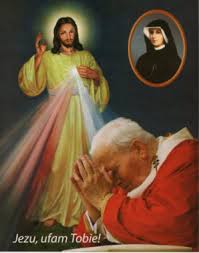
Canonizing Sister Faustina and Divine Mercy
HOMILY OF THE HOLY FATHER MASS IN ST PETER’S SQUARE FOR THE CANONIZATION OF SR MARY FAUSTINA KOWALSKA Sunday, 30 April 2000 1. “Confitemini Domino quoniam bonus, quoniam in saeculum misericordia eius”; “Give thanks to the Lord for he is good; his steadfast love endures for ever” (Ps 118: 1). So the Church sings on the Octave of[…]Continue reading→
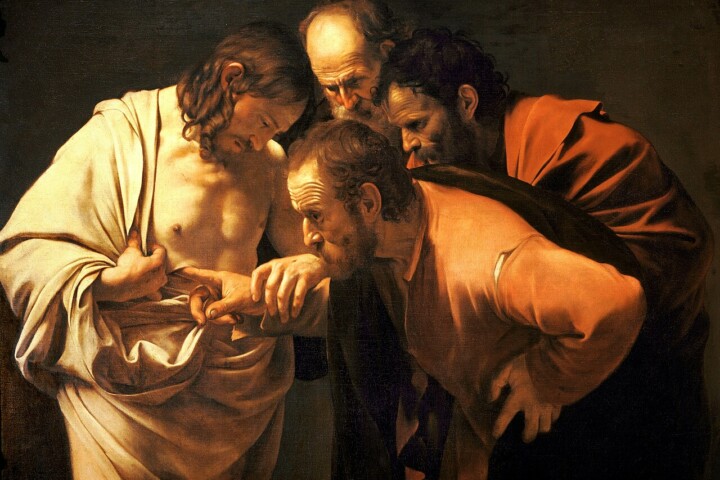
Divine Mercy Sunday – An Echo of Every Mass
Reach out your hand and put it in my side. Do not doubt but believe’… ‘My Lord and my God!’ (Jn. 20:18)). Today is Divine Mercy Sunday, and as we celebrate the end of the Easter Octave, we contemplate the wounded side of our Saviour, the Church’s source of life. On Good Friday in the[…]Continue reading→
First Holy Communion: Sermon from May 16, 1943
Here is a sermon from the good old days by +Rev. Msgr. Vincent Nicholas Foy (August 14, 1915 – March 13, 2017), from 1943. Readers may recall that Pope Saint Pius X, by the decree Quam Singulari in 1910, lowered the customary age of reception of Holy Communion – after the rigours of the plague[…]Continue reading→
In the Glorious Light of Easter, Alleluia!
Set your minds on things that are above, not on things that are on earth, for you have died, and your life is hidden with Christ in God. When Christ who is your life is revealed, then you also will be revealed with him in glory (Col. 3:3-4). The Resurrection of Our Lord and Saviour[…]Continue reading→
An Ancient Homily for Holy Saturday
The time between Good Friday and Easter Sunday is one of waiting, in silence, as the world wonders – anticipates – what will happen, after the death of Christ. We re-live this time each year in the anamnesis of our liturgy, and in turn look forward to the glorious re-creation of all things at the[…]Continue reading→
Europe’s Long Descent
(As we meditate on this day on Christ’s burial, and His descent into hell, it is fitting to ponder here with contributor Peter Marcus how the world seems to be heading there as well. The difference is that, although God cannot ‘redeem’ hell, nor those therein, He can and did redeem the world. There is[…]Continue reading→
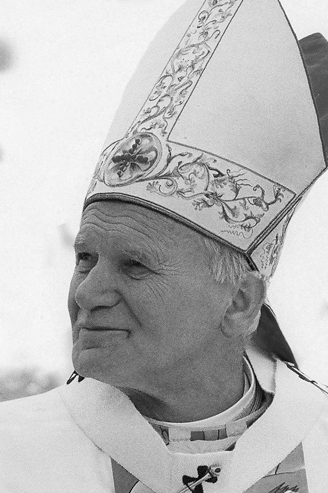
Pope Saint John Paul II’s First Good Friday Homily
ADDRESS OF HIS HOLINESS JOHN PAUL II AT THE CONCLUSION OF THE STATIONS OF THE CROSS AT THE COLOSSEUM Good Friday, 13 April 1979 When we make the Way of the Cross from one station to the next, in spirit we are always at the spot wherethis journey had its “historical” place: where it[…]Continue reading→