
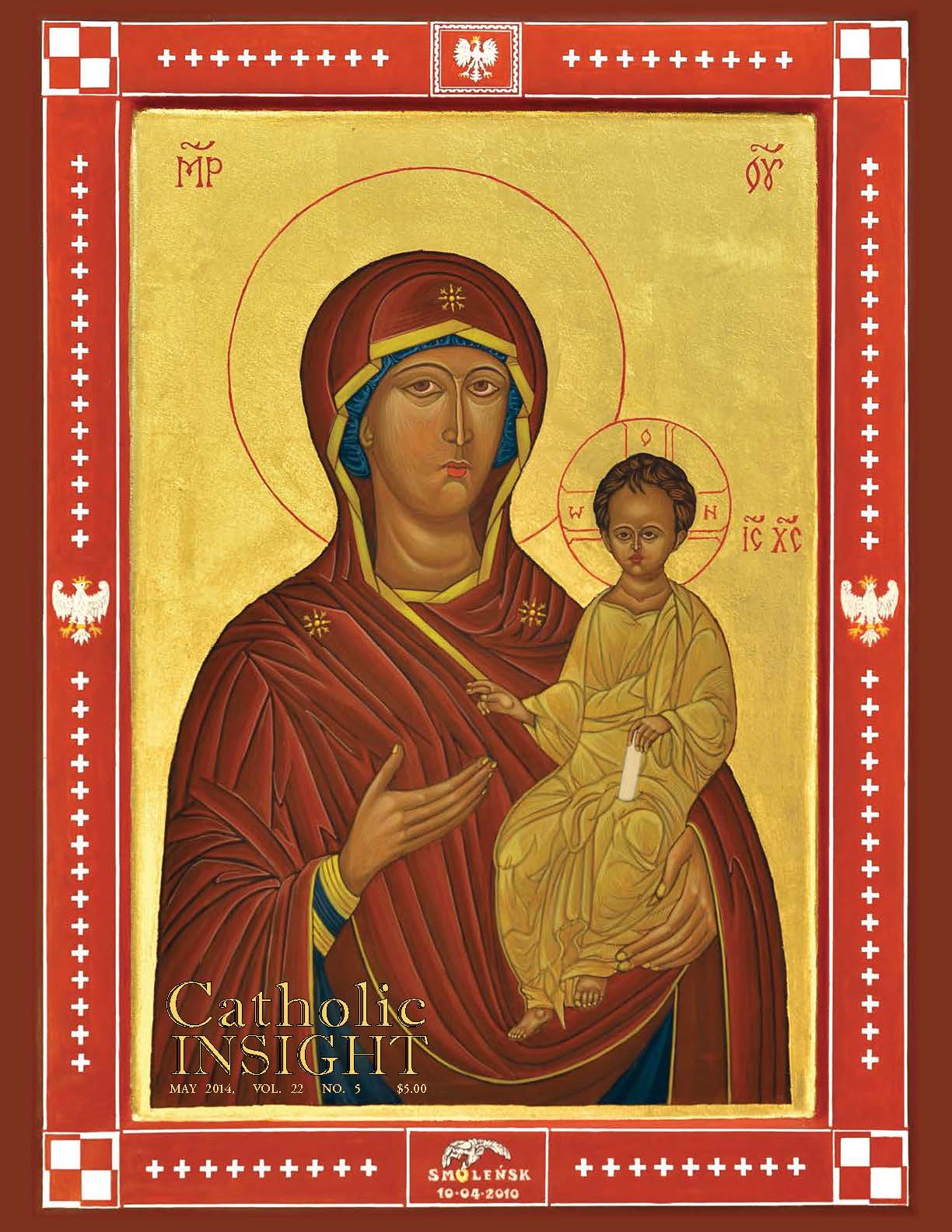
The Virgin Mary of Smolensk
Our cover artist, Janusz Charczuk, was featured in our December 2012 issue. He is originally from Poland, where he graduated from the Technical University of Gdansk with a Master’s in Architecture. His studies encompassed the fine arts, including the principles of architectural forms, composition, freehand drawing, painting, sculpture, and the history of art. Janusz immigrated to Canada in 1985, where he worked as an architect, and began painting icons about fifteen years ago. His work, which is available for purchase, can be viewed at holyiconstudio.com.
Much has been said about Katyn and the tragic events that occurred there seventy-one years ago. Today, one cannot reflect on these tragedies without also recalling the catastrophic plane crash in Smolensk. On 10 April 2010, the village of Katyn became irreversibly linked with the city of Smolensk, and the two will forever represent great wounds in Poland’s history.
On the Smolensk-Sewernyj military airfield, en route to commemorate the Katyn massacre, Poland’s presidential airplane crashed, killing president Lech Kaczynski and his wife, Poland’s highest military officials, numerous representatives of the nation’s political elite, and representatives of Katyn families.
It seems like only yesterday that I was talking to my friend, Leszek Solski, about his forthcoming journey to visit the crude gravesite of his father, uncle, and thousands of others. With somber heart, he was anxiously awaiting this opportunity to at last commemorate his kin and he promised to share his experience with me upon his return.
He was unable to keep this promise. He and ninety-five others never arrived in Katyn.
I have thought of my friend and of the many others who died often since the tragedy. In my own attempt to memorialize those ninety-six individuals, I began sketching and my sketches eventually grew into my icon called “The Virgin Mary of Smolensk.” Though the centre of the icon features the traditional image of the Virgin Mary of Smolensk, I have adapted specific details to reflect the disastrous events of that early April morning. The insignia of the Polish air force, a white and red checkered pattern, is represented in the four corners of the frame. Also in the frame rest ninety-six white crosses, to symbolize the ninety-six lives lost.
In iconography, the colour red symbolizes love, warmth, and life. Red is a symbol of resurrection; of life’s victory over death. However, it is also the colour of martyrdom. White represents God’s universe. It is a colour of purity, holiness, and simplicity.
It is my hope that this icon may one day comfort others the way creating it has brought comfort to me. It is my hope that this icon respectfully remembers those who perished in that plane and reminds us of what they intended to do on that day.

Saint Kateri , Canada’s Protectress
This was the title given to Saint Kateri Tekakwitha, by Pope Benedict XVI, when he canonized her on October 28th, 2012, along with six others, in Saint Peter’ Square (she had been beatified by Pope John Paul II back in 1980). With Saint Joseph as our protector, along with the Canadian martyrs, we seem to[…]Continue reading→

Remembering Father Alphonse de Valk
(Today marks the sixth anniversary of the death of Father Alphonse de Valk, C.S.B., a faithful, courageous and indefatigable Basilian priest, pro-life-and-family apostle, and the founder of Catholic Insight magazine. Here is what we wrote those on his entering into eternity five years ago, as we continue to remember him in our prayers and thoughts)[…]Continue reading→

My Name is Bernadette
April 16th is a propitious day, for besides the anniversary of Father de Valk’s death, who founded Catholic Insight in its print form decades ago, and the commemoration of the ‘two Benedicts’, mentioned in accompanying posts, today we also recall Saint Bernadette Soubirous, the young visionary to whom the Virgin Mary appeared numerous times at[…]Continue reading→

Canonizing Sister Faustina and Divine Mercy
HOMILY OF THE HOLY FATHER MASS IN ST PETER’S SQUARE FOR THE CANONIZATION OF SR MARY FAUSTINA KOWALSKA Sunday, 30 April 2000 1. “Confitemini Domino quoniam bonus, quoniam in saeculum misericordia eius”; “Give thanks to the Lord for he is good; his steadfast love endures for ever” (Ps 118: 1). So the Church sings on the Octave of[…]Continue reading→

Divine Mercy Sunday – An Echo of Every Mass
Reach out your hand and put it in my side. Do not doubt but believe’… ‘My Lord and my God!’ (Jn. 20:18)). Today is Divine Mercy Sunday, and as we celebrate the end of the Easter Octave, we contemplate the wounded side of our Saviour, the Church’s source of life. On Good Friday in the[…]Continue reading→

First Holy Communion: Sermon from May 16, 1943
Here is a sermon from the good old days by +Rev. Msgr. Vincent Nicholas Foy (August 14, 1915 – March 13, 2017), from 1943. Readers may recall that Pope Saint Pius X, by the decree Quam Singulari in 1910, lowered the customary age of reception of Holy Communion – after the rigours of the plague[…]Continue reading→

In the Glorious Light of Easter, Alleluia!
Set your minds on things that are above, not on things that are on earth, for you have died, and your life is hidden with Christ in God. When Christ who is your life is revealed, then you also will be revealed with him in glory (Col. 3:3-4). The Resurrection of Our Lord and Saviour[…]Continue reading→

An Ancient Homily for Holy Saturday
The time between Good Friday and Easter Sunday is one of waiting, in silence, as the world wonders – anticipates – what will happen, after the death of Christ. We re-live this time each year in the anamnesis of our liturgy, and in turn look forward to the glorious re-creation of all things at the[…]Continue reading→

Europe’s Long Descent
(As we meditate on this day on Christ’s burial, and His descent into hell, it is fitting to ponder here with contributor Peter Marcus how the world seems to be heading there as well. The difference is that, although God cannot ‘redeem’ hell, nor those therein, He can and did redeem the world. There is[…]Continue reading→
Pope Saint John Paul II’s First Good Friday Homily
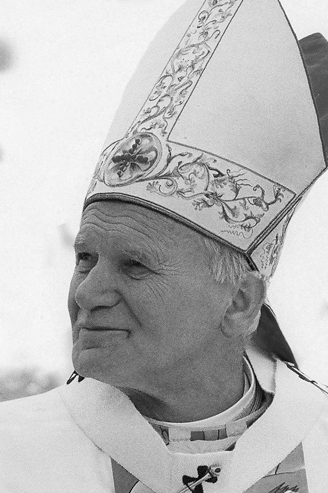
ADDRESS OF HIS HOLINESS JOHN PAUL II AT THE CONCLUSION OF THE STATIONS OF THE CROSS AT THE COLOSSEUM Good Friday, 13 April 1979 When we make the Way of the Cross from one station to the next, in spirit we are always at the spot wherethis journey had its “historical” place: where it[…]Continue reading→