
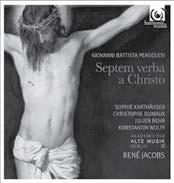
Giovanni Battista Pergolesi
Giovanni Battista Pergolesi: Septem Verba a Christo
Featuring Akademie für Alte Musik / René Jacobs (Conductor)
Harmoia Mundi, 2013
ASIN: B00A6U5B6M
In English the title of this long-forgotten masterpiece is The Seven Words Uttered by the Dying Christ on the Cross. It was scored for orchestra and soli: bass (Christ) and tenor, soprano, countertenor (Anima or Soul) is a cycle of seven cantatas, lasting slightly over an hour. Christ sings the opening Word in each cantata and the soul answers. The composer utilized the horn as a symbol for Christ, given that in his era the horn was accepted as a symbol of royalty.
The tradition of mounting this ex-liturgical office during the hours of twelve noon to three on Good Friday in churches started in the New World spread to Spain and then to the rest of Europe. Many are familiar with Haydn’s version of The Seven Last Words of Christ in their various versions, considered one of his masterpieces.
In the Spanish-speaking world this office was performed as follows: “The walls, windows, and pillars of the church were hung with black cloth, and only one lamp … illuminated the sacred darkness. … After a prelude, the bishop mounted the pulpit, pronounced one of the Seven Words, and delivered a meditation on it. As soon as it was over, he descended from the pulpit and fell to his knees before the altar. This pause was filled with music.” As so it progressed until the final Word was pronounced, when all left the church in silence after the one lamp had been extinguished.
Pergolesi (1710-1736) died very young but his music was fifty years ahead of its time and influenced many composers that lived in eighteenth-century Europe. His artistic voice is totally unique and his oeuvre sounds contemporary to Mozart and Haydn. If he had lived beyond his twenty-six years his reputation may have matched giants like Beethoven or Mozart. This work was not accepted in the twentieth century as an autograph of Pergolesi; indeed most of his religious oratorios were totally overlooked by musicologists and the early twentieth century considered religious music well down the list of priorities as secular humanism took hold of all Western societies. Music scholars concentrated on Pergolesi’s operas, the most famous being Serva Padrona, even though Catholic monasteries and libraries all over Germany and Austria had manuscripts or parts in their collections of his religious compositions. Another of his oratorios that has only come forward recently is the masterpiece La Morte di San Giuseppe (The Death of St. Joseph), which was performed by the Italian violin virtuoso Fabio Biondi with the New York Collegium a decade ago, but remains unrecorded to my knowledge. Both of these works are supreme masterpieces.
Rene Jacobs became world famous as a counter-tenor, and was based in Paris in the 1970s and 1980s. As a conductor he has since become one of the greatest European interpreters of Mozart operas (Grammy Award 2005). The Akademie fur Alte Musik, which celebrated their thirtieth anniversary last year, is usually heard in a chamber configuration (i.e. no conductor) and is based in Berlin. This world premiere recording was released in conjunction with the publication of the score by Breitkopf (breitkopf.com) and orchestral material or pianovocal, which is long overdue.
© Paul-James Dwyer 2014

Saint Kateri , Canada’s Protectress
This was the title given to Saint Kateri Tekakwitha, by Pope Benedict XVI, when he canonized her on October 28th, 2012, along with six others, in Saint Peter’ Square (she had been beatified by Pope John Paul II back in 1980). With Saint Joseph as our protector, along with the Canadian martyrs, we seem to[…]Continue reading→

Remembering Father Alphonse de Valk
(Today marks the sixth anniversary of the death of Father Alphonse de Valk, C.S.B., a faithful, courageous and indefatigable Basilian priest, pro-life-and-family apostle, and the founder of Catholic Insight magazine. Here is what we wrote those on his entering into eternity five years ago, as we continue to remember him in our prayers and thoughts)[…]Continue reading→

My Name is Bernadette
April 16th is a propitious day, for besides the anniversary of Father de Valk’s death, who founded Catholic Insight in its print form decades ago, and the commemoration of the ‘two Benedicts’, mentioned in accompanying posts, today we also recall Saint Bernadette Soubirous, the young visionary to whom the Virgin Mary appeared numerous times at[…]Continue reading→

Canonizing Sister Faustina and Divine Mercy
HOMILY OF THE HOLY FATHER MASS IN ST PETER’S SQUARE FOR THE CANONIZATION OF SR MARY FAUSTINA KOWALSKA Sunday, 30 April 2000 1. “Confitemini Domino quoniam bonus, quoniam in saeculum misericordia eius”; “Give thanks to the Lord for he is good; his steadfast love endures for ever” (Ps 118: 1). So the Church sings on the Octave of[…]Continue reading→

Divine Mercy Sunday – An Echo of Every Mass
Reach out your hand and put it in my side. Do not doubt but believe’… ‘My Lord and my God!’ (Jn. 20:18)). Today is Divine Mercy Sunday, and as we celebrate the end of the Easter Octave, we contemplate the wounded side of our Saviour, the Church’s source of life. On Good Friday in the[…]Continue reading→

First Holy Communion: Sermon from May 16, 1943
Here is a sermon from the good old days by +Rev. Msgr. Vincent Nicholas Foy (August 14, 1915 – March 13, 2017), from 1943. Readers may recall that Pope Saint Pius X, by the decree Quam Singulari in 1910, lowered the customary age of reception of Holy Communion – after the rigours of the plague[…]Continue reading→

In the Glorious Light of Easter, Alleluia!
Set your minds on things that are above, not on things that are on earth, for you have died, and your life is hidden with Christ in God. When Christ who is your life is revealed, then you also will be revealed with him in glory (Col. 3:3-4). The Resurrection of Our Lord and Saviour[…]Continue reading→

An Ancient Homily for Holy Saturday
The time between Good Friday and Easter Sunday is one of waiting, in silence, as the world wonders – anticipates – what will happen, after the death of Christ. We re-live this time each year in the anamnesis of our liturgy, and in turn look forward to the glorious re-creation of all things at the[…]Continue reading→

Europe’s Long Descent
(As we meditate on this day on Christ’s burial, and His descent into hell, it is fitting to ponder here with contributor Peter Marcus how the world seems to be heading there as well. The difference is that, although God cannot ‘redeem’ hell, nor those therein, He can and did redeem the world. There is[…]Continue reading→
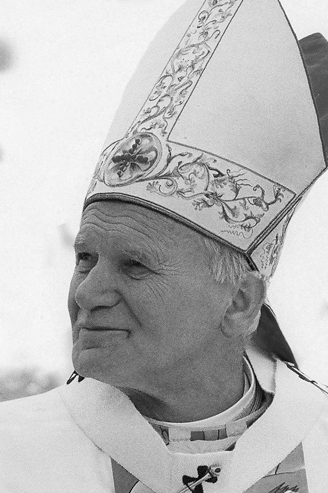
Pope Saint John Paul II’s First Good Friday Homily
ADDRESS OF HIS HOLINESS JOHN PAUL II AT THE CONCLUSION OF THE STATIONS OF THE CROSS AT THE COLOSSEUM Good Friday, 13 April 1979 When we make the Way of the Cross from one station to the next, in spirit we are always at the spot wherethis journey had its “historical” place: where it[…]Continue reading→