
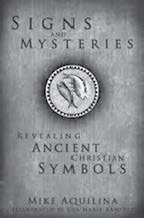
Signs and Mysteries: Revealing Ancient Christian Symbols
Signs and Mysteries: Revealing Ancient Christian Symbols
by Mike Aquilina
illustrated by Lea Marie Ravotti
Our Sunday Visitor, 2008
ISBN 978-1-59276-450-1
More devotional than academic, this book begins by discussing the theology, history, and culture of ancient Christian symbols. Aquilina focuses on the Bible and the Church fathers’ explanations and discussions for each symbol. Ancient saints such as Justin Martyr and Clement of Alexandria, and the historian Eusebius of Caesarea, established broad horizons for the Church’s symbols, believing that “Since their God is the Lord of all history … He was active in pagan cultures as well, preparing the way for them to receive the Gospel someday.”
These pagan symbols took on sacramental meaning when Christians adopted them. The fish is perhaps the best known ancient Christian symbol, as widespread as the cross is today. Like many such images, it represented both Christ and Christians, though some depictions relate to only one of the two. “In Greek the phrase ‘Jesus Christ, Son of God, Saviour’ produced the acronym ICHTHYS, the Greek word for fish,” Aquilina writes. Symbols had depth and therefore multiple meanings, so the symbol also signified that a Christian outside of the Church was like a fish out of water, “condemned to a spiritual death.”
The fish also pointed to Christ’s real presence in the Eucharist. It played a central role in paintings depicting agape meals or the Eucharist.
Pagans depicted dolphins on gravesites, since the animal carried the deceased on its back to the afterlife. The ancient Hebrews also loved the animal. Not surprisingly, Christians adopted the dolphin as a symbol for Christ carrying the souls of the dead to heaven. “Sometimes [dolphins] appear crushing the head of a sea monster or an octopus, representing Satan. Often they are shown twisted around a trident or an anchor, suggesting Christ on the Cross. In underground Rome there is even an image of a dolphin with an exposed heart.”
Orthodox theology underlay these symbols, giving them spiritual power and allowing the faithful to express their beliefs and take comfort in them. Because of widespread illiteracy, Christian artwork played a greater role than it does in the age of literacy. Aquilina’s use of biblical and patristic sources connects these symbols to underlying beliefs. People had great faith in Christ, yet needed something tangible. Very much a part of the fabric of the Roman Empire, Jesus’ followers did not try to escape from the wider culture.
Aquilina shows not only how symbols had a life of their own, but how one image could easily generate another, or how a culture or religion’s symbols could take on new meanings in Christianity.
Thus another important source for Christian symbols was the Jewish and Old Testament heritage. Ancient synagogues often depicted biblical scenes, such as David fighting Goliath. Christians used the symbol of Moses. Like many, Christian and otherwise, the meaning of this symbol, Aquilina tells us, blends into other personages or meanings. For Christians, Moses really meant Peter: “In several images, Peter appears receiving the divine law from Jesus Christ, just as Moses received the tablets of the law from God”—a Christian adoption of an ancient Hebrew imagery.

Saint Kateri , Canada’s Protectress
This was the title given to Saint Kateri Tekakwitha, by Pope Benedict XVI, when he canonized her on October 28th, 2012, along with six others, in Saint Peter’ Square (she had been beatified by Pope John Paul II back in 1980). With Saint Joseph as our protector, along with the Canadian martyrs, we seem to[…]Continue reading→

Remembering Father Alphonse de Valk
(Today marks the sixth anniversary of the death of Father Alphonse de Valk, C.S.B., a faithful, courageous and indefatigable Basilian priest, pro-life-and-family apostle, and the founder of Catholic Insight magazine. Here is what we wrote those on his entering into eternity five years ago, as we continue to remember him in our prayers and thoughts)[…]Continue reading→

My Name is Bernadette
April 16th is a propitious day, for besides the anniversary of Father de Valk’s death, who founded Catholic Insight in its print form decades ago, and the commemoration of the ‘two Benedicts’, mentioned in accompanying posts, today we also recall Saint Bernadette Soubirous, the young visionary to whom the Virgin Mary appeared numerous times at[…]Continue reading→
Canonizing Sister Faustina and Divine Mercy
HOMILY OF THE HOLY FATHER MASS IN ST PETER’S SQUARE FOR THE CANONIZATION OF SR MARY FAUSTINA KOWALSKA Sunday, 30 April 2000 1. “Confitemini Domino quoniam bonus, quoniam in saeculum misericordia eius”; “Give thanks to the Lord for he is good; his steadfast love endures for ever” (Ps 118: 1). So the Church sings on the Octave of[…]Continue reading→

Divine Mercy Sunday – An Echo of Every Mass
Reach out your hand and put it in my side. Do not doubt but believe’… ‘My Lord and my God!’ (Jn. 20:18)). Today is Divine Mercy Sunday, and as we celebrate the end of the Easter Octave, we contemplate the wounded side of our Saviour, the Church’s source of life. On Good Friday in the[…]Continue reading→
First Holy Communion: Sermon from May 16, 1943
Here is a sermon from the good old days by +Rev. Msgr. Vincent Nicholas Foy (August 14, 1915 – March 13, 2017), from 1943. Readers may recall that Pope Saint Pius X, by the decree Quam Singulari in 1910, lowered the customary age of reception of Holy Communion – after the rigours of the plague[…]Continue reading→
In the Glorious Light of Easter, Alleluia!
Set your minds on things that are above, not on things that are on earth, for you have died, and your life is hidden with Christ in God. When Christ who is your life is revealed, then you also will be revealed with him in glory (Col. 3:3-4). The Resurrection of Our Lord and Saviour[…]Continue reading→
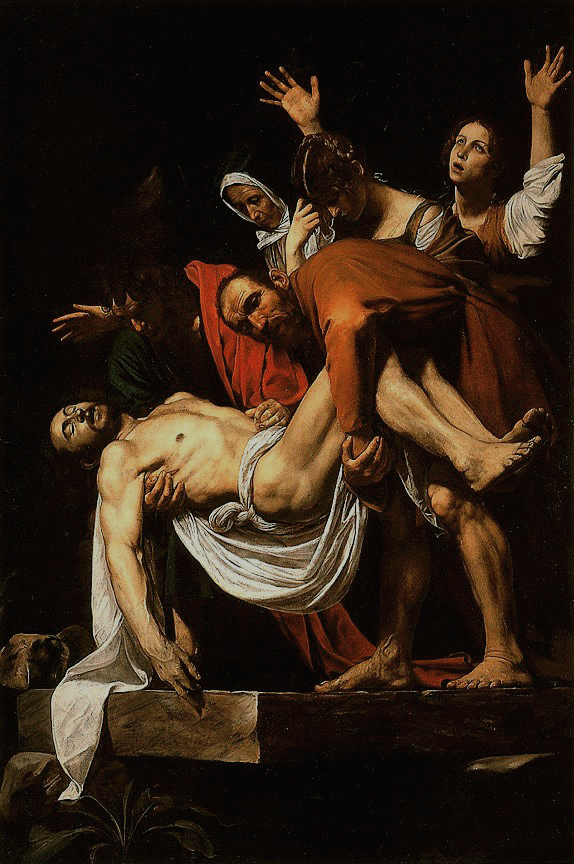
An Ancient Homily for Holy Saturday
The time between Good Friday and Easter Sunday is one of waiting, in silence, as the world wonders – anticipates – what will happen, after the death of Christ. We re-live this time each year in the anamnesis of our liturgy, and in turn look forward to the glorious re-creation of all things at the[…]Continue reading→
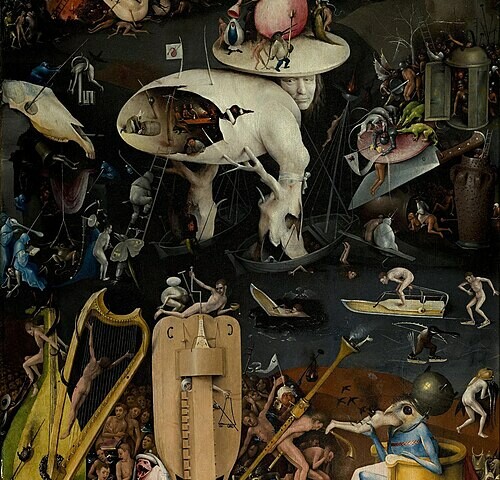
Europe’s Long Descent
(As we meditate on this day on Christ’s burial, and His descent into hell, it is fitting to ponder here with contributor Peter Marcus how the world seems to be heading there as well. The difference is that, although God cannot ‘redeem’ hell, nor those therein, He can and did redeem the world. There is[…]Continue reading→
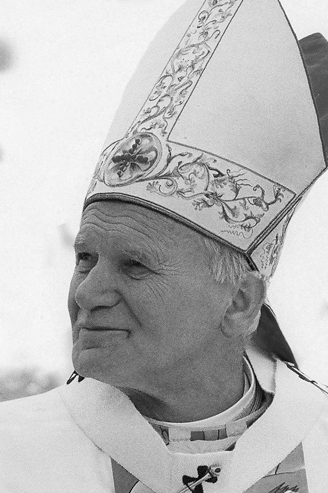
Pope Saint John Paul II’s First Good Friday Homily
ADDRESS OF HIS HOLINESS JOHN PAUL II AT THE CONCLUSION OF THE STATIONS OF THE CROSS AT THE COLOSSEUM Good Friday, 13 April 1979 When we make the Way of the Cross from one station to the next, in spirit we are always at the spot wherethis journey had its “historical” place: where it[…]Continue reading→